

32 Grain Porous Structure and Exploitation Properties of Humidity-Sensitive. . .
503
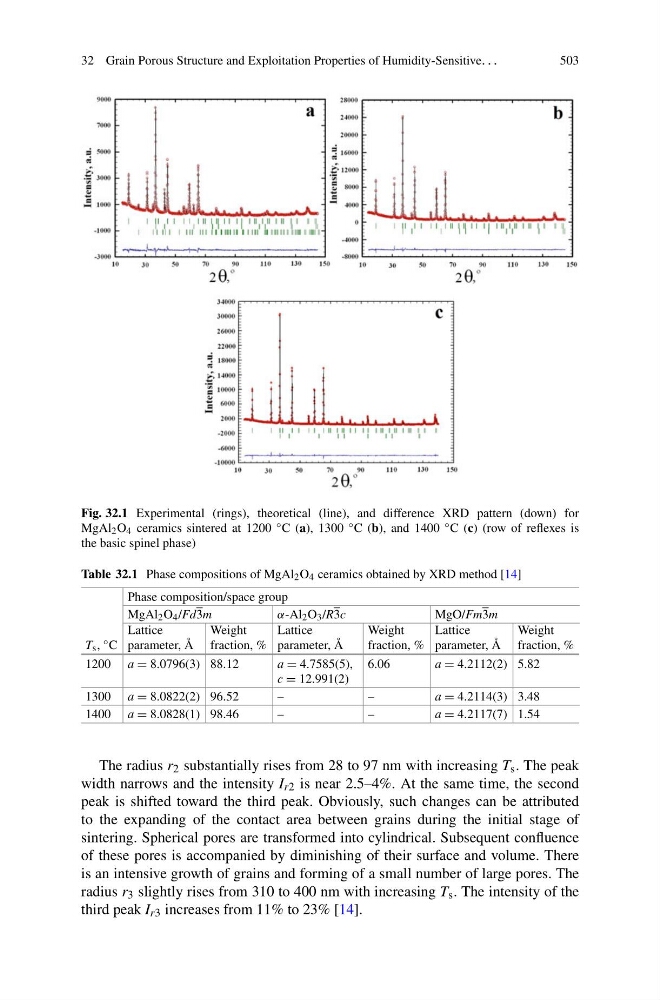
Fig. 32.1 Experimental (rings), theoretical (line), and difference XRD pattern (down) for
MgAl 2 O 4 ceramics sintered at 1200 ◦ C (a), 1300 ◦ C (b), and 1400 ◦ C (c) (row of reflexes is
the basic spinel phase)
Table 32.1 Phase compositions of MgAl 2 O 4 ceramics obtained by XRD method [14]
Phase composition/space group
MgAl 2 O 4 /Fd3m
α-Al 2 O 3 /R3c
MgO/Fm3m
T s , ◦ C
Lattice
parameter, Å
Weight
fraction, %
Lattice
parameter, Å
Weight
fraction, %
Lattice
parameter, Å
Weight
fraction, %
1200 Ã = 8.0796(3) 88.12
à = 4.7585(5),
Ô = 12.991(2)
6.06
à = 4.2112(2) 5.82
1300 Ã = 8.0822(2) 96.52
–
–
à = 4.2114(3) 3.48
1400 Ã = 8.0828(1) 98.46
–
–
à = 4.2117(7) 1.54
The radius r 2 substantially rises from 28 to 97 nm with increasing T s . The peak
width narrows and the intensity I r2 is near 2.5–4%. At the same time, the second
peak is shifted toward the third peak. Obviously, such changes can be attributed
to the expanding of the contact area between grains during the initial stage of
sintering. Spherical pores are transformed into cylindrical. Subsequent confluence
of these pores is accompanied by diminishing of their surface and volume. There
is an intensive growth of grains and forming of a small number of large pores. The
radius r 3 slightly rises from 310 to 400 nm with increasing T s . The intensity of the
third peak I r3 increases from 11% to 23% [14].
503
Fig. 32.1 Experimental (rings), theoretical (line), and difference XRD pattern (down) for
MgAl 2 O 4 ceramics sintered at 1200 ◦ C (a), 1300 ◦ C (b), and 1400 ◦ C (c) (row of reflexes is
the basic spinel phase)
Table 32.1 Phase compositions of MgAl 2 O 4 ceramics obtained by XRD method [14]
Phase composition/space group
MgAl 2 O 4 /Fd3m
α-Al 2 O 3 /R3c
MgO/Fm3m
T s , ◦ C
Lattice
parameter, Å
Weight
fraction, %
Lattice
parameter, Å
Weight
fraction, %
Lattice
parameter, Å
Weight
fraction, %
1200 Ã = 8.0796(3) 88.12
à = 4.7585(5),
Ô = 12.991(2)
6.06
à = 4.2112(2) 5.82
1300 Ã = 8.0822(2) 96.52
–
–
à = 4.2114(3) 3.48
1400 Ã = 8.0828(1) 98.46
–
–
à = 4.2117(7) 1.54
The radius r 2 substantially rises from 28 to 97 nm with increasing T s . The peak
width narrows and the intensity I r2 is near 2.5–4%. At the same time, the second
peak is shifted toward the third peak. Obviously, such changes can be attributed
to the expanding of the contact area between grains during the initial stage of
sintering. Spherical pores are transformed into cylindrical. Subsequent confluence
of these pores is accompanied by diminishing of their surface and volume. There
is an intensive growth of grains and forming of a small number of large pores. The
radius r 3 slightly rises from 310 to 400 nm with increasing T s . The intensity of the
third peak I r3 increases from 11% to 23% [14].