

31 Influence of Annealing in Vacuum on Dispersion Kinetics of Titanium. . .
491
2
4
100
0
–100
6
8
nm
Section Analysis
x 2.000 μm/div
z 1000.000 nm/div
d
c
a
b
0
2.5
5.0
7.5
10.0
μm
μm
10
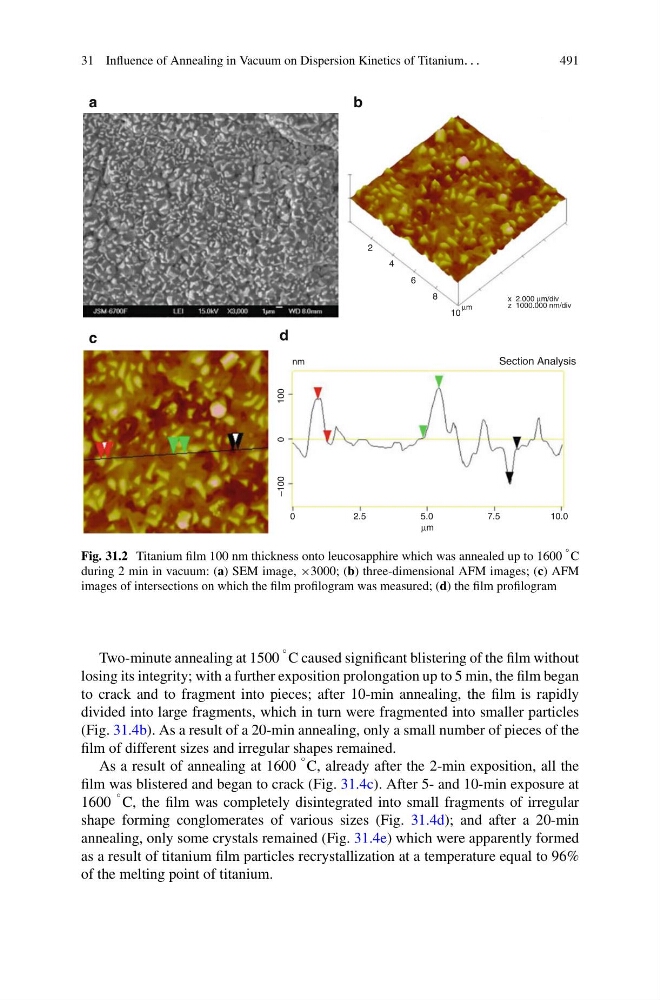
Fig. 31.2 Titanium film 100 nm thickness onto leucosapphire which was annealed up to 1600
◦ C
during 2 min in vacuum: (a) SEM image, ×3000; (b) three-dimensional AFM images; (c) AFM
images of intersections on which the film profilogram was measured; (d) the film profilogram
Two-minute annealing at 1500
◦ C caused significant blistering of the film without
losing its integrity; with a further exposition prolongation up to 5 min, the film began
to crack and to fragment into pieces; after 10-min annealing, the film is rapidly
divided into large fragments, which in turn were fragmented into smaller particles
(Fig. 31.4b). As a result of a 20-min annealing, only a small number of pieces of the
film of different sizes and irregular shapes remained.
As a result of annealing at 1600
◦ C, already after the 2-min exposition, all the
film was blistered and began to crack (Fig. 31.4c). After 5- and 10-min exposure at
1600
◦ C, the film was completely disintegrated into small fragments of irregular
shape forming conglomerates of various sizes (Fig. 31.4d); and after a 20-min
annealing, only some crystals remained (Fig. 31.4e) which were apparently formed
as a result of titanium film particles recrystallization at a temperature equal to 96%
of the melting point of titanium.
491
2
4
100
0
–100
6
8
nm
Section Analysis
x 2.000 μm/div
z 1000.000 nm/div
d
c
a
b
0
2.5
5.0
7.5
10.0
μm
μm
10
Fig. 31.2 Titanium film 100 nm thickness onto leucosapphire which was annealed up to 1600
◦ C
during 2 min in vacuum: (a) SEM image, ×3000; (b) three-dimensional AFM images; (c) AFM
images of intersections on which the film profilogram was measured; (d) the film profilogram
Two-minute annealing at 1500
◦ C caused significant blistering of the film without
losing its integrity; with a further exposition prolongation up to 5 min, the film began
to crack and to fragment into pieces; after 10-min annealing, the film is rapidly
divided into large fragments, which in turn were fragmented into smaller particles
(Fig. 31.4b). As a result of a 20-min annealing, only a small number of pieces of the
film of different sizes and irregular shapes remained.
As a result of annealing at 1600
◦ C, already after the 2-min exposition, all the
film was blistered and began to crack (Fig. 31.4c). After 5- and 10-min exposure at
1600
◦ C, the film was completely disintegrated into small fragments of irregular
shape forming conglomerates of various sizes (Fig. 31.4d); and after a 20-min
annealing, only some crystals remained (Fig. 31.4e) which were apparently formed
as a result of titanium film particles recrystallization at a temperature equal to 96%
of the melting point of titanium.