

490
Y. V. Naidich et al.
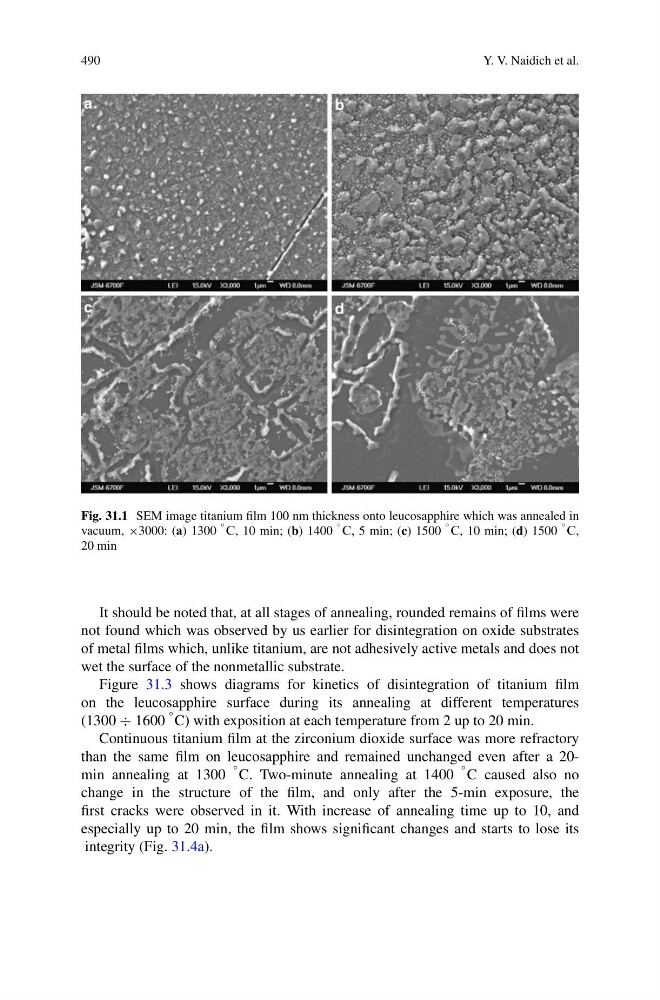
Fig. 31.1 SEM image titanium film 100 nm thickness onto leucosapphire which was annealed in
vacuum, ×3000: (Ã) 1300
◦ ´, 10 min; (b) 1400
◦ ´, 5 min; (c) 1500
◦ ´, 10 min; (d) 1500
◦ ´,
20 min
It should be noted that, at all stages of annealing, rounded remains of films were
not found which was observed by us earlier for disintegration on oxide substrates
of metal films which, unlike titanium, are not adhesively active metals and does not
wet the surface of the nonmetallic substrate.
Figure 31.3 shows diagrams for kinetics of disintegration of titanium film
on the leucosapphire surface during its annealing at different temperatures
(1300 ÷ 1600
◦ C) with exposition at each temperature from 2 up to 20 min.
Continuous titanium film at the zirconium dioxide surface was more refractory
than the same film on leucosapphire and remained unchanged even after a 20min annealing at 1300
◦ C. Two-minute annealing at 1400
◦ C caused also no
change in the structure of the film, and only after the 5-min exposure, the
first cracks were observed in it. With increase of annealing time up to 10, and
especially up to 20 min, the film shows significant changes and starts to lose its
integrity (Fig. 31.4a).
Y. V. Naidich et al.
Fig. 31.1 SEM image titanium film 100 nm thickness onto leucosapphire which was annealed in
vacuum, ×3000: (Ã) 1300
◦ ´, 10 min; (b) 1400
◦ ´, 5 min; (c) 1500
◦ ´, 10 min; (d) 1500
◦ ´,
20 min
It should be noted that, at all stages of annealing, rounded remains of films were
not found which was observed by us earlier for disintegration on oxide substrates
of metal films which, unlike titanium, are not adhesively active metals and does not
wet the surface of the nonmetallic substrate.
Figure 31.3 shows diagrams for kinetics of disintegration of titanium film
on the leucosapphire surface during its annealing at different temperatures
(1300 ÷ 1600
◦ C) with exposition at each temperature from 2 up to 20 min.
Continuous titanium film at the zirconium dioxide surface was more refractory
than the same film on leucosapphire and remained unchanged even after a 20min annealing at 1300
◦ C. Two-minute annealing at 1400
◦ C caused also no
change in the structure of the film, and only after the 5-min exposure, the
first cracks were observed in it. With increase of annealing time up to 10, and
especially up to 20 min, the film shows significant changes and starts to lose its
integrity (Fig. 31.4a).