

478
B. D. Vasyliv et al.
Fig. 30.2 A general view of
the experimental stand
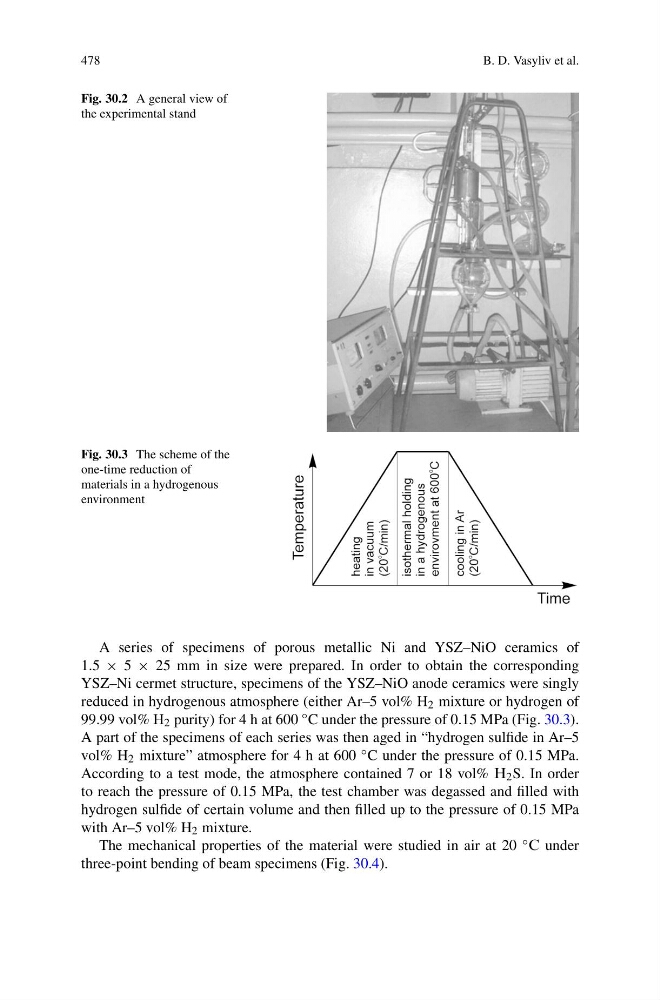
Fig. 30.3 The scheme of the
one-time reduction of
materials in a hydrogenous
environment
A series of specimens of porous metallic Ni and YSZ–NiO ceramics of
1.5 × 5 × 25 mm in size were prepared. In order to obtain the corresponding
YSZ–Ni cermet structure, specimens of the YSZ–NiO anode ceramics were singly
reduced in hydrogenous atmosphere (either Ar–5 vol% H 2 mixture or hydrogen of
99.99 vol% H 2 purity) for 4 h at 600 ◦ C under the pressure of 0.15 MPa (Fig. 30.3).
A part of the specimens of each series was then aged in “hydrogen sulfide in Ar–5
vol% H 2 mixture” atmosphere for 4 h at 600 ◦ C under the pressure of 0.15 MPa.
According to a test mode, the atmosphere contained 7 or 18 vol% ° 2 S. In order
to reach the pressure of 0.15 MPa, the test chamber was degassed and filled with
hydrogen sulfide of certain volume and then filled up to the pressure of 0.15 MPa
with Ar–5 vol% H 2 mixture.
The mechanical properties of the material were studied in air at 20 ◦ ´ under
three-point bending of beam specimens (Fig. 30.4).
B. D. Vasyliv et al.
Fig. 30.2 A general view of
the experimental stand
Fig. 30.3 The scheme of the
one-time reduction of
materials in a hydrogenous
environment
A series of specimens of porous metallic Ni and YSZ–NiO ceramics of
1.5 × 5 × 25 mm in size were prepared. In order to obtain the corresponding
YSZ–Ni cermet structure, specimens of the YSZ–NiO anode ceramics were singly
reduced in hydrogenous atmosphere (either Ar–5 vol% H 2 mixture or hydrogen of
99.99 vol% H 2 purity) for 4 h at 600 ◦ C under the pressure of 0.15 MPa (Fig. 30.3).
A part of the specimens of each series was then aged in “hydrogen sulfide in Ar–5
vol% H 2 mixture” atmosphere for 4 h at 600 ◦ C under the pressure of 0.15 MPa.
According to a test mode, the atmosphere contained 7 or 18 vol% ° 2 S. In order
to reach the pressure of 0.15 MPa, the test chamber was degassed and filled with
hydrogen sulfide of certain volume and then filled up to the pressure of 0.15 MPa
with Ar–5 vol% H 2 mixture.
The mechanical properties of the material were studied in air at 20 ◦ ´ under
three-point bending of beam specimens (Fig. 30.4).