

466
H. Klym et al.
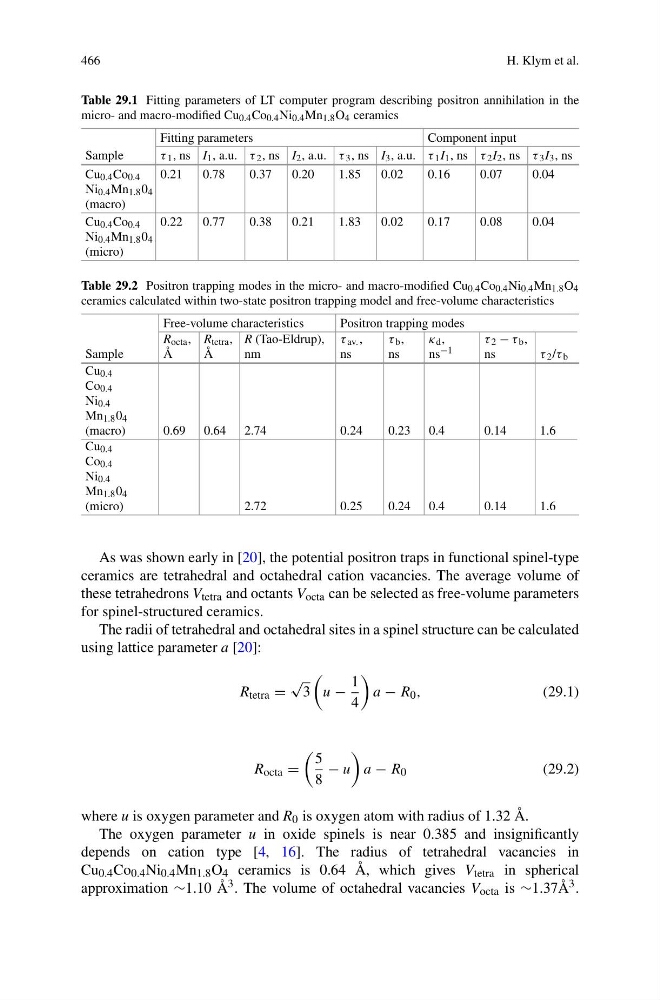
Table 29.1 Fitting parameters of LT computer program describing positron annihilation in the
micro- and macro-modified Cu 0.4 Co 0.4 Ni 0.4 Mn 1.8 O 4 ceramics
Fitting parameters
Component input
Sample
τ 1 , ns I 1 , a.u. τ 2 , ns I 2 , a.u. τ 3 , ns I 3 , a.u. τ 1 I 1 , ns τ 2 I 2 , ns τ 3 I 3 , ns
Cu 0.4 Co 0.4
Ni 0.4 Mn 1.8 0 4
(macro)
0.21
0.78
0.37
0.20
1.85
0.02
0.16
0.07
0.04
Cu 0.4 Co 0.4
Ni 0.4 Mn 1.8 0 4
(micro)
0.22
0.77
0.38
0.21
1.83
0.02
0.17
0.08
0.04
Table 29.2 Positron trapping modes in the micro- and macro-modified Cu 0.4 Co 0.4 Ni 0.4 Mn 1.8 O 4
ceramics calculated within two-state positron trapping model and free-volume characteristics
Free-volume characteristics
Positron trapping modes
Sample
R octa ,
Å
R tetra ,
Å
R (Tao-Eldrup),
nm
τ av. ,
ns
τ b ,
ns
κ d ,
ns −1
τ 2 − τ b ,
ns
τ 2 /τ b
Cu 0.4
Co 0.4
Ni 0.4
Mn 1.8 0 4
(macro)
0.69 0.64 2.74
0.24
0.23 0.4
0.14
1.6
Cu 0.4
Co 0.4
Ni 0.4
Mn 1.8 0 4
(micro)
2.72
0.25
0.24 0.4
0.14
1.6
As was shown early in [20], the potential positron traps in functional spinel-type
ceramics are tetrahedral and octahedral cation vacancies. The average volume of
these tetrahedrons V tetra and octants V octa can be selected as free-volume parameters
for spinel-structured ceramics.
The radii of tetrahedral and octahedral sites in a spinel structure can be calculated
using lattice parameter a [20]:
R tetra =
√
3
u −
1
4
a − R 0 ,
(29.1)
R octa =
5
8
− u
a − R 0
(29.2)
where u is oxygen parameter and R 0 is oxygen atom with radius of 1.32 Å.
The oxygen parameter u in oxide spinels is near 0.385 and insignificantly
depends on cation type [4, 16]. The radius of tetrahedral vacancies in
Cu 0.4 Co 0.4 Ni 0.4 Mn 1.8 O 4 ceramics is 0.64 Å, which gives V tetra in spherical
approximation ∼1.10 Å 3 . The volume of octahedral vacancies V octa is ∼1.37Å 3 .
H. Klym et al.
Table 29.1 Fitting parameters of LT computer program describing positron annihilation in the
micro- and macro-modified Cu 0.4 Co 0.4 Ni 0.4 Mn 1.8 O 4 ceramics
Fitting parameters
Component input
Sample
τ 1 , ns I 1 , a.u. τ 2 , ns I 2 , a.u. τ 3 , ns I 3 , a.u. τ 1 I 1 , ns τ 2 I 2 , ns τ 3 I 3 , ns
Cu 0.4 Co 0.4
Ni 0.4 Mn 1.8 0 4
(macro)
0.21
0.78
0.37
0.20
1.85
0.02
0.16
0.07
0.04
Cu 0.4 Co 0.4
Ni 0.4 Mn 1.8 0 4
(micro)
0.22
0.77
0.38
0.21
1.83
0.02
0.17
0.08
0.04
Table 29.2 Positron trapping modes in the micro- and macro-modified Cu 0.4 Co 0.4 Ni 0.4 Mn 1.8 O 4
ceramics calculated within two-state positron trapping model and free-volume characteristics
Free-volume characteristics
Positron trapping modes
Sample
R octa ,
Å
R tetra ,
Å
R (Tao-Eldrup),
nm
τ av. ,
ns
τ b ,
ns
κ d ,
ns −1
τ 2 − τ b ,
ns
τ 2 /τ b
Cu 0.4
Co 0.4
Ni 0.4
Mn 1.8 0 4
(macro)
0.69 0.64 2.74
0.24
0.23 0.4
0.14
1.6
Cu 0.4
Co 0.4
Ni 0.4
Mn 1.8 0 4
(micro)
2.72
0.25
0.24 0.4
0.14
1.6
As was shown early in [20], the potential positron traps in functional spinel-type
ceramics are tetrahedral and octahedral cation vacancies. The average volume of
these tetrahedrons V tetra and octants V octa can be selected as free-volume parameters
for spinel-structured ceramics.
The radii of tetrahedral and octahedral sites in a spinel structure can be calculated
using lattice parameter a [20]:
R tetra =
√
3
u −
1
4
a − R 0 ,
(29.1)
R octa =
5
8
− u
a − R 0
(29.2)
where u is oxygen parameter and R 0 is oxygen atom with radius of 1.32 Å.
The oxygen parameter u in oxide spinels is near 0.385 and insignificantly
depends on cation type [4, 16]. The radius of tetrahedral vacancies in
Cu 0.4 Co 0.4 Ni 0.4 Mn 1.8 O 4 ceramics is 0.64 Å, which gives V tetra in spherical
approximation ∼1.10 Å 3 . The volume of octahedral vacancies V octa is ∼1.37Å 3 .