

29 Structural Study of the Modified Cu 0.4 Co 0.4 Ni 0.4 Mn 1.8 O 4 . . .
465
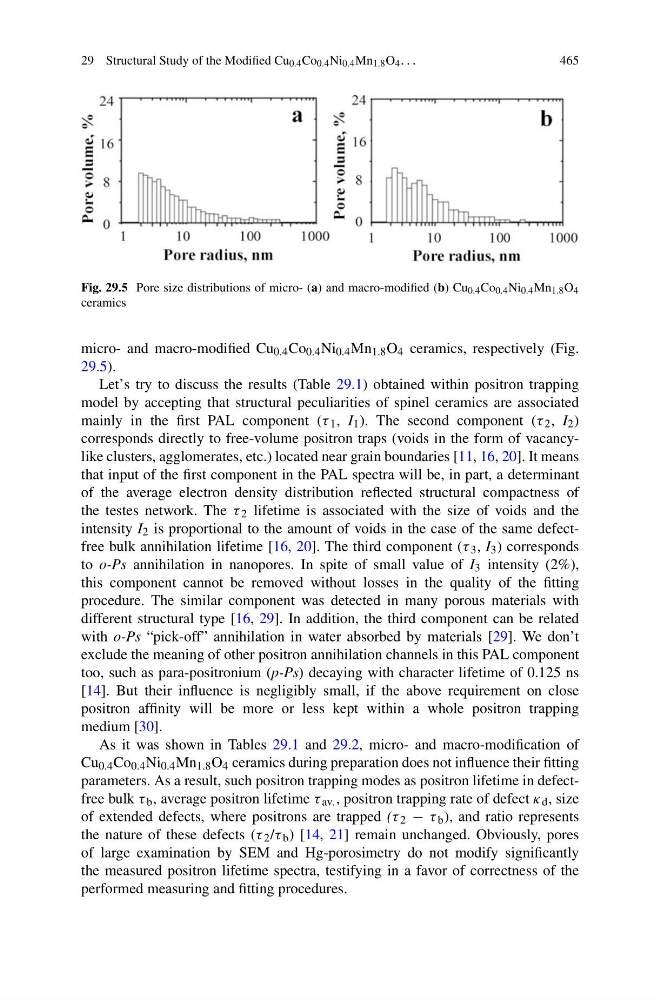
Fig. 29.5 Pore size distributions of micro- (a) and macro-modified (b) Cu 0.4 Co 0.4 Ni 0.4 Mn 1.8 O 4
ceramics
micro- and macro-modified Cu 0.4 Co 0.4 Ni 0.4 Mn 1.8 O 4 ceramics, respectively (Fig.
29.5).
Let’s try to discuss the results (Table 29.1) obtained within positron trapping
model by accepting that structural peculiarities of spinel ceramics are associated
mainly in the first PAL component (τ 1 , I 1 ). The second component (τ 2 , I 2 )
corresponds directly to free-volume positron traps (voids in the form of vacancylike clusters, agglomerates, etc.) located near grain boundaries [11, 16, 20]. It means
that input of the first component in the PAL spectra will be, in part, a determinant
of the average electron density distribution reflected structural compactness of
the testes network. The τ 2 lifetime is associated with the size of voids and the
intensity I 2 is proportional to the amount of voids in the case of the same defectfree bulk annihilation lifetime [16, 20]. The third component (τ 3 , I 3 ) corresponds
to o-Ps annihilation in nanopores. In spite of small value of I 3 intensity (2%),
this component cannot be removed without losses in the quality of the fitting
procedure. The similar component was detected in many porous materials with
different structural type [16, 29]. In addition, the third component can be related
with o-Ps “pick-off” annihilation in water absorbed by materials [29]. We don’t
exclude the meaning of other positron annihilation channels in this PAL component
too, such as para-positronium (p-Ps) decaying with character lifetime of 0.125 ns
[14]. But their influence is negligibly small, if the above requirement on close
positron affinity will be more or less kept within a whole positron trapping
medium [30].
As it was shown in Tables 29.1 and 29.2, micro- and macro-modification of
Cu 0.4 Co 0.4 Ni 0.4 Mn 1.8 O 4 ceramics during preparation does not influence their fitting
parameters. As a result, such positron trapping modes as positron lifetime in defectfree bulk τ b , average positron lifetime τ av. , positron trapping rate of defect κ d , size
of extended defects, where positrons are trapped (τ 2 − τ b ), and ratio represents
the nature of these defects (τ 2 /τ b ) [14, 21] remain unchanged. Obviously, pores
of large examination by SEM and Hg-porosimetry do not modify significantly
the measured positron lifetime spectra, testifying in a favor of correctness of the
performed measuring and fitting procedures.
465
Fig. 29.5 Pore size distributions of micro- (a) and macro-modified (b) Cu 0.4 Co 0.4 Ni 0.4 Mn 1.8 O 4
ceramics
micro- and macro-modified Cu 0.4 Co 0.4 Ni 0.4 Mn 1.8 O 4 ceramics, respectively (Fig.
29.5).
Let’s try to discuss the results (Table 29.1) obtained within positron trapping
model by accepting that structural peculiarities of spinel ceramics are associated
mainly in the first PAL component (τ 1 , I 1 ). The second component (τ 2 , I 2 )
corresponds directly to free-volume positron traps (voids in the form of vacancylike clusters, agglomerates, etc.) located near grain boundaries [11, 16, 20]. It means
that input of the first component in the PAL spectra will be, in part, a determinant
of the average electron density distribution reflected structural compactness of
the testes network. The τ 2 lifetime is associated with the size of voids and the
intensity I 2 is proportional to the amount of voids in the case of the same defectfree bulk annihilation lifetime [16, 20]. The third component (τ 3 , I 3 ) corresponds
to o-Ps annihilation in nanopores. In spite of small value of I 3 intensity (2%),
this component cannot be removed without losses in the quality of the fitting
procedure. The similar component was detected in many porous materials with
different structural type [16, 29]. In addition, the third component can be related
with o-Ps “pick-off” annihilation in water absorbed by materials [29]. We don’t
exclude the meaning of other positron annihilation channels in this PAL component
too, such as para-positronium (p-Ps) decaying with character lifetime of 0.125 ns
[14]. But their influence is negligibly small, if the above requirement on close
positron affinity will be more or less kept within a whole positron trapping
medium [30].
As it was shown in Tables 29.1 and 29.2, micro- and macro-modification of
Cu 0.4 Co 0.4 Ni 0.4 Mn 1.8 O 4 ceramics during preparation does not influence their fitting
parameters. As a result, such positron trapping modes as positron lifetime in defectfree bulk τ b , average positron lifetime τ av. , positron trapping rate of defect κ d , size
of extended defects, where positrons are trapped (τ 2 − τ b ), and ratio represents
the nature of these defects (τ 2 /τ b ) [14, 21] remain unchanged. Obviously, pores
of large examination by SEM and Hg-porosimetry do not modify significantly
the measured positron lifetime spectra, testifying in a favor of correctness of the
performed measuring and fitting procedures.