

450
A. Maizelis and B. Bairachniy
28.3.3 Modeling the Current Transients
Theoretical transients and the experimental data were compared using a nonlinear
fitting approach, and the contribution of the different processes involved was
determined. The best fit for all the transients studied was obtained on using
Eq. (28.7):
j = j 2DI + j 3DI ,
(28.7)
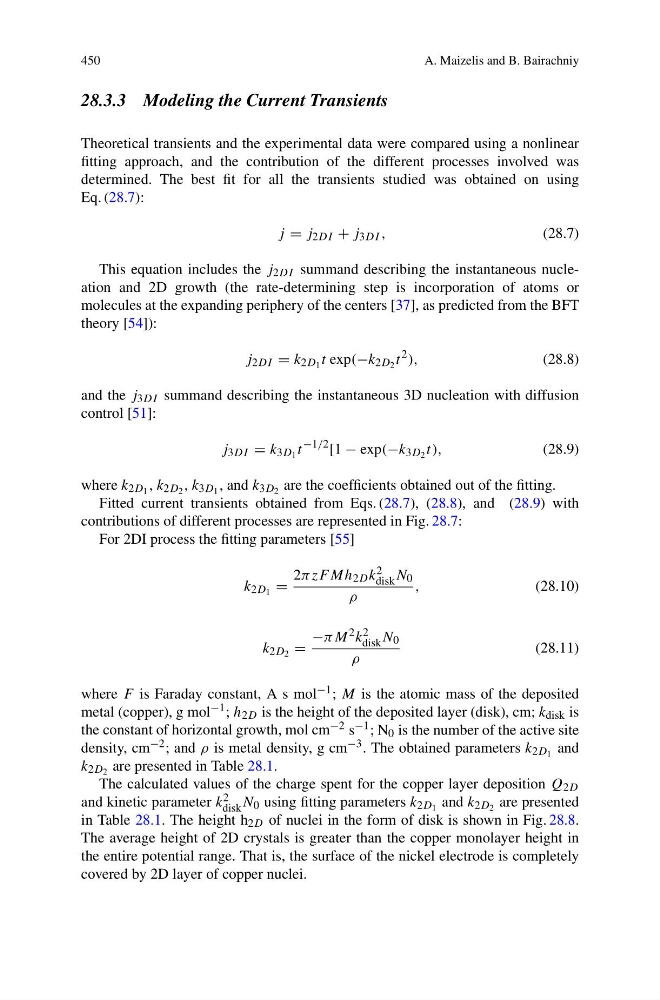
This equation includes the j 2DI summand describing the instantaneous nucleation and 2D growth (the rate-determining step is incorporation of atoms or
molecules at the expanding periphery of the centers [37], as predicted from the BFT
theory [54]):
j 2DI = k 2D 1 t exp(−k 2D 2 t
2 ),
(28.8)
and the j 3DI summand describing the instantaneous 3D nucleation with diffusion
control [51]:
j 3DI = k 3D 1 t
−1/2
[1 − exp(−k 3D 2 t),
(28.9)
where k 2D 1 , k 2D 2 , k 3D 1 , and k 3D 2 are the coefficients obtained out of the fitting.
Fitted current transients obtained from Eqs. (28.7), (28.8), and (28.9) with
contributions of different processes are represented in Fig. 28.7:
For 2DI process the fitting parameters [55]
k 2D 1 =
2πzF Mh 2D k 2
disk N 0
ρ
,
(28.10)
k 2D 2 =
−πM 2 k 2
disk N 0
ρ
(28.11)
where F is Faraday constant, A s mol −1 ; M is the atomic mass of the deposited
metal (copper), g mol −1 ; h 2D is the height of the deposited layer (disk), cm; k disk is
the constant of horizontal growth, mol cm −2 s −1 ; N 0 is the number of the active site
density, cm −2 ; and ρ is metal density, g cm −3 . The obtained parameters k 2D 1 and
k 2D 2 are presented in Table 28.1.
The calculated values of the charge spent for the copper layer deposition Q 2D
and kinetic parameter k 2
disk N 0 using fitting parameters k 2D 1 and k 2D 2 are presented
in Table 28.1. The height h 2D of nuclei in the form of disk is shown in Fig. 28.8.
The average height of 2D crystals is greater than the copper monolayer height in
the entire potential range. That is, the surface of the nickel electrode is completely
covered by 2D layer of copper nuclei.
A. Maizelis and B. Bairachniy
28.3.3 Modeling the Current Transients
Theoretical transients and the experimental data were compared using a nonlinear
fitting approach, and the contribution of the different processes involved was
determined. The best fit for all the transients studied was obtained on using
Eq. (28.7):
j = j 2DI + j 3DI ,
(28.7)
This equation includes the j 2DI summand describing the instantaneous nucleation and 2D growth (the rate-determining step is incorporation of atoms or
molecules at the expanding periphery of the centers [37], as predicted from the BFT
theory [54]):
j 2DI = k 2D 1 t exp(−k 2D 2 t
2 ),
(28.8)
and the j 3DI summand describing the instantaneous 3D nucleation with diffusion
control [51]:
j 3DI = k 3D 1 t
−1/2
[1 − exp(−k 3D 2 t),
(28.9)
where k 2D 1 , k 2D 2 , k 3D 1 , and k 3D 2 are the coefficients obtained out of the fitting.
Fitted current transients obtained from Eqs. (28.7), (28.8), and (28.9) with
contributions of different processes are represented in Fig. 28.7:
For 2DI process the fitting parameters [55]
k 2D 1 =
2πzF Mh 2D k 2
disk N 0
ρ
,
(28.10)
k 2D 2 =
−πM 2 k 2
disk N 0
ρ
(28.11)
where F is Faraday constant, A s mol −1 ; M is the atomic mass of the deposited
metal (copper), g mol −1 ; h 2D is the height of the deposited layer (disk), cm; k disk is
the constant of horizontal growth, mol cm −2 s −1 ; N 0 is the number of the active site
density, cm −2 ; and ρ is metal density, g cm −3 . The obtained parameters k 2D 1 and
k 2D 2 are presented in Table 28.1.
The calculated values of the charge spent for the copper layer deposition Q 2D
and kinetic parameter k 2
disk N 0 using fitting parameters k 2D 1 and k 2D 2 are presented
in Table 28.1. The height h 2D of nuclei in the form of disk is shown in Fig. 28.8.
The average height of 2D crystals is greater than the copper monolayer height in
the entire potential range. That is, the surface of the nickel electrode is completely
covered by 2D layer of copper nuclei.