

28 Copper Nucleation on Nickel from Pyrophosphate-Based Polyligand Electrolyte
449
the current rises sharply due to the rapid increase in the area of nuclei, which grow
only parallel to the substrate. Then the current drastically decreases and becomes
zero when the entire electrode surface is covered by a monolayer of deposited
metal. For nucleation and growth of 2D crystals, the dependencies j/j max on t/t max
(dimensionless coordinates) are proposed:
instantaneous
j
j max
= (
t
t max
)exp[−
1
2
(
t 2 − t max
t 2
max
)],
(28.5)
and progressive
j
j max
= (
t
t max
)
2 exp[−
2
3
(
t 3 − t 3
max
t 3
max
)]
(28.6)
mechanism as cited in [52].
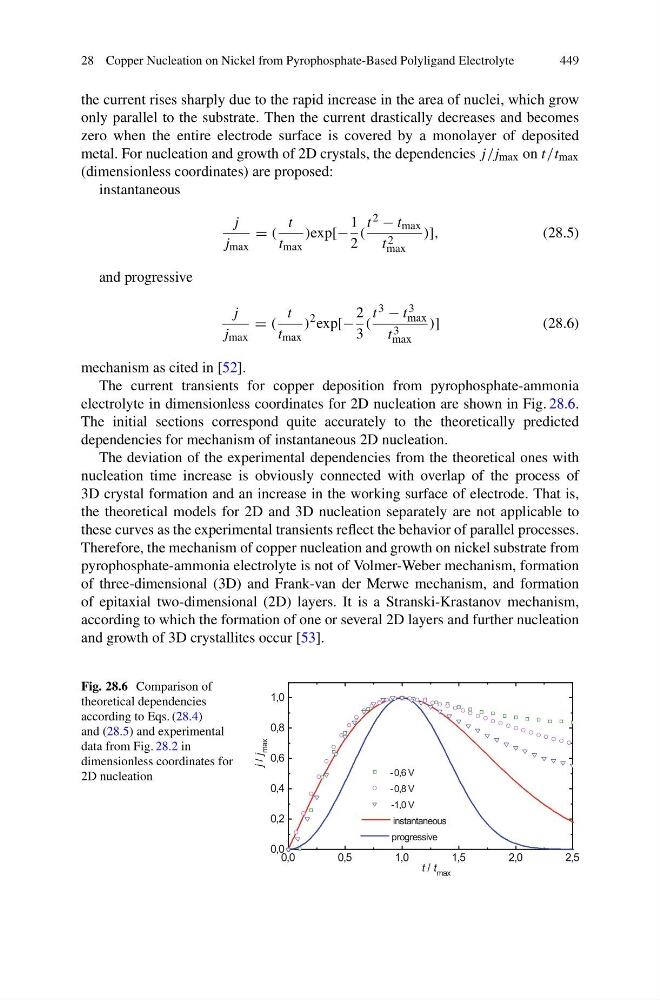
The current transients for copper deposition from pyrophosphate-ammonia
electrolyte in dimensionless coordinates for 2D nucleation are shown in Fig. 28.6.
The initial sections correspond quite accurately to the theoretically predicted
dependencies for mechanism of instantaneous 2D nucleation.
The deviation of the experimental dependencies from the theoretical ones with
nucleation time increase is obviously connected with overlap of the process of
3D crystal formation and an increase in the working surface of electrode. That is,
the theoretical models for 2D and 3D nucleation separately are not applicable to
these curves as the experimental transients reflect the behavior of parallel processes.
Therefore, the mechanism of copper nucleation and growth on nickel substrate from
pyrophosphate-ammonia electrolyte is not of Volmer-Weber mechanism, formation
of three-dimensional (3D) and Frank-van der Merwe mechanism, and formation
of epitaxial two-dimensional (2D) layers. It is a Stranski-Krastanov mechanism,
according to which the formation of one or several 2D layers and further nucleation
and growth of 3D crystallites occur [53].
Fig. 28.6 Comparison of
theoretical dependencies
according to Eqs. (28.4)
and (28.5) and experimental
data from Fig. 28.2 in
dimensionless coordinates for
2D nucleation
449
the current rises sharply due to the rapid increase in the area of nuclei, which grow
only parallel to the substrate. Then the current drastically decreases and becomes
zero when the entire electrode surface is covered by a monolayer of deposited
metal. For nucleation and growth of 2D crystals, the dependencies j/j max on t/t max
(dimensionless coordinates) are proposed:
instantaneous
j
j max
= (
t
t max
)exp[−
1
2
(
t 2 − t max
t 2
max
)],
(28.5)
and progressive
j
j max
= (
t
t max
)
2 exp[−
2
3
(
t 3 − t 3
max
t 3
max
)]
(28.6)
mechanism as cited in [52].
The current transients for copper deposition from pyrophosphate-ammonia
electrolyte in dimensionless coordinates for 2D nucleation are shown in Fig. 28.6.
The initial sections correspond quite accurately to the theoretically predicted
dependencies for mechanism of instantaneous 2D nucleation.
The deviation of the experimental dependencies from the theoretical ones with
nucleation time increase is obviously connected with overlap of the process of
3D crystal formation and an increase in the working surface of electrode. That is,
the theoretical models for 2D and 3D nucleation separately are not applicable to
these curves as the experimental transients reflect the behavior of parallel processes.
Therefore, the mechanism of copper nucleation and growth on nickel substrate from
pyrophosphate-ammonia electrolyte is not of Volmer-Weber mechanism, formation
of three-dimensional (3D) and Frank-van der Merwe mechanism, and formation
of epitaxial two-dimensional (2D) layers. It is a Stranski-Krastanov mechanism,
according to which the formation of one or several 2D layers and further nucleation
and growth of 3D crystallites occur [53].
Fig. 28.6 Comparison of
theoretical dependencies
according to Eqs. (28.4)
and (28.5) and experimental
data from Fig. 28.2 in
dimensionless coordinates for
2D nucleation