

438
Iu. Gudyma et al.
(a)
(b)
(c)
(d)
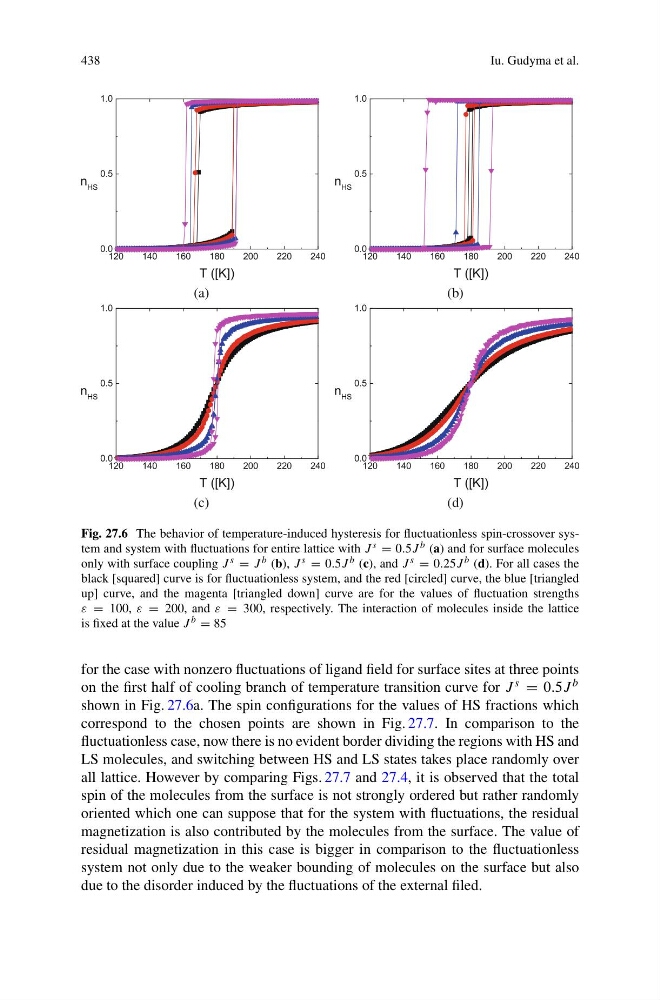
Fig. 27.6 The behavior of temperature-induced hysteresis for fluctuationless spin-crossover system and system with fluctuations for entire lattice with J s = 0.5J b (a) and for surface molecules
only with surface coupling J s = J b (b), J s = 0.5J b (c), and J s = 0.25J b (d). For all cases the
black [squared] curve is for fluctuationless system, and the red [circled] curve, the blue [triangled
up] curve, and the magenta [triangled down] curve are for the values of fluctuation strengths
ε = 100, ε = 200, and ε = 300, respectively. The interaction of molecules inside the lattice
is fixed at the value J b = 85
for the case with nonzero fluctuations of ligand field for surface sites at three points
on the first half of cooling branch of temperature transition curve for J s = 0.5J b
shown in Fig. 27.6a. The spin configurations for the values of HS fractions which
correspond to the chosen points are shown in Fig. 27.7. In comparison to the
fluctuationless case, now there is no evident border dividing the regions with HS and
LS molecules, and switching between HS and LS states takes place randomly over
all lattice. However by comparing Figs. 27.7 and 27.4, it is observed that the total
spin of the molecules from the surface is not strongly ordered but rather randomly
oriented which one can suppose that for the system with fluctuations, the residual
magnetization is also contributed by the molecules from the surface. The value of
residual magnetization in this case is bigger in comparison to the fluctuationless
system not only due to the weaker bounding of molecules on the surface but also
due to the disorder induced by the fluctuations of the external filed.
Iu. Gudyma et al.
(a)
(b)
(c)
(d)
Fig. 27.6 The behavior of temperature-induced hysteresis for fluctuationless spin-crossover system and system with fluctuations for entire lattice with J s = 0.5J b (a) and for surface molecules
only with surface coupling J s = J b (b), J s = 0.5J b (c), and J s = 0.25J b (d). For all cases the
black [squared] curve is for fluctuationless system, and the red [circled] curve, the blue [triangled
up] curve, and the magenta [triangled down] curve are for the values of fluctuation strengths
ε = 100, ε = 200, and ε = 300, respectively. The interaction of molecules inside the lattice
is fixed at the value J b = 85
for the case with nonzero fluctuations of ligand field for surface sites at three points
on the first half of cooling branch of temperature transition curve for J s = 0.5J b
shown in Fig. 27.6a. The spin configurations for the values of HS fractions which
correspond to the chosen points are shown in Fig. 27.7. In comparison to the
fluctuationless case, now there is no evident border dividing the regions with HS and
LS molecules, and switching between HS and LS states takes place randomly over
all lattice. However by comparing Figs. 27.7 and 27.4, it is observed that the total
spin of the molecules from the surface is not strongly ordered but rather randomly
oriented which one can suppose that for the system with fluctuations, the residual
magnetization is also contributed by the molecules from the surface. The value of
residual magnetization in this case is bigger in comparison to the fluctuationless
system not only due to the weaker bounding of molecules on the surface but also
due to the disorder induced by the fluctuations of the external filed.