

27 Cooperative Phenomena in Spin-Crossover Molecular Crystals
439
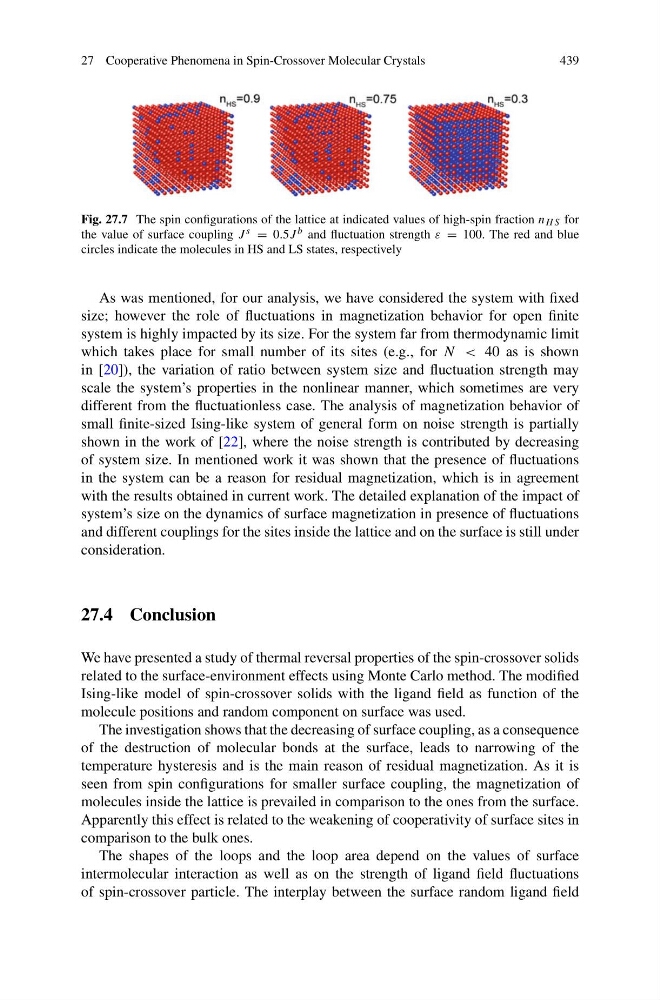
Fig. 27.7 The spin configurations of the lattice at indicated values of high-spin fraction n H S for
the value of surface coupling J s = 0.5J b and fluctuation strength ε = 100. The red and blue
circles indicate the molecules in HS and LS states, respectively
As was mentioned, for our analysis, we have considered the system with fixed
size; however the role of fluctuations in magnetization behavior for open finite
system is highly impacted by its size. For the system far from thermodynamic limit
which takes place for small number of its sites (e.g., for N < 40 as is shown
in [20]), the variation of ratio between system size and fluctuation strength may
scale the system’s properties in the nonlinear manner, which sometimes are very
different from the fluctuationless case. The analysis of magnetization behavior of
small finite-sized Ising-like system of general form on noise strength is partially
shown in the work of [22], where the noise strength is contributed by decreasing
of system size. In mentioned work it was shown that the presence of fluctuations
in the system can be a reason for residual magnetization, which is in agreement
with the results obtained in current work. The detailed explanation of the impact of
system’s size on the dynamics of surface magnetization in presence of fluctuations
and different couplings for the sites inside the lattice and on the surface is still under
consideration.
27.4 Conclusion
We have presented a study of thermal reversal properties of the spin-crossover solids
related to the surface-environment effects using Monte Carlo method. The modified
Ising-like model of spin-crossover solids with the ligand field as function of the
molecule positions and random component on surface was used.
The investigation shows that the decreasing of surface coupling, as a consequence
of the destruction of molecular bonds at the surface, leads to narrowing of the
temperature hysteresis and is the main reason of residual magnetization. As it is
seen from spin configurations for smaller surface coupling, the magnetization of
molecules inside the lattice is prevailed in comparison to the ones from the surface.
Apparently this effect is related to the weakening of cooperativity of surface sites in
comparison to the bulk ones.
The shapes of the loops and the loop area depend on the values of surface
intermolecular interaction as well as on the strength of ligand field fluctuations
of spin-crossover particle. The interplay between the surface random ligand field
439
Fig. 27.7 The spin configurations of the lattice at indicated values of high-spin fraction n H S for
the value of surface coupling J s = 0.5J b and fluctuation strength ε = 100. The red and blue
circles indicate the molecules in HS and LS states, respectively
As was mentioned, for our analysis, we have considered the system with fixed
size; however the role of fluctuations in magnetization behavior for open finite
system is highly impacted by its size. For the system far from thermodynamic limit
which takes place for small number of its sites (e.g., for N < 40 as is shown
in [20]), the variation of ratio between system size and fluctuation strength may
scale the system’s properties in the nonlinear manner, which sometimes are very
different from the fluctuationless case. The analysis of magnetization behavior of
small finite-sized Ising-like system of general form on noise strength is partially
shown in the work of [22], where the noise strength is contributed by decreasing
of system size. In mentioned work it was shown that the presence of fluctuations
in the system can be a reason for residual magnetization, which is in agreement
with the results obtained in current work. The detailed explanation of the impact of
system’s size on the dynamics of surface magnetization in presence of fluctuations
and different couplings for the sites inside the lattice and on the surface is still under
consideration.
27.4 Conclusion
We have presented a study of thermal reversal properties of the spin-crossover solids
related to the surface-environment effects using Monte Carlo method. The modified
Ising-like model of spin-crossover solids with the ligand field as function of the
molecule positions and random component on surface was used.
The investigation shows that the decreasing of surface coupling, as a consequence
of the destruction of molecular bonds at the surface, leads to narrowing of the
temperature hysteresis and is the main reason of residual magnetization. As it is
seen from spin configurations for smaller surface coupling, the magnetization of
molecules inside the lattice is prevailed in comparison to the ones from the surface.
Apparently this effect is related to the weakening of cooperativity of surface sites in
comparison to the bulk ones.
The shapes of the loops and the loop area depend on the values of surface
intermolecular interaction as well as on the strength of ligand field fluctuations
of spin-crossover particle. The interplay between the surface random ligand field