

27 Cooperative Phenomena in Spin-Crossover Molecular Crystals
437
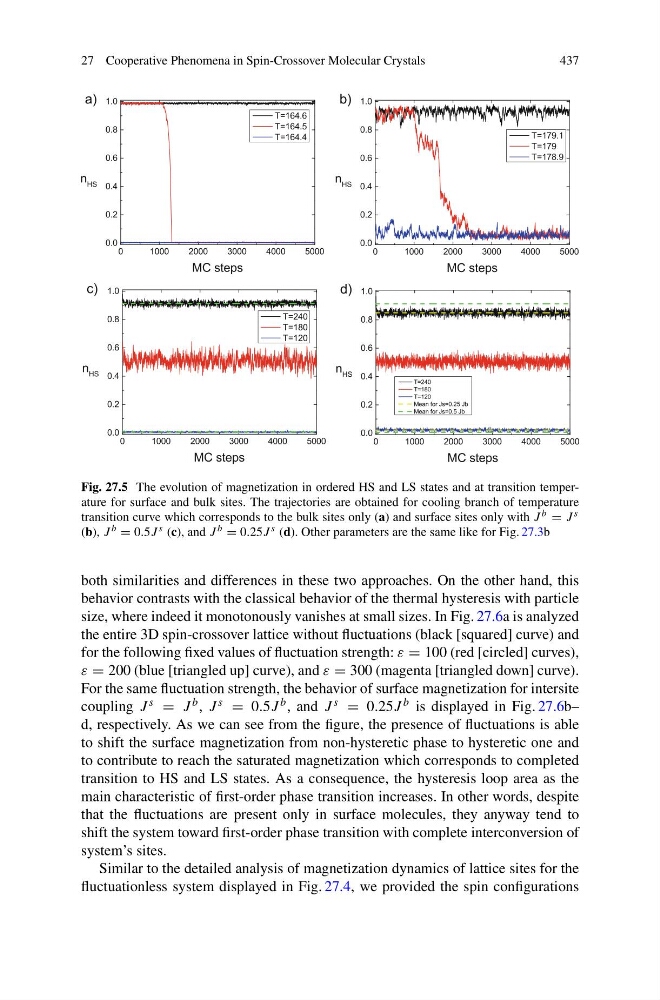
Fig. 27.5 The evolution of magnetization in ordered HS and LS states and at transition temperature for surface and bulk sites. The trajectories are obtained for cooling branch of temperature
transition curve which corresponds to the bulk sites only (a) and surface sites only with J b = J s
(b), J b = 0.5J s (c), and J b = 0.25J s (d). Other parameters are the same like for Fig. 27.3b
both similarities and differences in these two approaches. On the other hand, this
behavior contrasts with the classical behavior of the thermal hysteresis with particle
size, where indeed it monotonously vanishes at small sizes. In Fig. 27.6a is analyzed
the entire 3D spin-crossover lattice without fluctuations (black [squared] curve) and
for the following fixed values of fluctuation strength: ε = 100 (red [circled] curves),
ε = 200 (blue [triangled up] curve), and ε = 300 (magenta [triangled down] curve).
For the same fluctuation strength, the behavior of surface magnetization for intersite
coupling J s = J b , J s = 0.5J b , and J s = 0.25J b is displayed in Fig. 27.6b–
d, respectively. As we can see from the figure, the presence of fluctuations is able
to shift the surface magnetization from non-hysteretic phase to hysteretic one and
to contribute to reach the saturated magnetization which corresponds to completed
transition to HS and LS states. As a consequence, the hysteresis loop area as the
main characteristic of first-order phase transition increases. In other words, despite
that the fluctuations are present only in surface molecules, they anyway tend to
shift the system toward first-order phase transition with complete interconversion of
system’s sites.
Similar to the detailed analysis of magnetization dynamics of lattice sites for the
fluctuationless system displayed in Fig. 27.4, we provided the spin configurations
437
Fig. 27.5 The evolution of magnetization in ordered HS and LS states and at transition temperature for surface and bulk sites. The trajectories are obtained for cooling branch of temperature
transition curve which corresponds to the bulk sites only (a) and surface sites only with J b = J s
(b), J b = 0.5J s (c), and J b = 0.25J s (d). Other parameters are the same like for Fig. 27.3b
both similarities and differences in these two approaches. On the other hand, this
behavior contrasts with the classical behavior of the thermal hysteresis with particle
size, where indeed it monotonously vanishes at small sizes. In Fig. 27.6a is analyzed
the entire 3D spin-crossover lattice without fluctuations (black [squared] curve) and
for the following fixed values of fluctuation strength: ε = 100 (red [circled] curves),
ε = 200 (blue [triangled up] curve), and ε = 300 (magenta [triangled down] curve).
For the same fluctuation strength, the behavior of surface magnetization for intersite
coupling J s = J b , J s = 0.5J b , and J s = 0.25J b is displayed in Fig. 27.6b–
d, respectively. As we can see from the figure, the presence of fluctuations is able
to shift the surface magnetization from non-hysteretic phase to hysteretic one and
to contribute to reach the saturated magnetization which corresponds to completed
transition to HS and LS states. As a consequence, the hysteresis loop area as the
main characteristic of first-order phase transition increases. In other words, despite
that the fluctuations are present only in surface molecules, they anyway tend to
shift the system toward first-order phase transition with complete interconversion of
system’s sites.
Similar to the detailed analysis of magnetization dynamics of lattice sites for the
fluctuationless system displayed in Fig. 27.4, we provided the spin configurations