

26 Bifunctional Silicas with Immobilized Lignin
417
a
-1,3
-1,1
-0,9
-0,7
-0,5
-0,3
10
60
110
Temperature,
o C
)
p
U
o
x
E
(
g
m
/
W
m
,
w
o
l
f
t
a
e
H
Lig_pure
Lig-A1
Lig-A2
Lig-A3
Lig-A4
Lig-A5
Lignin
2
1
4
3
5
b
-1,3
-1,1
-0,9
-0,7
-0,5
-0,3
10
60
110
Temperature,
o C
)
p
U
o
x
E
(
g
m
/
W
m
,
w
o
l
f
t
a
e
H
Lig_pure
Lig-A6
Lig-A7
Lig-A8
Lig-A9
Lig-A10
Lignin
7
6
10
8
9
c
-1,45
-0,95
-0,45
0,05
-50
50
150
250
350
450
Temperature,
o
C
)
P
U
o
x
E
(
g
m
/
W
m
,
w
o
l
f
t
a
e
H
3.1
1.1
1.2
3.2
2.2
2.1
322
175
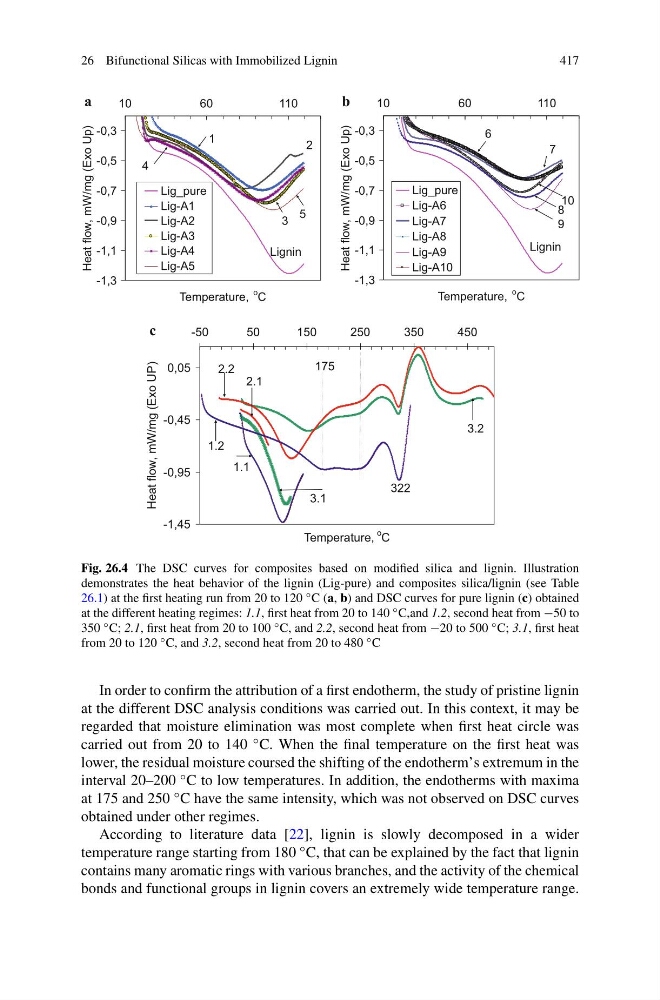
Fig. 26.4 The DSC curves for composites based on modified silica and lignin. Illustration
demonstrates the heat behavior of the lignin (Lig-pure) and composites silica/lignin (see Table
26.1) at the first heating run from 20 to 120 ◦ C (a, b) and DSC curves for pure lignin (c) obtained
at the different heating regimes: 1.1, first heat from 20 to 140 ◦ C,and 1.2, second heat from −50 to
350 ◦ C; 2.1, first heat from 20 to 100 ◦ C, and 2.2, second heat from −20 to 500 ◦ C; 3.1, first heat
from 20 to 120 ◦ C, and 3.2, second heat from 20 to 480 ◦ C
In order to confirm the attribution of a first endotherm, the study of pristine lignin
at the different DSC analysis conditions was carried out. In this context, it may be
regarded that moisture elimination was most complete when first heat circle was
carried out from 20 to 140 ◦ C. When the final temperature on the first heat was
lower, the residual moisture coursed the shifting of the endotherm’s extremum in the
interval 20–200 ◦ C to low temperatures. In addition, the endotherms with maxima
at 175 and 250 ◦ C have the same intensity, which was not observed on DSC curves
obtained under other regimes.
According to literature data [22], lignin is slowly decomposed in a wider
temperature range starting from 180 ◦ C, that can be explained by the fact that lignin
contains many aromatic rings with various branches, and the activity of the chemical
bonds and functional groups in lignin covers an extremely wide temperature range.
417
a
-1,3
-1,1
-0,9
-0,7
-0,5
-0,3
10
60
110
Temperature,
o C
)
p
U
o
x
E
(
g
m
/
W
m
,
w
o
l
f
t
a
e
H
Lig_pure
Lig-A1
Lig-A2
Lig-A3
Lig-A4
Lig-A5
Lignin
2
1
4
3
5
b
-1,3
-1,1
-0,9
-0,7
-0,5
-0,3
10
60
110
Temperature,
o C
)
p
U
o
x
E
(
g
m
/
W
m
,
w
o
l
f
t
a
e
H
Lig_pure
Lig-A6
Lig-A7
Lig-A8
Lig-A9
Lig-A10
Lignin
7
6
10
8
9
c
-1,45
-0,95
-0,45
0,05
-50
50
150
250
350
450
Temperature,
o
C
)
P
U
o
x
E
(
g
m
/
W
m
,
w
o
l
f
t
a
e
H
3.1
1.1
1.2
3.2
2.2
2.1
322
175
Fig. 26.4 The DSC curves for composites based on modified silica and lignin. Illustration
demonstrates the heat behavior of the lignin (Lig-pure) and composites silica/lignin (see Table
26.1) at the first heating run from 20 to 120 ◦ C (a, b) and DSC curves for pure lignin (c) obtained
at the different heating regimes: 1.1, first heat from 20 to 140 ◦ C,and 1.2, second heat from −50 to
350 ◦ C; 2.1, first heat from 20 to 100 ◦ C, and 2.2, second heat from −20 to 500 ◦ C; 3.1, first heat
from 20 to 120 ◦ C, and 3.2, second heat from 20 to 480 ◦ C
In order to confirm the attribution of a first endotherm, the study of pristine lignin
at the different DSC analysis conditions was carried out. In this context, it may be
regarded that moisture elimination was most complete when first heat circle was
carried out from 20 to 140 ◦ C. When the final temperature on the first heat was
lower, the residual moisture coursed the shifting of the endotherm’s extremum in the
interval 20–200 ◦ C to low temperatures. In addition, the endotherms with maxima
at 175 and 250 ◦ C have the same intensity, which was not observed on DSC curves
obtained under other regimes.
According to literature data [22], lignin is slowly decomposed in a wider
temperature range starting from 180 ◦ C, that can be explained by the fact that lignin
contains many aromatic rings with various branches, and the activity of the chemical
bonds and functional groups in lignin covers an extremely wide temperature range.