

416
Y. Bolbukh et al.
0
1
2
3
4
5
200
250
300
350
400
Wavelength, nm
Absorbance, u.a.
Lig-pure
Lig-A1
Lig-A2
Lig-A3
Lig-A4
Lig-A5
Lig-A6
Lig-A7
lig-A8
Lig-A9
Lig-A10
235
280
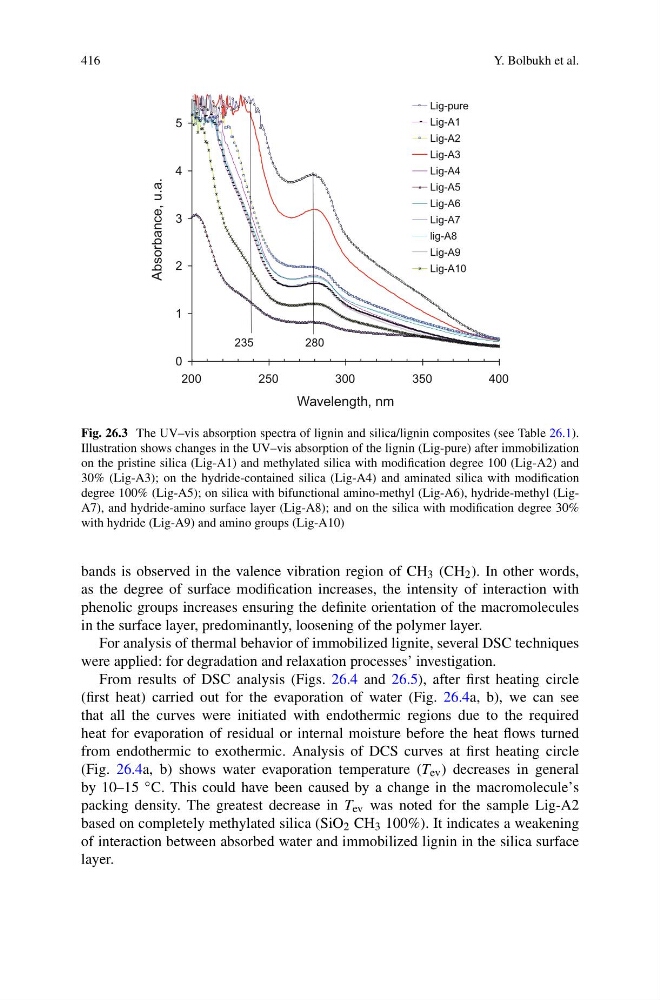
Fig. 26.3 The UV–vis absorption spectra of lignin and silica/lignin composites (see Table 26.1).
Illustration shows changes in the UV–vis absorption of the lignin (Lig-pure) after immobilization
on the pristine silica (Lig-A1) and methylated silica with modification degree 100 (Lig-A2) and
30% (Lig-A3); on the hydride-contained silica (Lig-A4) and aminated silica with modification
degree 100% (Lig-A5); on silica with bifunctional amino-methyl (Lig-A6), hydride-methyl (LigA7), and hydride-amino surface layer (Lig-A8); and on the silica with modification degree 30%
with hydride (Lig-A9) and amino groups (Lig-A10)
bands is observed in the valence vibration region of CH 3 (CH 2 ). In other words,
as the degree of surface modification increases, the intensity of interaction with
phenolic groups increases ensuring the definite orientation of the macromolecules
in the surface layer, predominantly, loosening of the polymer layer.
For analysis of thermal behavior of immobilized lignite, several DSC techniques
were applied: for degradation and relaxation processes’ investigation.
From results of DSC analysis (Figs. 26.4 and 26.5), after first heating circle
(first heat) carried out for the evaporation of water (Fig. 26.4a, b), we can see
that all the curves were initiated with endothermic regions due to the required
heat for evaporation of residual or internal moisture before the heat flows turned
from endothermic to exothermic. Analysis of DCS curves at first heating circle
(Fig. 26.4a, b) shows water evaporation temperature (T ev ) decreases in general
by 10–15 ◦ C. This could have been caused by a change in the macromolecule’s
packing density. The greatest decrease in T ev was noted for the sample Lig-A2
based on completely methylated silica (SiO 2 CH 3 100%). It indicates a weakening
of interaction between absorbed water and immobilized lignin in the silica surface
layer.
Y. Bolbukh et al.
0
1
2
3
4
5
200
250
300
350
400
Wavelength, nm
Absorbance, u.a.
Lig-pure
Lig-A1
Lig-A2
Lig-A3
Lig-A4
Lig-A5
Lig-A6
Lig-A7
lig-A8
Lig-A9
Lig-A10
235
280
Fig. 26.3 The UV–vis absorption spectra of lignin and silica/lignin composites (see Table 26.1).
Illustration shows changes in the UV–vis absorption of the lignin (Lig-pure) after immobilization
on the pristine silica (Lig-A1) and methylated silica with modification degree 100 (Lig-A2) and
30% (Lig-A3); on the hydride-contained silica (Lig-A4) and aminated silica with modification
degree 100% (Lig-A5); on silica with bifunctional amino-methyl (Lig-A6), hydride-methyl (LigA7), and hydride-amino surface layer (Lig-A8); and on the silica with modification degree 30%
with hydride (Lig-A9) and amino groups (Lig-A10)
bands is observed in the valence vibration region of CH 3 (CH 2 ). In other words,
as the degree of surface modification increases, the intensity of interaction with
phenolic groups increases ensuring the definite orientation of the macromolecules
in the surface layer, predominantly, loosening of the polymer layer.
For analysis of thermal behavior of immobilized lignite, several DSC techniques
were applied: for degradation and relaxation processes’ investigation.
From results of DSC analysis (Figs. 26.4 and 26.5), after first heating circle
(first heat) carried out for the evaporation of water (Fig. 26.4a, b), we can see
that all the curves were initiated with endothermic regions due to the required
heat for evaporation of residual or internal moisture before the heat flows turned
from endothermic to exothermic. Analysis of DCS curves at first heating circle
(Fig. 26.4a, b) shows water evaporation temperature (T ev ) decreases in general
by 10–15 ◦ C. This could have been caused by a change in the macromolecule’s
packing density. The greatest decrease in T ev was noted for the sample Lig-A2
based on completely methylated silica (SiO 2 CH 3 100%). It indicates a weakening
of interaction between absorbed water and immobilized lignin in the silica surface
layer.