

418
Y. Bolbukh et al.
20
120
220
320
420
Temperature,
o C
1
2
3
4
5
Lignin
b–relaxation
20
120
220
320
420
Temperature,
o C
Heat flow (Exo UP)
Heat flow (Exo UP)
6
7
8
9
10
Lignin
melting
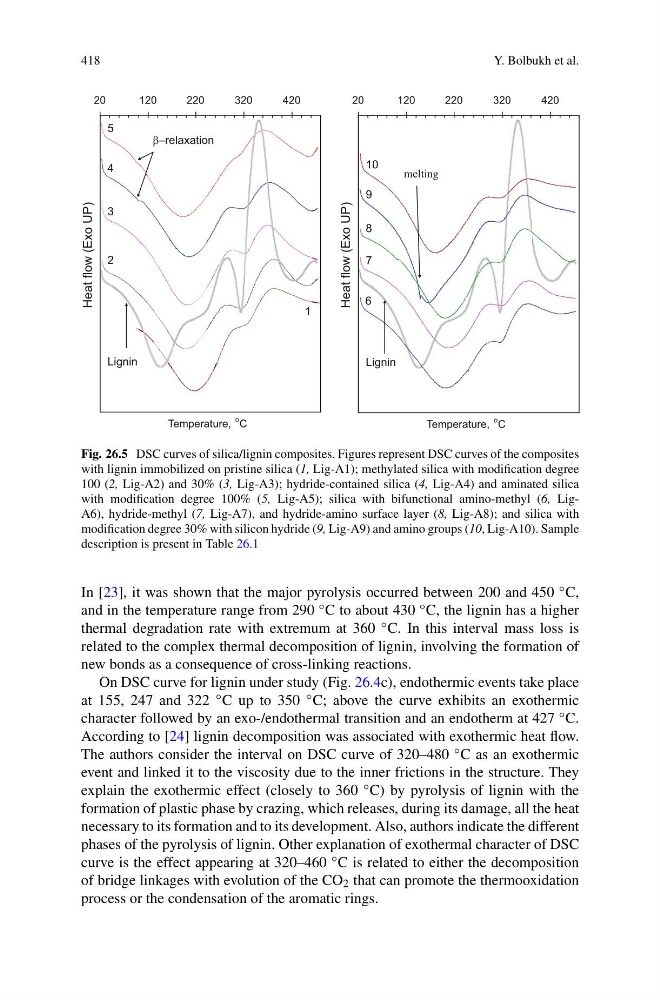
Fig. 26.5 DSC curves of silica/lignin composites. Figures represent DSC curves of the composites
with lignin immobilized on pristine silica (1, Lig-A1); methylated silica with modification degree
100 (2, Lig-A2) and 30% (3, Lig-A3); hydride-contained silica (4, Lig-A4) and aminated silica
with modification degree 100% (5, Lig-A5); silica with bifunctional amino-methyl (6, LigA6), hydride-methyl (7, Lig-A7), and hydride-amino surface layer (8, Lig-A8); and silica with
modification degree 30% with silicon hydride (9, Lig-A9) and amino groups (10, Lig-A10). Sample
description is present in Table 26.1
In [23], it was shown that the major pyrolysis occurred between 200 and 450 ◦ C,
and in the temperature range from 290 ◦ C to about 430 ◦ C, the lignin has a higher
thermal degradation rate with extremum at 360 ◦ C. In this interval mass loss is
related to the complex thermal decomposition of lignin, involving the formation of
new bonds as a consequence of cross-linking reactions.
On DSC curve for lignin under study (Fig. 26.4c), endothermic events take place
at 155, 247 and 322 ◦ C up to 350 ◦ C; above the curve exhibits an exothermic
character followed by an exo-/endothermal transition and an endotherm at 427 ◦ C.
According to [24] lignin decomposition was associated with exothermic heat flow.
The authors consider the interval on DSC curve of 320–480 ◦ C as an exothermic
event and linked it to the viscosity due to the inner frictions in the structure. They
explain the exothermic effect (closely to 360 ◦ C) by pyrolysis of lignin with the
formation of plastic phase by crazing, which releases, during its damage, all the heat
necessary to its formation and to its development. Also, authors indicate the different
phases of the pyrolysis of lignin. Other explanation of exothermal character of DSC
curve is the effect appearing at 320–460 ◦ C is related to either the decomposition
of bridge linkages with evolution of the CO 2 that can promote the thermooxidation
process or the condensation of the aromatic rings.
Y. Bolbukh et al.
20
120
220
320
420
Temperature,
o C
1
2
3
4
5
Lignin
b–relaxation
20
120
220
320
420
Temperature,
o C
Heat flow (Exo UP)
Heat flow (Exo UP)
6
7
8
9
10
Lignin
melting
Fig. 26.5 DSC curves of silica/lignin composites. Figures represent DSC curves of the composites
with lignin immobilized on pristine silica (1, Lig-A1); methylated silica with modification degree
100 (2, Lig-A2) and 30% (3, Lig-A3); hydride-contained silica (4, Lig-A4) and aminated silica
with modification degree 100% (5, Lig-A5); silica with bifunctional amino-methyl (6, LigA6), hydride-methyl (7, Lig-A7), and hydride-amino surface layer (8, Lig-A8); and silica with
modification degree 30% with silicon hydride (9, Lig-A9) and amino groups (10, Lig-A10). Sample
description is present in Table 26.1
In [23], it was shown that the major pyrolysis occurred between 200 and 450 ◦ C,
and in the temperature range from 290 ◦ C to about 430 ◦ C, the lignin has a higher
thermal degradation rate with extremum at 360 ◦ C. In this interval mass loss is
related to the complex thermal decomposition of lignin, involving the formation of
new bonds as a consequence of cross-linking reactions.
On DSC curve for lignin under study (Fig. 26.4c), endothermic events take place
at 155, 247 and 322 ◦ C up to 350 ◦ C; above the curve exhibits an exothermic
character followed by an exo-/endothermal transition and an endotherm at 427 ◦ C.
According to [24] lignin decomposition was associated with exothermic heat flow.
The authors consider the interval on DSC curve of 320–480 ◦ C as an exothermic
event and linked it to the viscosity due to the inner frictions in the structure. They
explain the exothermic effect (closely to 360 ◦ C) by pyrolysis of lignin with the
formation of plastic phase by crazing, which releases, during its damage, all the heat
necessary to its formation and to its development. Also, authors indicate the different
phases of the pyrolysis of lignin. Other explanation of exothermal character of DSC
curve is the effect appearing at 320–460 ◦ C is related to either the decomposition
of bridge linkages with evolution of the CO 2 that can promote the thermooxidation
process or the condensation of the aromatic rings.