

370
M. Satalkar et al.
23.3.5 Antistructural Modeling
Antistructural modeling is a new approach, which lets us predict the nature of the
active surface centers. It is based on the superposition of the crystal structure with
spinel antistructure V
A
V
2
B
(V 4
•• ) O , where V
A is negatively charged tetrahedral
cationic vacancy, V
B is negatively charged octahedral cationic vacancy, and V ••
O
is positively charged oxygen vacancy. The markings '', ''' (negative charge) and
•• (positive charge) correspond to the electronic charge of the species as regards
the sites in the spinel lattice. So each cation from A site interacts with tetrahedral
cationic vacancy V
A , each cation from B site interacts with octahedral cationic
vacancy V
B , and oxygen anions interact with oxygen vacancy V ••
O . Antistructural
modeling can be used for describing solid-solid interactions [61–63], for explanations of the defects in the ferrites system irradiated by γ-rays [64], for catalysts [65,
66], etc.
Detail explanation of the interaction between metal cations, oxygen anions, and
spinel vacancies, respectively, can be written as Me
2+
A +V
A → Me
×
A ; Me
3+
A +V
A →
Me
•
A ; Me
2+
B + V
B → Me
B ; Me
3+
B + V
B → Me
×
B ; O 2- + V ••
O → O
×
O , where × is an
effective zero charge. The positive effective charges for electron neutrality reason
must be balanced by the equivalent concentration of negative effective charges. In
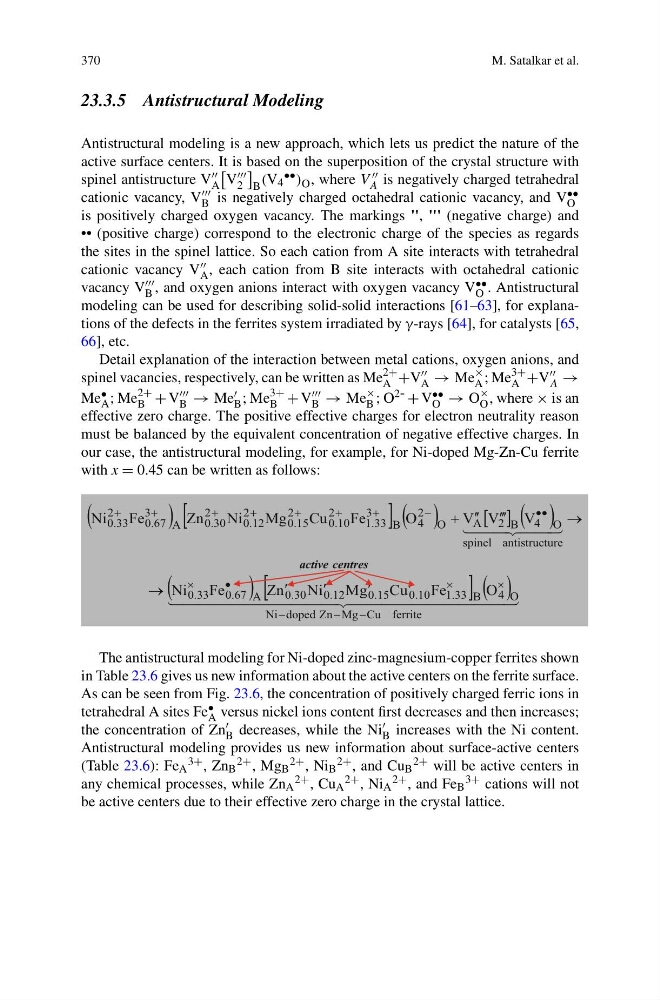
our case, the antistructural modeling, for example, for Ni-doped Mg-Zn-Cu ferrite
with x = 0.45 can be written as follows:
(
)[
] ( )
[ ] ( )
(
)[
] ( )
ferrite
Cu
Mg
Zn
doped
Ni
O
4
B
33
.
1
10
.
0
15
.
0
12
.
0
30
.
0
A
67
.
0
33
.
0
ure
antistruct
spinel
O
4
B
2
A
O
2
4
B
3
33
.
1
2
10
.
0
2
15
.
0
2
12
.
0
2
30
.
0
A
3
67
.
0
2
33
.
0
O
Fe
u
C
g
M
i
N
n
Z
Fe
Ni
V
V
V
O
Fe
Cu
Mg
Ni
Zn
Fe
Ni
-
-
-
´
´
·
´
·
·
-
+
+
+
+
+
+
+
¢
¢
¢
¢
®
®
¢
¢
¢
¢
¢
+
centres
active
The antistructural modeling for Ni-doped zinc-magnesium-copper ferrites shown
in Table 23.6 gives us new information about the active centers on the ferrite surface.
As can be seen from Fig. 23.6, the concentration of positively charged ferric ions in
tetrahedral A sites Fe
•
A versus nickel ions content first decreases and then increases;
the concentration of Zn
B decreases, while the Ni
B increases with the Ni content.
Antistructural modeling provides us new information about surface-active centers
(Table 23.6): Fe A
3+ , Zn B
2+ , Mg B
2+ , Ni B
2+ , and Cu B
2+ will be active centers in
any chemical processes, while Zn A
2+ , Cu A
2+ , Ni A
2+ , and Fe B
3+ cations will not
be active centers due to their effective zero charge in the crystal lattice.
M. Satalkar et al.
23.3.5 Antistructural Modeling
Antistructural modeling is a new approach, which lets us predict the nature of the
active surface centers. It is based on the superposition of the crystal structure with
spinel antistructure V
A
V
2
B
(V 4
•• ) O , where V
A is negatively charged tetrahedral
cationic vacancy, V
B is negatively charged octahedral cationic vacancy, and V ••
O
is positively charged oxygen vacancy. The markings '', ''' (negative charge) and
•• (positive charge) correspond to the electronic charge of the species as regards
the sites in the spinel lattice. So each cation from A site interacts with tetrahedral
cationic vacancy V
A , each cation from B site interacts with octahedral cationic
vacancy V
B , and oxygen anions interact with oxygen vacancy V ••
O . Antistructural
modeling can be used for describing solid-solid interactions [61–63], for explanations of the defects in the ferrites system irradiated by γ-rays [64], for catalysts [65,
66], etc.
Detail explanation of the interaction between metal cations, oxygen anions, and
spinel vacancies, respectively, can be written as Me
2+
A +V
A → Me
×
A ; Me
3+
A +V
A →
Me
•
A ; Me
2+
B + V
B → Me
B ; Me
3+
B + V
B → Me
×
B ; O 2- + V ••
O → O
×
O , where × is an
effective zero charge. The positive effective charges for electron neutrality reason
must be balanced by the equivalent concentration of negative effective charges. In
our case, the antistructural modeling, for example, for Ni-doped Mg-Zn-Cu ferrite
with x = 0.45 can be written as follows:
(
)[
] ( )
[ ] ( )
(
)[
] ( )
ferrite
Cu
Mg
Zn
doped
Ni
O
4
B
33
.
1
10
.
0
15
.
0
12
.
0
30
.
0
A
67
.
0
33
.
0
ure
antistruct
spinel
O
4
B
2
A
O
2
4
B
3
33
.
1
2
10
.
0
2
15
.
0
2
12
.
0
2
30
.
0
A
3
67
.
0
2
33
.
0
O
Fe
u
C
g
M
i
N
n
Z
Fe
Ni
V
V
V
O
Fe
Cu
Mg
Ni
Zn
Fe
Ni
-
-
-
´
´
·
´
·
·
-
+
+
+
+
+
+
+
¢
¢
¢
¢
®
®
¢
¢
¢
¢
¢
+
centres
active
The antistructural modeling for Ni-doped zinc-magnesium-copper ferrites shown
in Table 23.6 gives us new information about the active centers on the ferrite surface.
As can be seen from Fig. 23.6, the concentration of positively charged ferric ions in
tetrahedral A sites Fe
•
A versus nickel ions content first decreases and then increases;
the concentration of Zn
B decreases, while the Ni
B increases with the Ni content.
Antistructural modeling provides us new information about surface-active centers
(Table 23.6): Fe A
3+ , Zn B
2+ , Mg B
2+ , Ni B
2+ , and Cu B
2+ will be active centers in
any chemical processes, while Zn A
2+ , Cu A
2+ , Ni A
2+ , and Fe B
3+ cations will not
be active centers due to their effective zero charge in the crystal lattice.