

23 Ni Addition Induced Changes in Structural, Magnetic, and Cationic. . .
369
0.00 0.15 0.30 0.45 0.60 0.75
0.00
0.05
0.10
0.15
0.20
0.25
0.30
0
3
6
9
12
15
M r /M s
Linear Fit
M
r /M
s
Ni content (x)
(a)
M
r (Am 2
/kg)
0.00 0.15 0.30 0.45 0.60 0.75
0
10
20
30
40
50
40
80
120
160
Ni content (x)
K
1
x 10
3
(erg/cc)
(b)
H c (Oe)
Linear Fit
H
c (Oe)
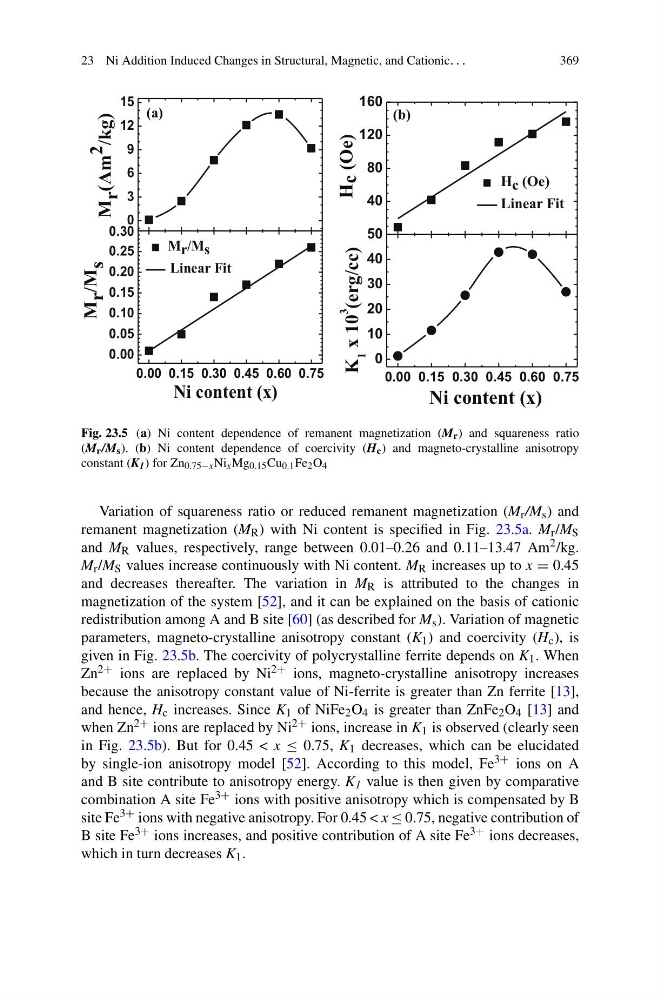
Fig. 23.5 (a) Ni content dependence of remanent magnetization (M r ) and squareness ratio
(M r /M s ). (b) Ni content dependence of coercivity (H c ) and magneto-crystalline anisotropy
constant (K 1 ) for Zn 0.75−x Ni x Mg 0.15 Cu 0.1 Fe 2 O 4
Variation of squareness ratio or reduced remanent magnetization (M r /M s ) and
remanent magnetization (M R ) with Ni content is specified in Fig. 23.5a. M r /M S
and M R values, respectively, range between 0.01–0.26 and 0.11–13.47 Am 2 /kg.
M r /M S values increase continuously with Ni content. M R increases up to x = 0.45
and decreases thereafter. The variation in M R is attributed to the changes in
magnetization of the system [52], and it can be explained on the basis of cationic
redistribution among A and B site [60] (as described for M s ). Variation of magnetic
parameters, magneto-crystalline anisotropy constant (K 1 ) and coercivity (H c ), is
given in Fig. 23.5b. The coercivity of polycrystalline ferrite depends on K 1 . When
Zn 2+ ions are replaced by Ni 2+ ions, magneto-crystalline anisotropy increases
because the anisotropy constant value of Ni-ferrite is greater than Zn ferrite [13],
and hence, H c increases. Since K 1 of NiFe 2 O 4 is greater than ZnFe 2 O 4 [13] and
when Zn 2+ ions are replaced by Ni 2+ ions, increase in K 1 is observed (clearly seen
in Fig. 23.5b). But for 0.45 < x ≤ 0.75, K 1 decreases, which can be elucidated
by single-ion anisotropy model [52]. According to this model, Fe 3+ ions on A
and B site contribute to anisotropy energy. K 1 value is then given by comparative
combination A site Fe 3+ ions with positive anisotropy which is compensated by B
site Fe 3+ ions with negative anisotropy. For 0.45 < x ≤ 0.75, negative contribution of
B site Fe 3+ ions increases, and positive contribution of A site Fe 3+ ions decreases,
which in turn decreases K 1 .
369
0.00 0.15 0.30 0.45 0.60 0.75
0.00
0.05
0.10
0.15
0.20
0.25
0.30
0
3
6
9
12
15
M r /M s
Linear Fit
M
r /M
s
Ni content (x)
(a)
M
r (Am 2
/kg)
0.00 0.15 0.30 0.45 0.60 0.75
0
10
20
30
40
50
40
80
120
160
Ni content (x)
K
1
x 10
3
(erg/cc)
(b)
H c (Oe)
Linear Fit
H
c (Oe)
Fig. 23.5 (a) Ni content dependence of remanent magnetization (M r ) and squareness ratio
(M r /M s ). (b) Ni content dependence of coercivity (H c ) and magneto-crystalline anisotropy
constant (K 1 ) for Zn 0.75−x Ni x Mg 0.15 Cu 0.1 Fe 2 O 4
Variation of squareness ratio or reduced remanent magnetization (M r /M s ) and
remanent magnetization (M R ) with Ni content is specified in Fig. 23.5a. M r /M S
and M R values, respectively, range between 0.01–0.26 and 0.11–13.47 Am 2 /kg.
M r /M S values increase continuously with Ni content. M R increases up to x = 0.45
and decreases thereafter. The variation in M R is attributed to the changes in
magnetization of the system [52], and it can be explained on the basis of cationic
redistribution among A and B site [60] (as described for M s ). Variation of magnetic
parameters, magneto-crystalline anisotropy constant (K 1 ) and coercivity (H c ), is
given in Fig. 23.5b. The coercivity of polycrystalline ferrite depends on K 1 . When
Zn 2+ ions are replaced by Ni 2+ ions, magneto-crystalline anisotropy increases
because the anisotropy constant value of Ni-ferrite is greater than Zn ferrite [13],
and hence, H c increases. Since K 1 of NiFe 2 O 4 is greater than ZnFe 2 O 4 [13] and
when Zn 2+ ions are replaced by Ni 2+ ions, increase in K 1 is observed (clearly seen
in Fig. 23.5b). But for 0.45 < x ≤ 0.75, K 1 decreases, which can be elucidated
by single-ion anisotropy model [52]. According to this model, Fe 3+ ions on A
and B site contribute to anisotropy energy. K 1 value is then given by comparative
combination A site Fe 3+ ions with positive anisotropy which is compensated by B
site Fe 3+ ions with negative anisotropy. For 0.45 < x ≤ 0.75, negative contribution of
B site Fe 3+ ions increases, and positive contribution of A site Fe 3+ ions decreases,
which in turn decreases K 1 .