

368
M. Satalkar et al.
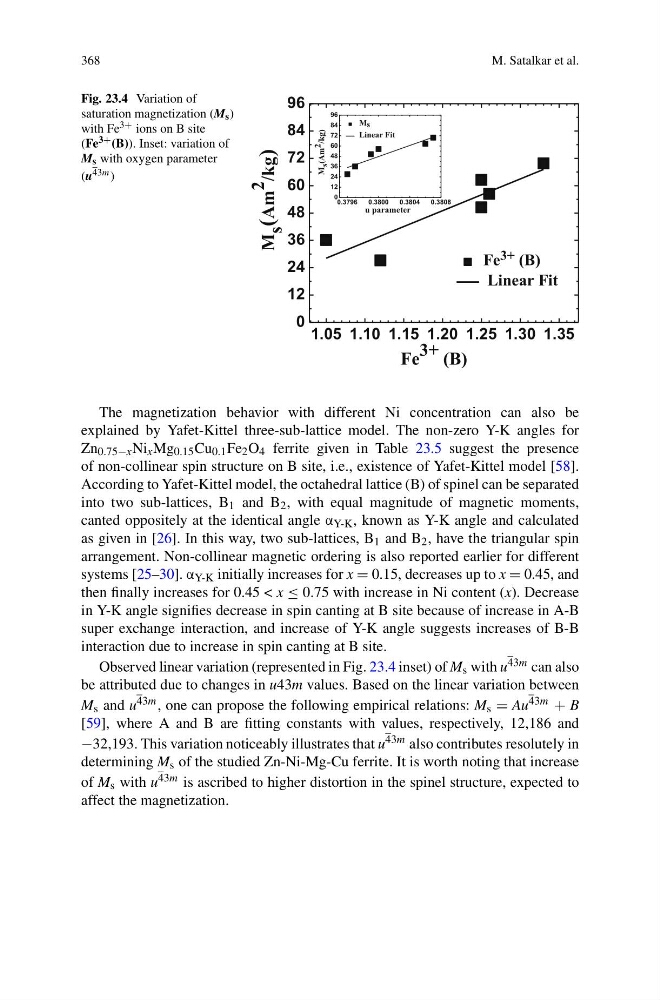
Fig. 23.4 Variation of
saturation magnetization (M s )
with Fe 3+ ions on B site
(Fe 3+ (B)). Inset: variation of
M s with oxygen parameter
(u 43m )
1.05 1.10 1.15 1.20 1.25 1.30 1.35
0
12
24
36
48
60
72
84
96
0.3796
0.3800
0.3804
0.3808
0
12
24
36
48
60
72
84
96
Ms
Linear Fit
M
s (Am 2
/kg)
u parameter
M
s (Am
2
/kg)
Fe 3+ (B)
Linear Fit
Fe
3+ (B)
The magnetization behavior with different Ni concentration can also be
explained by Yafet-Kittel three-sub-lattice model. The non-zero Y-K angles for
Zn 0.75−x Ni x Mg 0.15 Cu 0.1 Fe 2 O 4 ferrite given in Table 23.5 suggest the presence
of non-collinear spin structure on B site, i.e., existence of Yafet-Kittel model [58].
According to Yafet-Kittel model, the octahedral lattice (B) of spinel can be separated
into two sub-lattices, B 1 and B 2 , with equal magnitude of magnetic moments,
canted oppositely at the identical angle α Y-K , known as Y-K angle and calculated
as given in [26]. In this way, two sub-lattices, B 1 and B 2 , have the triangular spin
arrangement. Non-collinear magnetic ordering is also reported earlier for different
systems [25–30]. α Y-K initially increases for x = 0.15, decreases up to x = 0.45, and
then finally increases for 0.45 < x ≤ 0.75 with increase in Ni content (x). Decrease
in Y-K angle signifies decrease in spin canting at B site because of increase in A-B
super exchange interaction, and increase of Y-K angle suggests increases of B-B
interaction due to increase in spin canting at B site.
Observed linear variation (represented in Fig. 23.4 inset) of M s with u 43m can also
be attributed due to changes in u43m values. Based on the linear variation between
M s and u 43m , one can propose the following empirical relations: M s = Au 43m + B
[59], where A and B are fitting constants with values, respectively, 12,186 and
−32,193. This variation noticeably illustrates that u 43m also contributes resolutely in
determining M s of the studied Zn-Ni-Mg-Cu ferrite. It is worth noting that increase
of M s with u 43m is ascribed to higher distortion in the spinel structure, expected to
affect the magnetization.
M. Satalkar et al.
Fig. 23.4 Variation of
saturation magnetization (M s )
with Fe 3+ ions on B site
(Fe 3+ (B)). Inset: variation of
M s with oxygen parameter
(u 43m )
1.05 1.10 1.15 1.20 1.25 1.30 1.35
0
12
24
36
48
60
72
84
96
0.3796
0.3800
0.3804
0.3808
0
12
24
36
48
60
72
84
96
Ms
Linear Fit
M
s (Am 2
/kg)
u parameter
M
s (Am
2
/kg)
Fe 3+ (B)
Linear Fit
Fe
3+ (B)
The magnetization behavior with different Ni concentration can also be
explained by Yafet-Kittel three-sub-lattice model. The non-zero Y-K angles for
Zn 0.75−x Ni x Mg 0.15 Cu 0.1 Fe 2 O 4 ferrite given in Table 23.5 suggest the presence
of non-collinear spin structure on B site, i.e., existence of Yafet-Kittel model [58].
According to Yafet-Kittel model, the octahedral lattice (B) of spinel can be separated
into two sub-lattices, B 1 and B 2 , with equal magnitude of magnetic moments,
canted oppositely at the identical angle α Y-K , known as Y-K angle and calculated
as given in [26]. In this way, two sub-lattices, B 1 and B 2 , have the triangular spin
arrangement. Non-collinear magnetic ordering is also reported earlier for different
systems [25–30]. α Y-K initially increases for x = 0.15, decreases up to x = 0.45, and
then finally increases for 0.45 < x ≤ 0.75 with increase in Ni content (x). Decrease
in Y-K angle signifies decrease in spin canting at B site because of increase in A-B
super exchange interaction, and increase of Y-K angle suggests increases of B-B
interaction due to increase in spin canting at B site.
Observed linear variation (represented in Fig. 23.4 inset) of M s with u 43m can also
be attributed due to changes in u43m values. Based on the linear variation between
M s and u 43m , one can propose the following empirical relations: M s = Au 43m + B
[59], where A and B are fitting constants with values, respectively, 12,186 and
−32,193. This variation noticeably illustrates that u 43m also contributes resolutely in
determining M s of the studied Zn-Ni-Mg-Cu ferrite. It is worth noting that increase
of M s with u 43m is ascribed to higher distortion in the spinel structure, expected to
affect the magnetization.