

328
V. Orel et al.
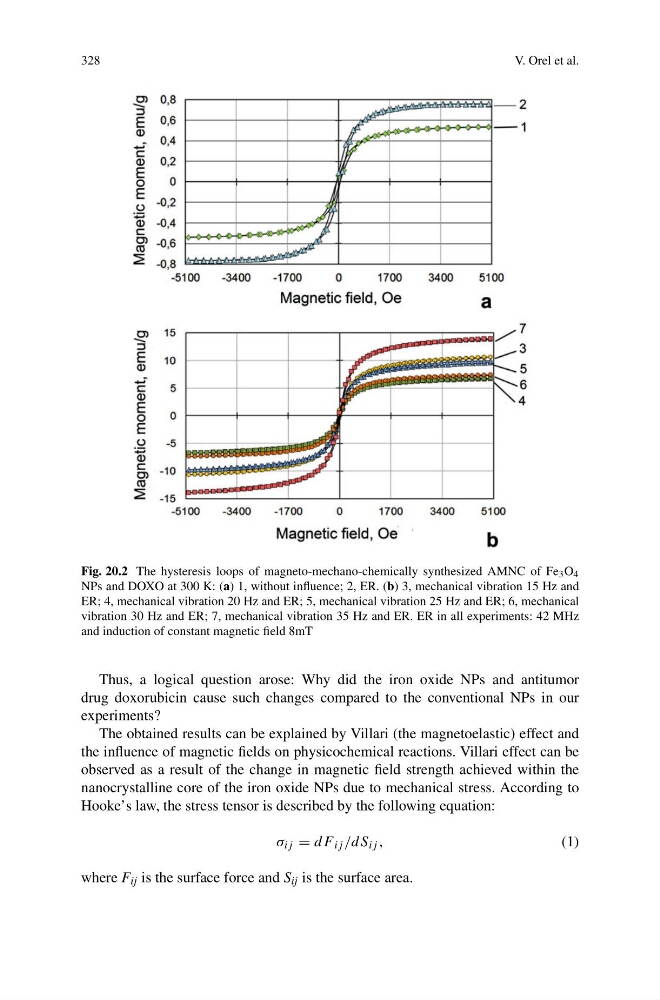
Fig. 20.2 The hysteresis loops of magneto-mechano-chemically synthesized AMNC of Fe 3 O 4
NPs and DOXO at 300 K: (a) 1, without influence; 2, ER. (b) 3, mechanical vibration 15 Hz and
ER; 4, mechanical vibration 20 Hz and ER; 5, mechanical vibration 25 Hz and ER; 6, mechanical
vibration 30 Hz and ER; 7, mechanical vibration 35 Hz and ER. ER in all experiments: 42 MHz
and induction of constant magnetic field 8mT
Thus, a logical question arose: Why did the iron oxide NPs and antitumor
drug doxorubicin cause such changes compared to the conventional NPs in our
experiments?
The obtained results can be explained by Villari (the magnetoelastic) effect and
the influence of magnetic fields on physicochemical reactions. Villari effect can be
observed as a result of the change in magnetic field strength achieved within the
nanocrystalline core of the iron oxide NPs due to mechanical stress. According to
Hooke’s law, the stress tensor is described by the following equation:
σ ij = dF ij /dS ij ,
(1)
where F ij is the surface force and S ij is the surface area.
V. Orel et al.
Fig. 20.2 The hysteresis loops of magneto-mechano-chemically synthesized AMNC of Fe 3 O 4
NPs and DOXO at 300 K: (a) 1, without influence; 2, ER. (b) 3, mechanical vibration 15 Hz and
ER; 4, mechanical vibration 20 Hz and ER; 5, mechanical vibration 25 Hz and ER; 6, mechanical
vibration 30 Hz and ER; 7, mechanical vibration 35 Hz and ER. ER in all experiments: 42 MHz
and induction of constant magnetic field 8mT
Thus, a logical question arose: Why did the iron oxide NPs and antitumor
drug doxorubicin cause such changes compared to the conventional NPs in our
experiments?
The obtained results can be explained by Villari (the magnetoelastic) effect and
the influence of magnetic fields on physicochemical reactions. Villari effect can be
observed as a result of the change in magnetic field strength achieved within the
nanocrystalline core of the iron oxide NPs due to mechanical stress. According to
Hooke’s law, the stress tensor is described by the following equation:
σ ij = dF ij /dS ij ,
(1)
where F ij is the surface force and S ij is the surface area.