

20 Magnetic Memory of Antitumor Magneto-sensitive Nanocomplex
327
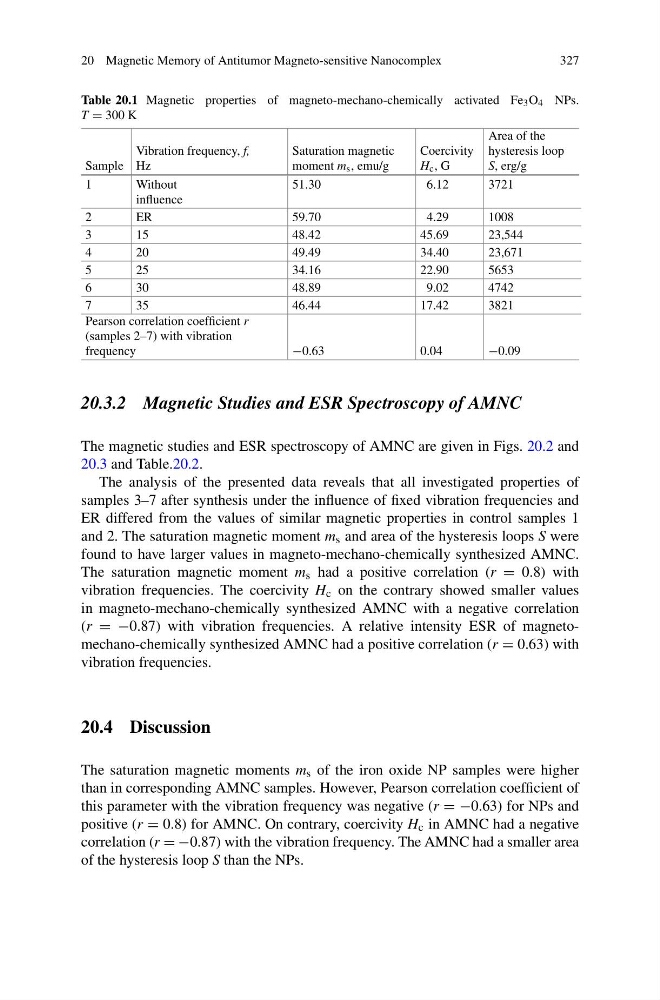
Table 20.1 Magnetic properties of magneto-mechano-chemically activated Fe 3 O 4 NPs.
T = 300 K
Sample
Vibration frequency, f,
Hz
Saturation magnetic
moment m s , emu/g
Coercivity
H c , G
Area of the
hysteresis loop
S, erg/g
1
Without
influence
51.30
6.12
3721
2
ER
59.70
4.29
1008
3
15
48.42
45.69
23,544
4
20
49.49
34.40
23,671
5
25
34.16
22.90
5653
6
30
48.89
9.02
4742
7
35
46.44
17.42
3821
Pearson correlation coefficient r
(samples 2–7) with vibration
frequency
−0.63
0.04
−0.09
20.3.2 Magnetic Studies and ESR Spectroscopy of AMNC
The magnetic studies and ESR spectroscopy of AMNC are given in Figs. 20.2 and
20.3 and Table.20.2.
The analysis of the presented data reveals that all investigated properties of
samples 3–7 after synthesis under the influence of fixed vibration frequencies and
ER differed from the values of similar magnetic properties in control samples 1
and 2. The saturation magnetic moment m s and area of the hysteresis loops S were
found to have larger values in magneto-mechano-chemically synthesized AMNC.
The saturation magnetic moment m s had a positive correlation (r = 0.8) with
vibration frequencies. The coercivity H c on the contrary showed smaller values
in magneto-mechano-chemically synthesized AMNC with a negative correlation
(r = −0.87) with vibration frequencies. A relative intensity ESR of magnetomechano-chemically synthesized AMNC had a positive correlation (r = 0.63) with
vibration frequencies.
20.4 Discussion
The saturation magnetic moments m s of the iron oxide NP samples were higher
than in corresponding AMNC samples. However, Pearson correlation coefficient of
this parameter with the vibration frequency was negative (r = −0.63) for NPs and
positive (r = 0.8) for AMNC. On contrary, coercivity H c in AMNC had a negative
correlation (r = −0.87) with the vibration frequency. The AMNC had a smaller area
of the hysteresis loop S than the NPs.
327
Table 20.1 Magnetic properties of magneto-mechano-chemically activated Fe 3 O 4 NPs.
T = 300 K
Sample
Vibration frequency, f,
Hz
Saturation magnetic
moment m s , emu/g
Coercivity
H c , G
Area of the
hysteresis loop
S, erg/g
1
Without
influence
51.30
6.12
3721
2
ER
59.70
4.29
1008
3
15
48.42
45.69
23,544
4
20
49.49
34.40
23,671
5
25
34.16
22.90
5653
6
30
48.89
9.02
4742
7
35
46.44
17.42
3821
Pearson correlation coefficient r
(samples 2–7) with vibration
frequency
−0.63
0.04
−0.09
20.3.2 Magnetic Studies and ESR Spectroscopy of AMNC
The magnetic studies and ESR spectroscopy of AMNC are given in Figs. 20.2 and
20.3 and Table.20.2.
The analysis of the presented data reveals that all investigated properties of
samples 3–7 after synthesis under the influence of fixed vibration frequencies and
ER differed from the values of similar magnetic properties in control samples 1
and 2. The saturation magnetic moment m s and area of the hysteresis loops S were
found to have larger values in magneto-mechano-chemically synthesized AMNC.
The saturation magnetic moment m s had a positive correlation (r = 0.8) with
vibration frequencies. The coercivity H c on the contrary showed smaller values
in magneto-mechano-chemically synthesized AMNC with a negative correlation
(r = −0.87) with vibration frequencies. A relative intensity ESR of magnetomechano-chemically synthesized AMNC had a positive correlation (r = 0.63) with
vibration frequencies.
20.4 Discussion
The saturation magnetic moments m s of the iron oxide NP samples were higher
than in corresponding AMNC samples. However, Pearson correlation coefficient of
this parameter with the vibration frequency was negative (r = −0.63) for NPs and
positive (r = 0.8) for AMNC. On contrary, coercivity H c in AMNC had a negative
correlation (r = −0.87) with the vibration frequency. The AMNC had a smaller area
of the hysteresis loop S than the NPs.