

20 Magnetic Memory of Antitumor Magneto-sensitive Nanocomplex
329
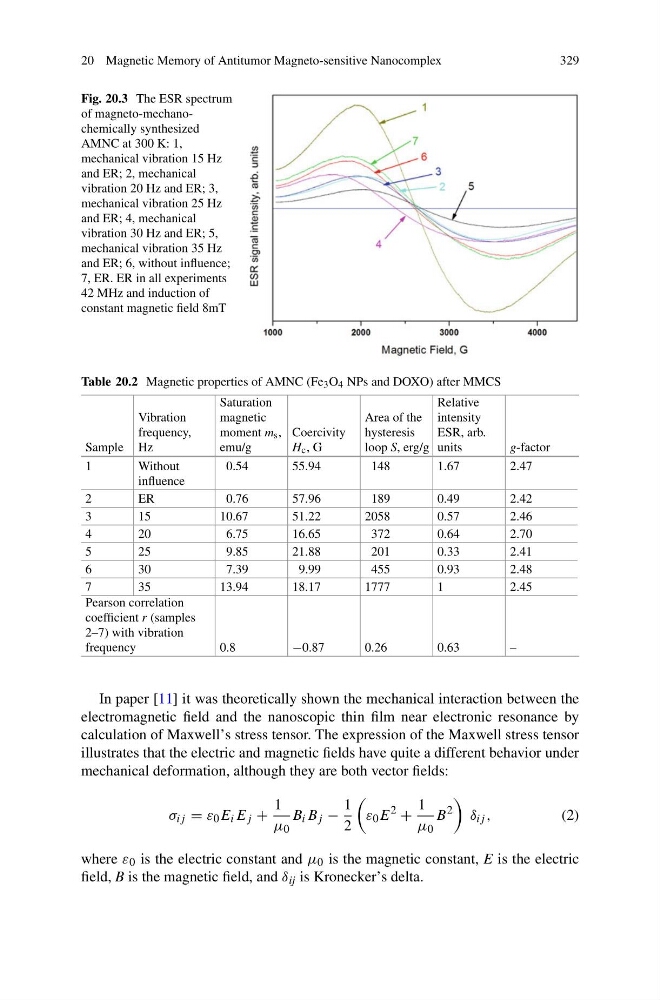
Fig. 20.3 The ESR spectrum
of magneto-mechanochemically synthesized
AMNC at 300 K: 1,
mechanical vibration 15 Hz
and ER; 2, mechanical
vibration 20 Hz and ER; 3,
mechanical vibration 25 Hz
and ER; 4, mechanical
vibration 30 Hz and ER; 5,
mechanical vibration 35 Hz
and ER; 6, without influence;
7, ER. ER in all experiments
42 MHz and induction of
constant magnetic field 8mT
Table 20.2 Magnetic properties of AMNC (Fe 3 O 4 NPs and DOXO) after MMCS
Sample
Vibration
frequency,
Hz
Saturation
magnetic
moment m s ,
emu/g
Coercivity
H c , G
Area of the
hysteresis
loop S, erg/g
Relative
intensity
ESR, arb.
units
g-factor
1
Without
influence
0.54
55.94
148
1.67
2.47
2
ER
0.76
57.96
189
0.49
2.42
3
15
10.67
51.22
2058
0.57
2.46
4
20
6.75
16.65
372
0.64
2.70
5
25
9.85
21.88
201
0.33
2.41
6
30
7.39
9.99
455
0.93
2.48
7
35
13.94
18.17
1777
1
2.45
Pearson correlation
coefficient r (samples
2–7) with vibration
frequency
0.8
−0.87
0.26
0.63
–
In paper [11] it was theoretically shown the mechanical interaction between the
electromagnetic field and the nanoscopic thin film near electronic resonance by
calculation of Maxwell’s stress tensor. The expression of the Maxwell stress tensor
illustrates that the electric and magnetic fields have quite a different behavior under
mechanical deformation, although they are both vector fields:
σ ij = ε 0 E i E j +
1
μ 0
B i B j −
1
2
ε 0 E
2
+
1
μ 0
B
2
δ ij ,
(2)
where ε 0 is the electric constant and μ 0 is the magnetic constant, E is the electric
field, B is the magnetic field, and δ ij is Kronecker’s delta.
329
Fig. 20.3 The ESR spectrum
of magneto-mechanochemically synthesized
AMNC at 300 K: 1,
mechanical vibration 15 Hz
and ER; 2, mechanical
vibration 20 Hz and ER; 3,
mechanical vibration 25 Hz
and ER; 4, mechanical
vibration 30 Hz and ER; 5,
mechanical vibration 35 Hz
and ER; 6, without influence;
7, ER. ER in all experiments
42 MHz and induction of
constant magnetic field 8mT
Table 20.2 Magnetic properties of AMNC (Fe 3 O 4 NPs and DOXO) after MMCS
Sample
Vibration
frequency,
Hz
Saturation
magnetic
moment m s ,
emu/g
Coercivity
H c , G
Area of the
hysteresis
loop S, erg/g
Relative
intensity
ESR, arb.
units
g-factor
1
Without
influence
0.54
55.94
148
1.67
2.47
2
ER
0.76
57.96
189
0.49
2.42
3
15
10.67
51.22
2058
0.57
2.46
4
20
6.75
16.65
372
0.64
2.70
5
25
9.85
21.88
201
0.33
2.41
6
30
7.39
9.99
455
0.93
2.48
7
35
13.94
18.17
1777
1
2.45
Pearson correlation
coefficient r (samples
2–7) with vibration
frequency
0.8
−0.87
0.26
0.63
–
In paper [11] it was theoretically shown the mechanical interaction between the
electromagnetic field and the nanoscopic thin film near electronic resonance by
calculation of Maxwell’s stress tensor. The expression of the Maxwell stress tensor
illustrates that the electric and magnetic fields have quite a different behavior under
mechanical deformation, although they are both vector fields:
σ ij = ε 0 E i E j +
1
μ 0
B i B j −
1
2
ε 0 E
2
+
1
μ 0
B
2
δ ij ,
(2)
where ε 0 is the electric constant and μ 0 is the magnetic constant, E is the electric
field, B is the magnetic field, and δ ij is Kronecker’s delta.