

316
V. Malyshev et al.
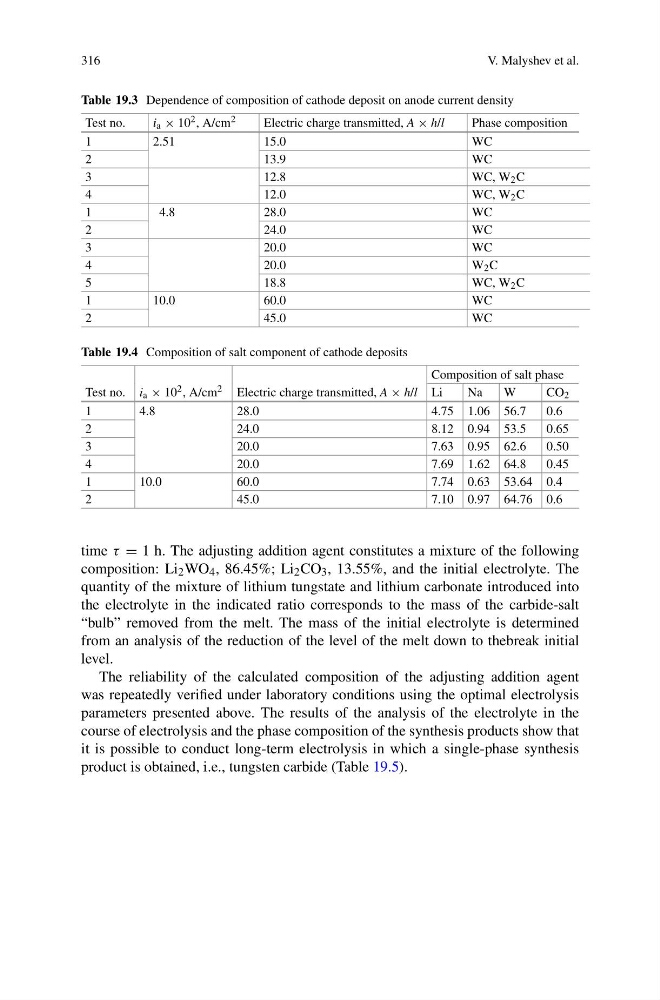
Table 19.3 Dependence of composition of cathode deposit on anode current density
Test no.
i a × 10 2 , A/cm 2
Electric charge transmitted, A × h/l
Phase composition
1
2.51
15.0
WC
2
13.9
WC
3
12.8
WC, W 2 C
4
12.0
WC, W 2 C
1
4.8
28.0
WC
2
24.0
WC
3
20.0
WC
4
20.0
W 2 C
5
18.8
WC, W 2 C
1
10.0
60.0
WC
2
45.0
WC
Table 19.4 Composition of salt component of cathode deposits
Composition of salt phase
Test no. i a × 10 2 , A/cm 2 Electric charge transmitted, A × h/l Li
Na
W
CO 2
1
4.8
28.0
4.75 1.06 56.7
0.6
2
24.0
8.12 0.94 53.5
0.65
3
20.0
7.63 0.95 62.6
0.50
4
20.0
7.69 1.62 64.8
0.45
1
10.0
60.0
7.74 0.63 53.64 0.4
2
45.0
7.10 0.97 64.76 0.6
time τ = 1 h. The adjusting addition agent constitutes a mixture of the following
composition: Li 2 WO 4 , 86.45%; Li 2 CO 3 , 13.55%, and the initial electrolyte. The
quantity of the mixture of lithium tungstate and lithium carbonate introduced into
the electrolyte in the indicated ratio corresponds to the mass of the carbide-salt
“bulb” removed from the melt. The mass of the initial electrolyte is determined
from an analysis of the reduction of the level of the melt down to thebreak initial
level.
The reliability of the calculated composition of the adjusting addition agent
was repeatedly verified under laboratory conditions using the optimal electrolysis
parameters presented above. The results of the analysis of the electrolyte in the
course of electrolysis and the phase composition of the synthesis products show that
it is possible to conduct long-term electrolysis in which a single-phase synthesis
product is obtained, i.e., tungsten carbide (Table 19.5).
V. Malyshev et al.
Table 19.3 Dependence of composition of cathode deposit on anode current density
Test no.
i a × 10 2 , A/cm 2
Electric charge transmitted, A × h/l
Phase composition
1
2.51
15.0
WC
2
13.9
WC
3
12.8
WC, W 2 C
4
12.0
WC, W 2 C
1
4.8
28.0
WC
2
24.0
WC
3
20.0
WC
4
20.0
W 2 C
5
18.8
WC, W 2 C
1
10.0
60.0
WC
2
45.0
WC
Table 19.4 Composition of salt component of cathode deposits
Composition of salt phase
Test no. i a × 10 2 , A/cm 2 Electric charge transmitted, A × h/l Li
Na
W
CO 2
1
4.8
28.0
4.75 1.06 56.7
0.6
2
24.0
8.12 0.94 53.5
0.65
3
20.0
7.63 0.95 62.6
0.50
4
20.0
7.69 1.62 64.8
0.45
1
10.0
60.0
7.74 0.63 53.64 0.4
2
45.0
7.10 0.97 64.76 0.6
time τ = 1 h. The adjusting addition agent constitutes a mixture of the following
composition: Li 2 WO 4 , 86.45%; Li 2 CO 3 , 13.55%, and the initial electrolyte. The
quantity of the mixture of lithium tungstate and lithium carbonate introduced into
the electrolyte in the indicated ratio corresponds to the mass of the carbide-salt
“bulb” removed from the melt. The mass of the initial electrolyte is determined
from an analysis of the reduction of the level of the melt down to thebreak initial
level.
The reliability of the calculated composition of the adjusting addition agent
was repeatedly verified under laboratory conditions using the optimal electrolysis
parameters presented above. The results of the analysis of the electrolyte in the
course of electrolysis and the phase composition of the synthesis products show that
it is possible to conduct long-term electrolysis in which a single-phase synthesis
product is obtained, i.e., tungsten carbide (Table 19.5).