

19 High-Temperature Electrochemical Synthesis of Nanopowders. . .
317
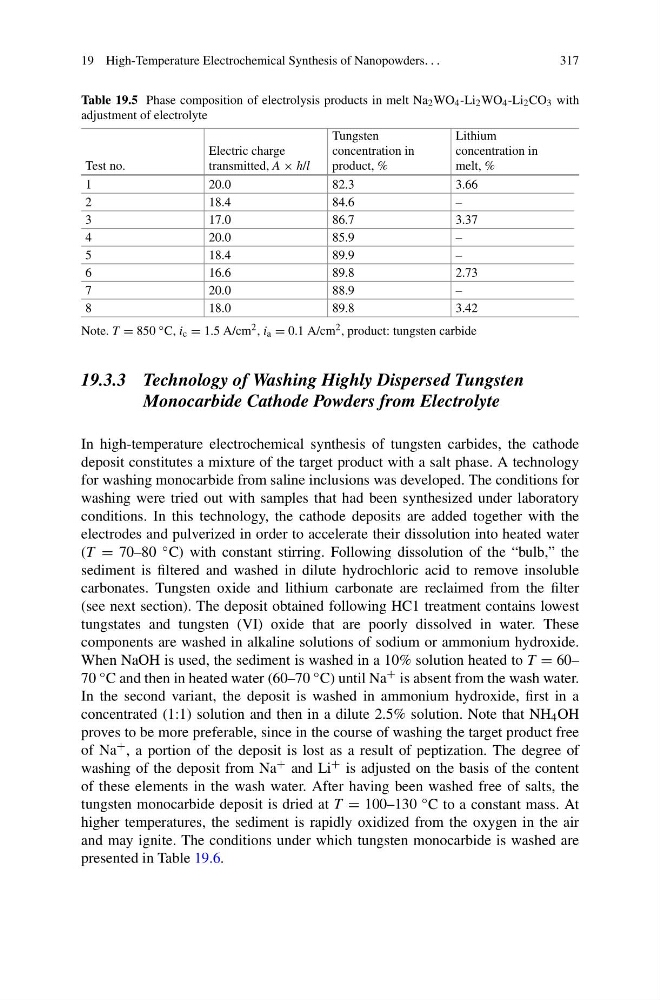
Table 19.5 Phase composition of electrolysis products in melt Na 2 WO 4 -Li 2 WO 4 -Li 2 CO 3 with
adjustment of electrolyte
Test no.
Electric charge
transmitted, A × h/l
Tungsten
concentration in
product, %
Lithium
concentration in
melt, %
1
20.0
82.3
3.66
2
18.4
84.6
–
3
17.0
86.7
3.37
4
20.0
85.9
–
5
18.4
89.9
–
6
16.6
89.8
2.73
7
20.0
88.9
–
8
18.0
89.8
3.42
Note. T = 850 ◦ C, i c = 1.5 A/cm 2 , i a = 0.1 A/cm 2 , product: tungsten carbide
19.3.3 Technology of Washing Highly Dispersed Tungsten
Monocarbide Cathode Powders from Electrolyte
In high-temperature electrochemical synthesis of tungsten carbides, the cathode
deposit constitutes a mixture of the target product with a salt phase. A technology
for washing monocarbide from saline inclusions was developed. The conditions for
washing were tried out with samples that had been synthesized under laboratory
conditions. In this technology, the cathode deposits are added together with the
electrodes and pulverized in order to accelerate their dissolution into heated water
(T = 70–80 ◦ C) with constant stirring. Following dissolution of the “bulb,” the
sediment is filtered and washed in dilute hydrochloric acid to remove insoluble
carbonates. Tungsten oxide and lithium carbonate are reclaimed from the filter
(see next section). The deposit obtained following HC1 treatment contains lowest
tungstates and tungsten (VI) oxide that are poorly dissolved in water. These
components are washed in alkaline solutions of sodium or ammonium hydroxide.
When NaOH is used, the sediment is washed in a 10% solution heated to T = 60–
70 ◦ C and then in heated water (60–70 ◦ C) until Na + is absent from the wash water.
In the second variant, the deposit is washed in ammonium hydroxide, first in a
concentrated (1:1) solution and then in a dilute 2.5% solution. Note that NH 4 OH
proves to be more preferable, since in the course of washing the target product free
of Na + , a portion of the deposit is lost as a result of peptization. The degree of
washing of the deposit from Na + and Li + is adjusted on the basis of the content
of these elements in the wash water. After having been washed free of salts, the
tungsten monocarbide deposit is dried at T = 100–130 ◦ C to a constant mass. At
higher temperatures, the sediment is rapidly oxidized from the oxygen in the air
and may ignite. The conditions under which tungsten monocarbide is washed are
presented in Table 19.6.
317
Table 19.5 Phase composition of electrolysis products in melt Na 2 WO 4 -Li 2 WO 4 -Li 2 CO 3 with
adjustment of electrolyte
Test no.
Electric charge
transmitted, A × h/l
Tungsten
concentration in
product, %
Lithium
concentration in
melt, %
1
20.0
82.3
3.66
2
18.4
84.6
–
3
17.0
86.7
3.37
4
20.0
85.9
–
5
18.4
89.9
–
6
16.6
89.8
2.73
7
20.0
88.9
–
8
18.0
89.8
3.42
Note. T = 850 ◦ C, i c = 1.5 A/cm 2 , i a = 0.1 A/cm 2 , product: tungsten carbide
19.3.3 Technology of Washing Highly Dispersed Tungsten
Monocarbide Cathode Powders from Electrolyte
In high-temperature electrochemical synthesis of tungsten carbides, the cathode
deposit constitutes a mixture of the target product with a salt phase. A technology
for washing monocarbide from saline inclusions was developed. The conditions for
washing were tried out with samples that had been synthesized under laboratory
conditions. In this technology, the cathode deposits are added together with the
electrodes and pulverized in order to accelerate their dissolution into heated water
(T = 70–80 ◦ C) with constant stirring. Following dissolution of the “bulb,” the
sediment is filtered and washed in dilute hydrochloric acid to remove insoluble
carbonates. Tungsten oxide and lithium carbonate are reclaimed from the filter
(see next section). The deposit obtained following HC1 treatment contains lowest
tungstates and tungsten (VI) oxide that are poorly dissolved in water. These
components are washed in alkaline solutions of sodium or ammonium hydroxide.
When NaOH is used, the sediment is washed in a 10% solution heated to T = 60–
70 ◦ C and then in heated water (60–70 ◦ C) until Na + is absent from the wash water.
In the second variant, the deposit is washed in ammonium hydroxide, first in a
concentrated (1:1) solution and then in a dilute 2.5% solution. Note that NH 4 OH
proves to be more preferable, since in the course of washing the target product free
of Na + , a portion of the deposit is lost as a result of peptization. The degree of
washing of the deposit from Na + and Li + is adjusted on the basis of the content
of these elements in the wash water. After having been washed free of salts, the
tungsten monocarbide deposit is dried at T = 100–130 ◦ C to a constant mass. At
higher temperatures, the sediment is rapidly oxidized from the oxygen in the air
and may ignite. The conditions under which tungsten monocarbide is washed are
presented in Table 19.6.