

308
V. A. Zazhigalov et al.
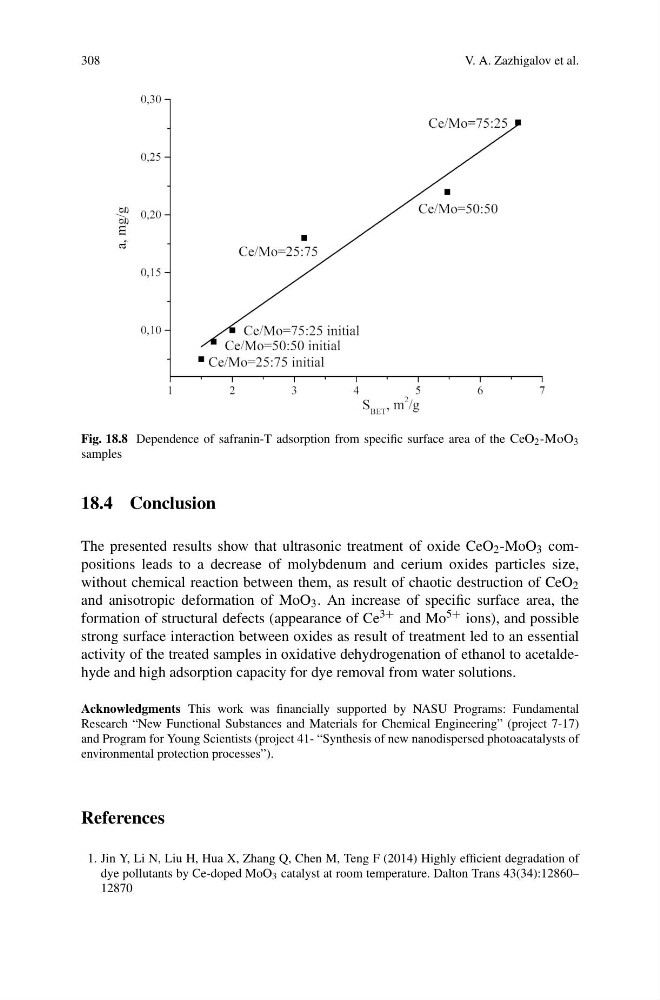
Fig. 18.8 Dependence of safranin-T adsorption from specific surface area of the ´È± 2 -¯Ñ± 3
samples
18.4 Conclusion
The presented results show that ultrasonic treatment of oxide CeO 2 -MoO 3 compositions leads to a decrease of molybdenum and cerium oxides particles size,
without chemical reaction between them, as result of chaotic destruction of CeO 2
and anisotropic deformation of MoO 3 . An increase of specific surface area, the
formation of structural defects (appearance of Ce 3+ and Mo 5+ ions), and possible
strong surface interaction between oxides as result of treatment led to an essential
activity of the treated samples in oxidative dehydrogenation of ethanol to acetaldehyde and high adsorption capacity for dye removal from water solutions.
Acknowledgments This work was financially supported by NASU Programs: Fundamental
Research “New Functional Substances and Materials for Chemical Engineering” (project 7-17)
and Program for Young Scientists (project 41- “Synthesis of new nanodispersed photoacatalysts of
environmental protection processes”).
References
1. Jin Y, Li N, Liu H, Hua X, Zhang Q, Chen M, Teng F (2014) Highly efficient degradation of
dye pollutants by Ce-doped MoO 3 catalyst at room temperature. Dalton Trans 43(34):12860–
12870
V. A. Zazhigalov et al.
Fig. 18.8 Dependence of safranin-T adsorption from specific surface area of the ´È± 2 -¯Ñ± 3
samples
18.4 Conclusion
The presented results show that ultrasonic treatment of oxide CeO 2 -MoO 3 compositions leads to a decrease of molybdenum and cerium oxides particles size,
without chemical reaction between them, as result of chaotic destruction of CeO 2
and anisotropic deformation of MoO 3 . An increase of specific surface area, the
formation of structural defects (appearance of Ce 3+ and Mo 5+ ions), and possible
strong surface interaction between oxides as result of treatment led to an essential
activity of the treated samples in oxidative dehydrogenation of ethanol to acetaldehyde and high adsorption capacity for dye removal from water solutions.
Acknowledgments This work was financially supported by NASU Programs: Fundamental
Research “New Functional Substances and Materials for Chemical Engineering” (project 7-17)
and Program for Young Scientists (project 41- “Synthesis of new nanodispersed photoacatalysts of
environmental protection processes”).
References
1. Jin Y, Li N, Liu H, Hua X, Zhang Q, Chen M, Teng F (2014) Highly efficient degradation of
dye pollutants by Ce-doped MoO 3 catalyst at room temperature. Dalton Trans 43(34):12860–
12870