

10
M. V. Ved’ et al.
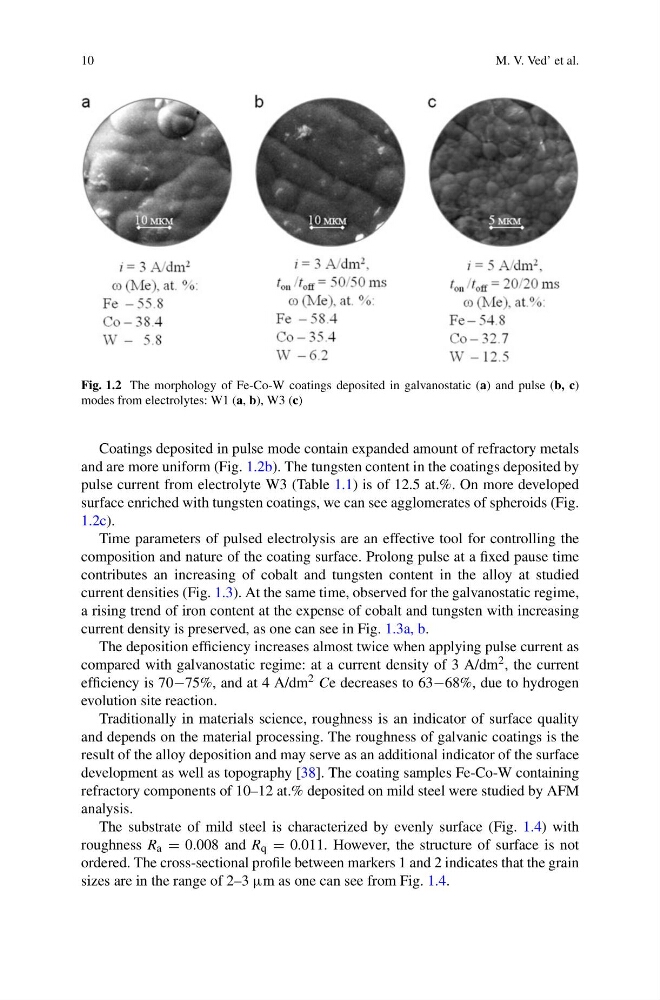
Fig. 1.2 The morphology of Fe-Co-W coatings deposited in galvanostatic (a) and pulse (b, c)
modes from electrolytes: W1 (a, b), W3 (c)
Coatings deposited in pulse mode contain expanded amount of refractory metals
and are more uniform (Fig. 1.2b). The tungsten content in the coatings deposited by
pulse current from electrolyte W3 (Table 1.1) is of 12.5 at.%. On more developed
surface enriched with tungsten coatings, we can see agglomerates of spheroids (Fig.
1.2c).
Time parameters of pulsed electrolysis are an effective tool for controlling the
composition and nature of the coating surface. Prolong pulse at a fixed pause time
contributes an increasing of cobalt and tungsten content in the alloy at studied
current densities (Fig. 1.3). At the same time, observed for the galvanostatic regime,
a rising trend of iron content at the expense of cobalt and tungsten with increasing
current density is preserved, as one can see in Fig. 1.3a, b.
The deposition efficiency increases almost twice when applying pulse current as
compared with galvanostatic regime: at a current density of 3 A/dm 2 , the current
efficiency is 70−75%, and at 4 A/dm 2 Ce decreases to 63−68%, due to hydrogen
evolution site reaction.
Traditionally in materials science, roughness is an indicator of surface quality
and depends on the material processing. The roughness of galvanic coatings is the
result of the alloy deposition and may serve as an additional indicator of the surface
development as well as topography [38]. The coating samples Fe-Co-W containing
refractory components of 10–12 at.% deposited on mild steel were studied by AFM
analysis.
The substrate of mild steel is characterized by evenly surface (Fig. 1.4) with
roughness R a = 0.008 and R q = 0.011. However, the structure of surface is not
ordered. The cross-sectional profile between markers 1 and 2 indicates that the grain
sizes are in the range of 2–3 μm as one can see from Fig. 1.4.
M. V. Ved’ et al.
Fig. 1.2 The morphology of Fe-Co-W coatings deposited in galvanostatic (a) and pulse (b, c)
modes from electrolytes: W1 (a, b), W3 (c)
Coatings deposited in pulse mode contain expanded amount of refractory metals
and are more uniform (Fig. 1.2b). The tungsten content in the coatings deposited by
pulse current from electrolyte W3 (Table 1.1) is of 12.5 at.%. On more developed
surface enriched with tungsten coatings, we can see agglomerates of spheroids (Fig.
1.2c).
Time parameters of pulsed electrolysis are an effective tool for controlling the
composition and nature of the coating surface. Prolong pulse at a fixed pause time
contributes an increasing of cobalt and tungsten content in the alloy at studied
current densities (Fig. 1.3). At the same time, observed for the galvanostatic regime,
a rising trend of iron content at the expense of cobalt and tungsten with increasing
current density is preserved, as one can see in Fig. 1.3a, b.
The deposition efficiency increases almost twice when applying pulse current as
compared with galvanostatic regime: at a current density of 3 A/dm 2 , the current
efficiency is 70−75%, and at 4 A/dm 2 Ce decreases to 63−68%, due to hydrogen
evolution site reaction.
Traditionally in materials science, roughness is an indicator of surface quality
and depends on the material processing. The roughness of galvanic coatings is the
result of the alloy deposition and may serve as an additional indicator of the surface
development as well as topography [38]. The coating samples Fe-Co-W containing
refractory components of 10–12 at.% deposited on mild steel were studied by AFM
analysis.
The substrate of mild steel is characterized by evenly surface (Fig. 1.4) with
roughness R a = 0.008 and R q = 0.011. However, the structure of surface is not
ordered. The cross-sectional profile between markers 1 and 2 indicates that the grain
sizes are in the range of 2–3 μm as one can see from Fig. 1.4.