

1 Nanostructured Functional Coatings of Iron Family Metals with Refractory. . .
11
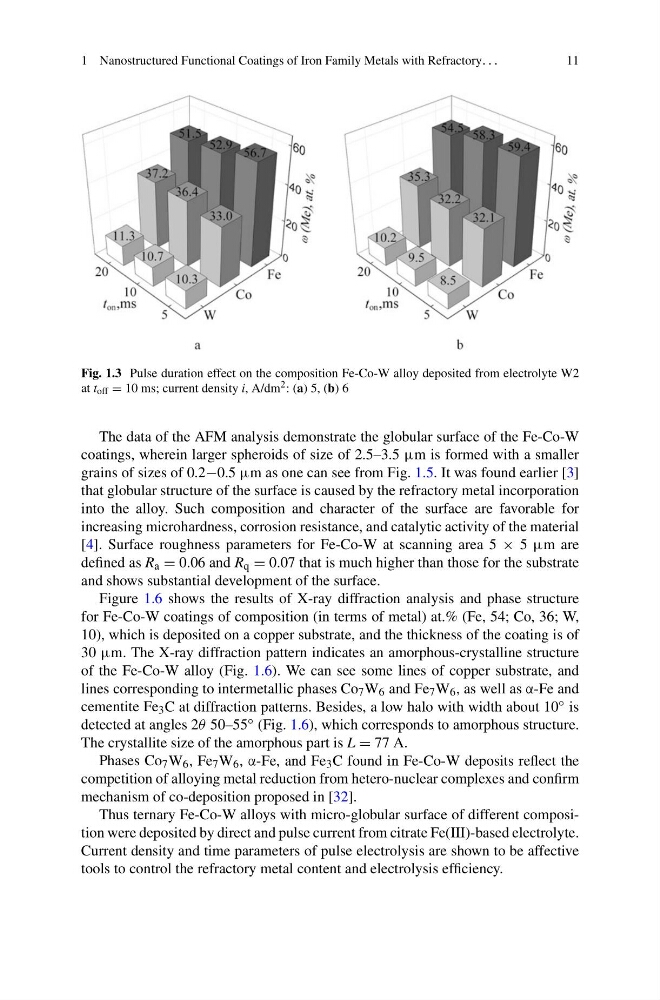
Fig. 1.3 Pulse duration effect on the composition Fe-Co-W alloy deposited from electrolyte W2
at t off = 10 ms; current density i, A/dm 2 : (a) 5, (b) 6
The data of the AFM analysis demonstrate the globular surface of the Fe-Co-W
coatings, wherein larger spheroids of size of 2.5–3.5 μm is formed with a smaller
grains of sizes of 0.2−0.5 μm as one can see from Fig. 1.5. It was found earlier [3]
that globular structure of the surface is caused by the refractory metal incorporation
into the alloy. Such composition and character of the surface are favorable for
increasing microhardness, corrosion resistance, and catalytic activity of the material
[4]. Surface roughness parameters for Fe-Co-W at scanning area 5 × 5 μm are
defined as R a = 0.06 and R q = 0.07 that is much higher than those for the substrate
and shows substantial development of the surface.
Figure 1.6 shows the results of X-ray diffraction analysis and phase structure
for Fe-Co-W coatings of composition (in terms of metal) at.% (Fe, 54; Co, 36; W,
10), which is deposited on a copper substrate, and the thickness of the coating is of
30 μm. The X-ray diffraction pattern indicates an amorphous-crystalline structure
of the Fe-Co-W alloy (Fig. 1.6). We can see some lines of copper substrate, and
lines corresponding to intermetallic phases Co 7 W 6 and Fe 7 W 6 , as well as α-Fe and
cementite Fe 3 C at diffraction patterns. Besides, a low halo with width about 10 ◦ is
detected at angles 2θ 50–55 ◦ (Fig. 1.6), which corresponds to amorphous structure.
The crystallite size of the amorphous part is L = 77 A.
Phases Co 7 W 6 , Fe 7 W 6 , α-Fe, and Fe 3 C found in Fe-Co-W deposits reflect the
competition of alloying metal reduction from hetero-nuclear complexes and confirm
mechanism of co-deposition proposed in [32].
Thus ternary Fe-Co-W alloys with micro-globular surface of different composition were deposited by direct and pulse current from citrate Fe(III)-based electrolyte.
Current density and time parameters of pulse electrolysis are shown to be affective
tools to control the refractory metal content and electrolysis efficiency.
11
Fig. 1.3 Pulse duration effect on the composition Fe-Co-W alloy deposited from electrolyte W2
at t off = 10 ms; current density i, A/dm 2 : (a) 5, (b) 6
The data of the AFM analysis demonstrate the globular surface of the Fe-Co-W
coatings, wherein larger spheroids of size of 2.5–3.5 μm is formed with a smaller
grains of sizes of 0.2−0.5 μm as one can see from Fig. 1.5. It was found earlier [3]
that globular structure of the surface is caused by the refractory metal incorporation
into the alloy. Such composition and character of the surface are favorable for
increasing microhardness, corrosion resistance, and catalytic activity of the material
[4]. Surface roughness parameters for Fe-Co-W at scanning area 5 × 5 μm are
defined as R a = 0.06 and R q = 0.07 that is much higher than those for the substrate
and shows substantial development of the surface.
Figure 1.6 shows the results of X-ray diffraction analysis and phase structure
for Fe-Co-W coatings of composition (in terms of metal) at.% (Fe, 54; Co, 36; W,
10), which is deposited on a copper substrate, and the thickness of the coating is of
30 μm. The X-ray diffraction pattern indicates an amorphous-crystalline structure
of the Fe-Co-W alloy (Fig. 1.6). We can see some lines of copper substrate, and
lines corresponding to intermetallic phases Co 7 W 6 and Fe 7 W 6 , as well as α-Fe and
cementite Fe 3 C at diffraction patterns. Besides, a low halo with width about 10 ◦ is
detected at angles 2θ 50–55 ◦ (Fig. 1.6), which corresponds to amorphous structure.
The crystallite size of the amorphous part is L = 77 A.
Phases Co 7 W 6 , Fe 7 W 6 , α-Fe, and Fe 3 C found in Fe-Co-W deposits reflect the
competition of alloying metal reduction from hetero-nuclear complexes and confirm
mechanism of co-deposition proposed in [32].
Thus ternary Fe-Co-W alloys with micro-globular surface of different composition were deposited by direct and pulse current from citrate Fe(III)-based electrolyte.
Current density and time parameters of pulse electrolysis are shown to be affective
tools to control the refractory metal content and electrolysis efficiency.