

1 Nanostructured Functional Coatings of Iron Family Metals with Refractory. . .
9
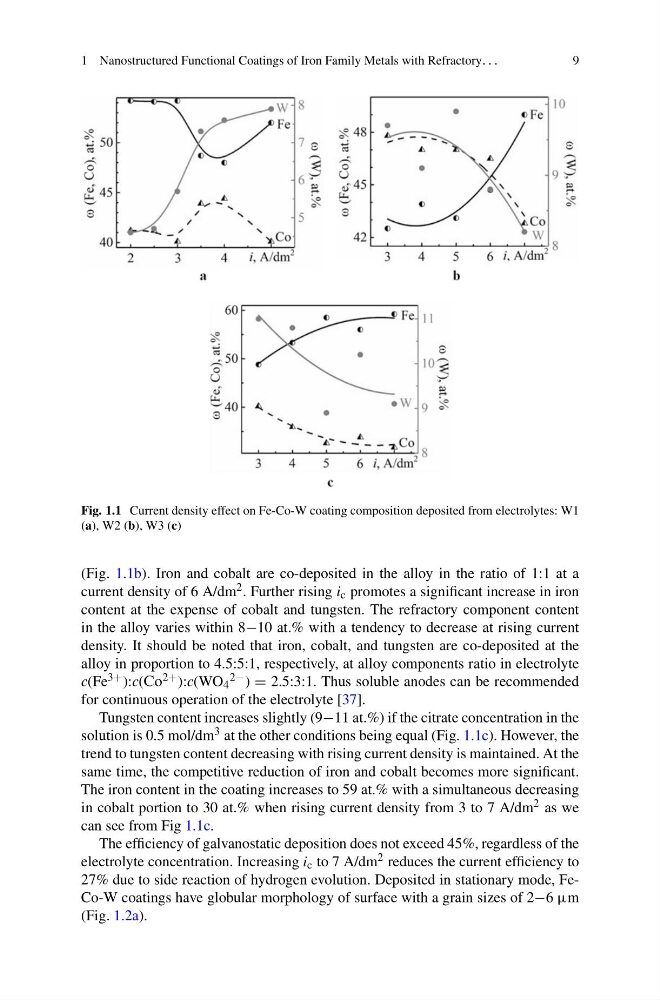
Fig. 1.1 Current density effect on Fe-Co-W coating composition deposited from electrolytes: W1
(a), W2 (b), W3 (c)
(Fig. 1.1b). Iron and cobalt are co-deposited in the alloy in the ratio of 1:1 at a
current density of 6 A/dm 2 . Further rising i c promotes a significant increase in iron
content at the expense of cobalt and tungsten. The refractory component content
in the alloy varies within 8−10 at.% with a tendency to decrease at rising current
density. It should be noted that iron, cobalt, and tungsten are co-deposited at the
alloy in proportion to 4.5:5:1, respectively, at alloy components ratio in electrolyte
Ô(Fe 3+ ):Ô(´Ñ 2+ ):Ô(WO 4
2− ) = 2.5:3:1. Thus soluble anodes can be recommended
for continuous operation of the electrolyte [37].
Tungsten content increases slightly (9−11 at.%) if the citrate concentration in the
solution is 0.5 mol/dm 3 at the other conditions being equal (Fig. 1.1c). However, the
trend to tungsten content decreasing with rising current density is maintained. At the
same time, the competitive reduction of iron and cobalt becomes more significant.
The iron content in the coating increases to 59 at.% with a simultaneous decreasing
in cobalt portion to 30 at.% when rising current density from 3 to 7 A/dm 2 as we
can see from Fig 1.1c.
The efficiency of galvanostatic deposition does not exceed 45%, regardless of the
electrolyte concentration. Increasing i c to 7 A/dm 2 reduces the current efficiency to
27% due to side reaction of hydrogen evolution. Deposited in stationary mode, FeCo-W coatings have globular morphology of surface with a grain sizes of 2−6 μm
(Fig. 1.2a).
9
Fig. 1.1 Current density effect on Fe-Co-W coating composition deposited from electrolytes: W1
(a), W2 (b), W3 (c)
(Fig. 1.1b). Iron and cobalt are co-deposited in the alloy in the ratio of 1:1 at a
current density of 6 A/dm 2 . Further rising i c promotes a significant increase in iron
content at the expense of cobalt and tungsten. The refractory component content
in the alloy varies within 8−10 at.% with a tendency to decrease at rising current
density. It should be noted that iron, cobalt, and tungsten are co-deposited at the
alloy in proportion to 4.5:5:1, respectively, at alloy components ratio in electrolyte
Ô(Fe 3+ ):Ô(´Ñ 2+ ):Ô(WO 4
2− ) = 2.5:3:1. Thus soluble anodes can be recommended
for continuous operation of the electrolyte [37].
Tungsten content increases slightly (9−11 at.%) if the citrate concentration in the
solution is 0.5 mol/dm 3 at the other conditions being equal (Fig. 1.1c). However, the
trend to tungsten content decreasing with rising current density is maintained. At the
same time, the competitive reduction of iron and cobalt becomes more significant.
The iron content in the coating increases to 59 at.% with a simultaneous decreasing
in cobalt portion to 30 at.% when rising current density from 3 to 7 A/dm 2 as we
can see from Fig 1.1c.
The efficiency of galvanostatic deposition does not exceed 45%, regardless of the
electrolyte concentration. Increasing i c to 7 A/dm 2 reduces the current efficiency to
27% due to side reaction of hydrogen evolution. Deposited in stationary mode, FeCo-W coatings have globular morphology of surface with a grain sizes of 2−6 μm
(Fig. 1.2a).