

12 Mechanical and Thermal Characteristics of Irradiation Cross-linked Hydrogels
209
Fig. 12.2 SEM image of
radiation cross-linked PVA
hydrogel
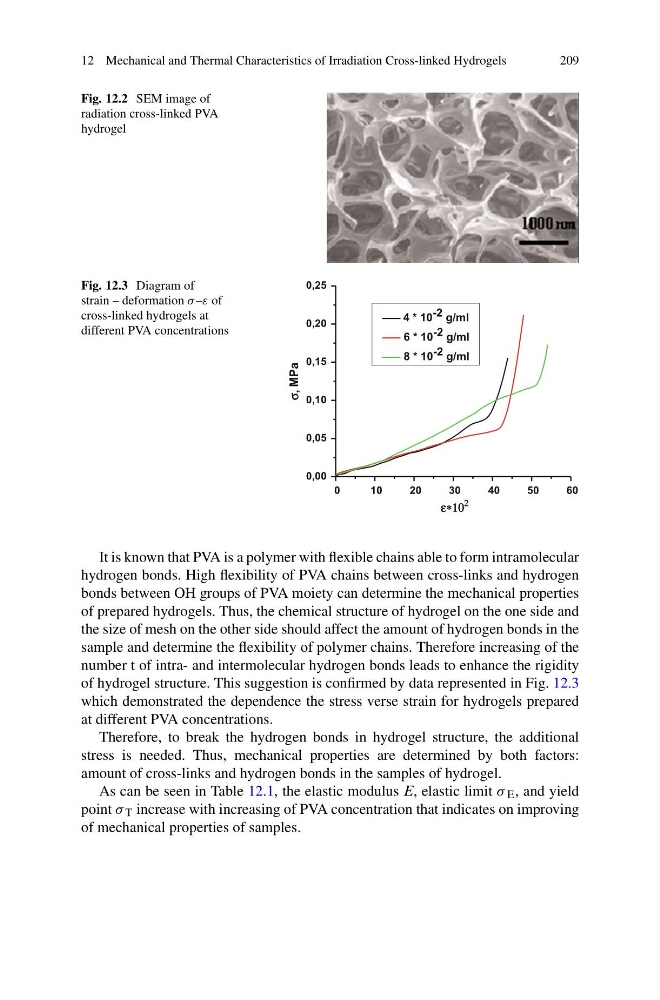
Fig. 12.3 Diagram of
strain – deformation σ –ε of
cross-linked hydrogels at
different PVA concentrations
0
1 0
2 0
3 0
4 0
5 0
6 0
0,00
0,05
0,10
0,15
0,20
0,25
4 * 10 -2 g/ml
6 * 10 -2 g/ml
8 * 10 -2 g/ml
s, MPa
e*10
2
It is known that PVA is a polymer with flexible chains able to form intramolecular
hydrogen bonds. High flexibility of PVA chains between cross-links and hydrogen
bonds between OH groups of PVA moiety can determine the mechanical properties
of prepared hydrogels. Thus, the chemical structure of hydrogel on the one side and
the size of mesh on the other side should affect the amount of hydrogen bonds in the
sample and determine the flexibility of polymer chains. Therefore increasing of the
number t of intra- and intermolecular hydrogen bonds leads to enhance the rigidity
of hydrogel structure. This suggestion is confirmed by data represented in Fig. 12.3
which demonstrated the dependence the stress verse strain for hydrogels prepared
at different PVA concentrations.
Therefore, to break the hydrogen bonds in hydrogel structure, the additional
stress is needed. Thus, mechanical properties are determined by both factors:
amount of cross-links and hydrogen bonds in the samples of hydrogel.
As can be seen in Table 12.1, the elastic modulus ¨, elastic limit σ ¨ , and yield
point σ T increase with increasing of PVA concentration that indicates on improving
of mechanical properties of samples.
209
Fig. 12.2 SEM image of
radiation cross-linked PVA
hydrogel
Fig. 12.3 Diagram of
strain – deformation σ –ε of
cross-linked hydrogels at
different PVA concentrations
0
1 0
2 0
3 0
4 0
5 0
6 0
0,00
0,05
0,10
0,15
0,20
0,25
4 * 10 -2 g/ml
6 * 10 -2 g/ml
8 * 10 -2 g/ml
s, MPa
e*10
2
It is known that PVA is a polymer with flexible chains able to form intramolecular
hydrogen bonds. High flexibility of PVA chains between cross-links and hydrogen
bonds between OH groups of PVA moiety can determine the mechanical properties
of prepared hydrogels. Thus, the chemical structure of hydrogel on the one side and
the size of mesh on the other side should affect the amount of hydrogen bonds in the
sample and determine the flexibility of polymer chains. Therefore increasing of the
number t of intra- and intermolecular hydrogen bonds leads to enhance the rigidity
of hydrogel structure. This suggestion is confirmed by data represented in Fig. 12.3
which demonstrated the dependence the stress verse strain for hydrogels prepared
at different PVA concentrations.
Therefore, to break the hydrogen bonds in hydrogel structure, the additional
stress is needed. Thus, mechanical properties are determined by both factors:
amount of cross-links and hydrogen bonds in the samples of hydrogel.
As can be seen in Table 12.1, the elastic modulus ¨, elastic limit σ ¨ , and yield
point σ T increase with increasing of PVA concentration that indicates on improving
of mechanical properties of samples.