

208
O. Nadtoka et al.
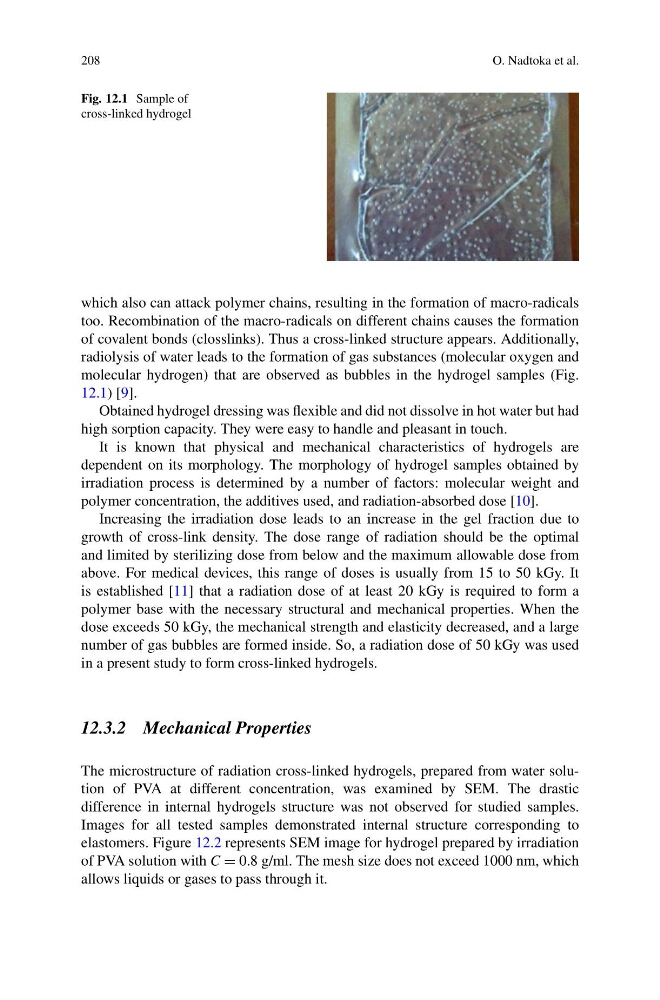
Fig. 12.1 Sample of
cross-linked hydrogel
which also can attack polymer chains, resulting in the formation of macro-radicals
too. Recombination of the macro-radicals on different chains causes the formation
of covalent bonds (closslinks). Thus a cross-linked structure appears. Additionally,
radiolysis of water leads to the formation of gas substances (molecular oxygen and
molecular hydrogen) that are observed as bubbles in the hydrogel samples (Fig.
12.1) [9].
Obtained hydrogel dressing was flexible and did not dissolve in hot water but had
high sorption capacity. They were easy to handle and pleasant in touch.
It is known that physical and mechanical characteristics of hydrogels are
dependent on its morphology. The morphology of hydrogel samples obtained by
irradiation process is determined by a number of factors: molecular weight and
polymer concentration, the additives used, and radiation-absorbed dose [10].
Increasing the irradiation dose leads to an increase in the gel fraction due to
growth of cross-link density. The dose range of radiation should be the optimal
and limited by sterilizing dose from below and the maximum allowable dose from
above. For medical devices, this range of doses is usually from 15 to 50 kGy. It
is established [11] that a radiation dose of at least 20 kGy is required to form a
polymer base with the necessary structural and mechanical properties. When the
dose exceeds 50 kGy, the mechanical strength and elasticity decreased, and a large
number of gas bubbles are formed inside. So, a radiation dose of 50 kGy was used
in a present study to form cross-linked hydrogels.
12.3.2 Mechanical Properties
The microstructure of radiation cross-linked hydrogels, prepared from water solution of PVA at different concentration, was examined by SEM. The drastic
difference in internal hydrogels structure was not observed for studied samples.
Images for all tested samples demonstrated internal structure corresponding to
elastomers. Figure 12.2 represents SEM image for hydrogel prepared by irradiation
of PVA solution with C = 0.8 g/ml. The mesh size does not exceed 1000 nm, which
allows liquids or gases to pass through it.
O. Nadtoka et al.
Fig. 12.1 Sample of
cross-linked hydrogel
which also can attack polymer chains, resulting in the formation of macro-radicals
too. Recombination of the macro-radicals on different chains causes the formation
of covalent bonds (closslinks). Thus a cross-linked structure appears. Additionally,
radiolysis of water leads to the formation of gas substances (molecular oxygen and
molecular hydrogen) that are observed as bubbles in the hydrogel samples (Fig.
12.1) [9].
Obtained hydrogel dressing was flexible and did not dissolve in hot water but had
high sorption capacity. They were easy to handle and pleasant in touch.
It is known that physical and mechanical characteristics of hydrogels are
dependent on its morphology. The morphology of hydrogel samples obtained by
irradiation process is determined by a number of factors: molecular weight and
polymer concentration, the additives used, and radiation-absorbed dose [10].
Increasing the irradiation dose leads to an increase in the gel fraction due to
growth of cross-link density. The dose range of radiation should be the optimal
and limited by sterilizing dose from below and the maximum allowable dose from
above. For medical devices, this range of doses is usually from 15 to 50 kGy. It
is established [11] that a radiation dose of at least 20 kGy is required to form a
polymer base with the necessary structural and mechanical properties. When the
dose exceeds 50 kGy, the mechanical strength and elasticity decreased, and a large
number of gas bubbles are formed inside. So, a radiation dose of 50 kGy was used
in a present study to form cross-linked hydrogels.
12.3.2 Mechanical Properties
The microstructure of radiation cross-linked hydrogels, prepared from water solution of PVA at different concentration, was examined by SEM. The drastic
difference in internal hydrogels structure was not observed for studied samples.
Images for all tested samples demonstrated internal structure corresponding to
elastomers. Figure 12.2 represents SEM image for hydrogel prepared by irradiation
of PVA solution with C = 0.8 g/ml. The mesh size does not exceed 1000 nm, which
allows liquids or gases to pass through it.