

194
L. K. Matkovska et al.
4000
3500
3000
2500
2000
1500
1000
500
30
5
Absorbance
Wavenumber (cm
-1
)
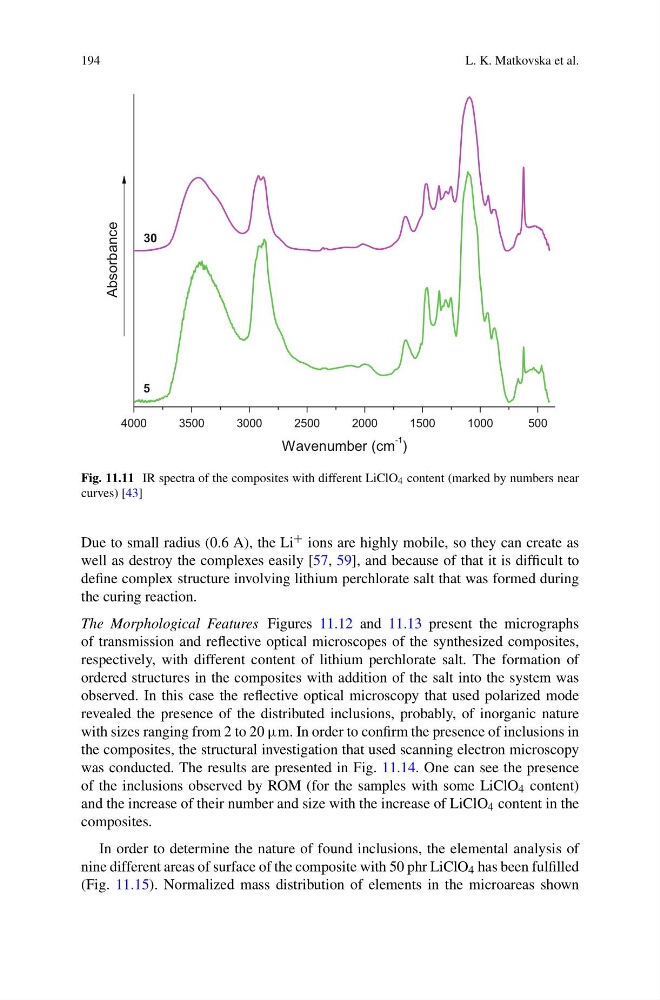
Fig. 11.11 IR spectra of the composites with different LiClO 4 content (marked by numbers near
curves) [43]
Due to small radius (0.6 A), the Li + ions are highly mobile, so they can create as
well as destroy the complexes easily [57, 59], and because of that it is difficult to
define complex structure involving lithium perchlorate salt that was formed during
the curing reaction.
The Morphological Features Figures 11.12 and 11.13 present the micrographs
of transmission and reflective optical microscopes of the synthesized composites,
respectively, with different content of lithium perchlorate salt. The formation of
ordered structures in the composites with addition of the salt into the system was
observed. In this case the reflective optical microscopy that used polarized mode
revealed the presence of the distributed inclusions, probably, of inorganic nature
with sizes ranging from 2 to 20 μm. In order to confirm the presence of inclusions in
the composites, the structural investigation that used scanning electron microscopy
was conducted. The results are presented in Fig. 11.14. One can see the presence
of the inclusions observed by ROM (for the samples with some LiClO 4 content)
and the increase of their number and size with the increase of LiClO 4 content in the
composites.
In order to determine the nature of found inclusions, the elemental analysis of
nine different areas of surface of the composite with 50 phr LiClO 4 has been fulfilled
(Fig. 11.15). Normalized mass distribution of elements in the microareas shown
L. K. Matkovska et al.
4000
3500
3000
2500
2000
1500
1000
500
30
5
Absorbance
Wavenumber (cm
-1
)
Fig. 11.11 IR spectra of the composites with different LiClO 4 content (marked by numbers near
curves) [43]
Due to small radius (0.6 A), the Li + ions are highly mobile, so they can create as
well as destroy the complexes easily [57, 59], and because of that it is difficult to
define complex structure involving lithium perchlorate salt that was formed during
the curing reaction.
The Morphological Features Figures 11.12 and 11.13 present the micrographs
of transmission and reflective optical microscopes of the synthesized composites,
respectively, with different content of lithium perchlorate salt. The formation of
ordered structures in the composites with addition of the salt into the system was
observed. In this case the reflective optical microscopy that used polarized mode
revealed the presence of the distributed inclusions, probably, of inorganic nature
with sizes ranging from 2 to 20 μm. In order to confirm the presence of inclusions in
the composites, the structural investigation that used scanning electron microscopy
was conducted. The results are presented in Fig. 11.14. One can see the presence
of the inclusions observed by ROM (for the samples with some LiClO 4 content)
and the increase of their number and size with the increase of LiClO 4 content in the
composites.
In order to determine the nature of found inclusions, the elemental analysis of
nine different areas of surface of the composite with 50 phr LiClO 4 has been fulfilled
(Fig. 11.15). Normalized mass distribution of elements in the microareas shown