

11 Structure and Electrical/Dielectric Properties of Ion-Conductive Polymer. . .
193
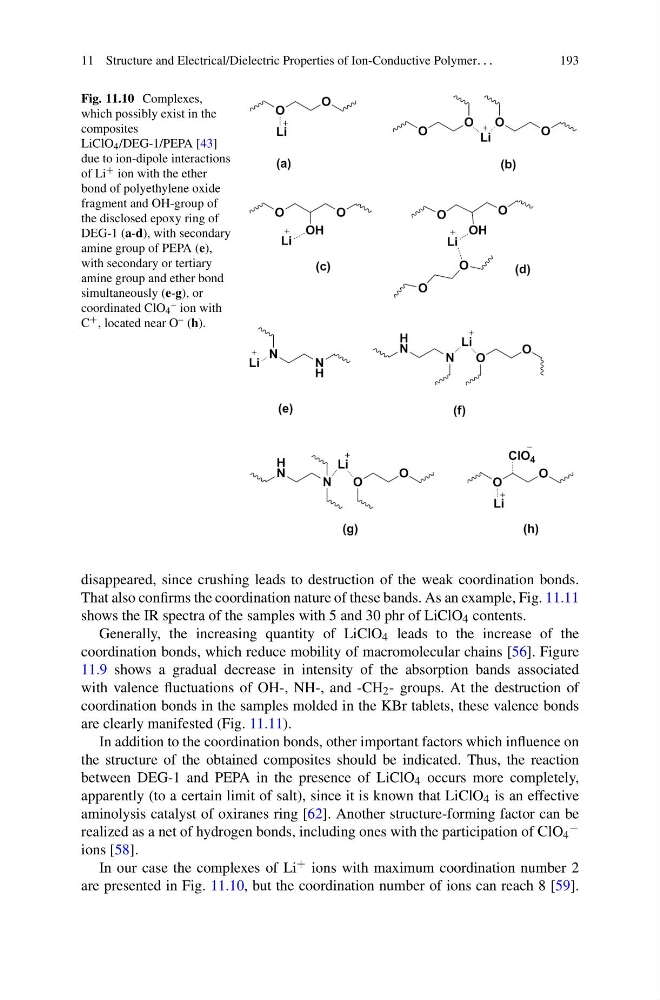
Fig. 11.10 Complexes,
which possibly exist in the
composites
LiClO 4 /DEG-1/PEPA [43]
due to ion-dipole interactions
of Li + ion with the ether
bond of polyethylene oxide
fragment and OH-group of
the disclosed epoxy ring of
DEG-1 (a-d), with secondary
amine group of PEPA (e),
with secondary or tertiary
amine group and ether bond
simultaneously (e-g), or
coordinated ClO 4
– ion with
C + , located near O – (h).
disappeared, since crushing leads to destruction of the weak coordination bonds.
That also confirms the coordination nature of these bands. As an example, Fig. 11.11
shows the IR spectra of the samples with 5 and 30 phr of LiClO 4 contents.
Generally, the increasing quantity of LiClO 4 leads to the increase of the
coordination bonds, which reduce mobility of macromolecular chains [56]. Figure
11.9 shows a gradual decrease in intensity of the absorption bands associated
with valence fluctuations of OH-, NH-, and -CH 2 - groups. At the destruction of
coordination bonds in the samples molded in the KBr tablets, these valence bonds
are clearly manifested (Fig. 11.11).
In addition to the coordination bonds, other important factors which influence on
the structure of the obtained composites should be indicated. Thus, the reaction
between DEG-1 and PEPA in the presence of LiClO 4 occurs more completely,
apparently (to a certain limit of salt), since it is known that LiClO 4 is an effective
aminolysis catalyst of oxiranes ring [62]. Another structure-forming factor can be
realized as a net of hydrogen bonds, including ones with the participation of ´lO 4
−
ions [58].
In our case the complexes of Li + ions with maximum coordination number 2
are presented in Fig. 11.10, but the coordination number of ions can reach 8 [59].
193
Fig. 11.10 Complexes,
which possibly exist in the
composites
LiClO 4 /DEG-1/PEPA [43]
due to ion-dipole interactions
of Li + ion with the ether
bond of polyethylene oxide
fragment and OH-group of
the disclosed epoxy ring of
DEG-1 (a-d), with secondary
amine group of PEPA (e),
with secondary or tertiary
amine group and ether bond
simultaneously (e-g), or
coordinated ClO 4
– ion with
C + , located near O – (h).
disappeared, since crushing leads to destruction of the weak coordination bonds.
That also confirms the coordination nature of these bands. As an example, Fig. 11.11
shows the IR spectra of the samples with 5 and 30 phr of LiClO 4 contents.
Generally, the increasing quantity of LiClO 4 leads to the increase of the
coordination bonds, which reduce mobility of macromolecular chains [56]. Figure
11.9 shows a gradual decrease in intensity of the absorption bands associated
with valence fluctuations of OH-, NH-, and -CH 2 - groups. At the destruction of
coordination bonds in the samples molded in the KBr tablets, these valence bonds
are clearly manifested (Fig. 11.11).
In addition to the coordination bonds, other important factors which influence on
the structure of the obtained composites should be indicated. Thus, the reaction
between DEG-1 and PEPA in the presence of LiClO 4 occurs more completely,
apparently (to a certain limit of salt), since it is known that LiClO 4 is an effective
aminolysis catalyst of oxiranes ring [62]. Another structure-forming factor can be
realized as a net of hydrogen bonds, including ones with the participation of ´lO 4
−
ions [58].
In our case the complexes of Li + ions with maximum coordination number 2
are presented in Fig. 11.10, but the coordination number of ions can reach 8 [59].