

192
L. K. Matkovska et al.
4000
3500
3000
1500
1000
10
20
40
50
0
30
5
860-864
1000-1190
1525
1300-1520
2750-3000
Absorbance
Wavenumber(cm -1 )
3200-3600
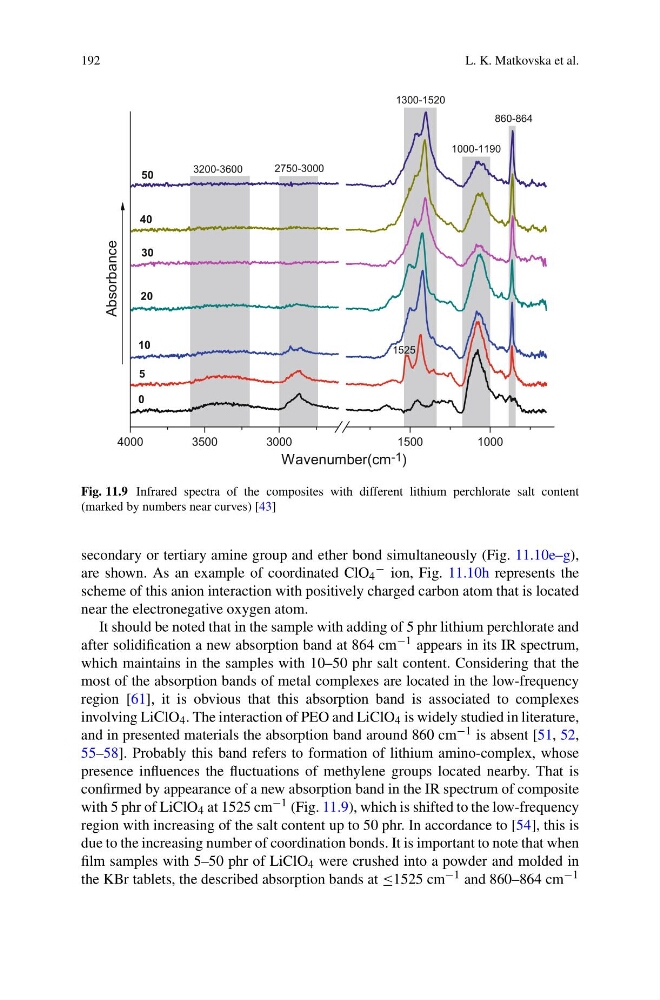
Fig. 11.9 Infrared spectra of the composites with different lithium perchlorate salt content
(marked by numbers near curves) [43]
secondary or tertiary amine group and ether bond simultaneously (Fig. 11.10e–g),
are shown. As an example of coordinated ClO 4
− ion, Fig. 11.10h represents the
scheme of this anion interaction with positively charged carbon atom that is located
near the electronegative oxygen atom.
It should be noted that in the sample with adding of 5 phr lithium perchlorate and
after solidification a new absorption band at 864 cm −1 appears in its IR spectrum,
which maintains in the samples with 10–50 phr salt content. Considering that the
most of the absorption bands of metal complexes are located in the low-frequency
region [61], it is obvious that this absorption band is associated to complexes
involving Li´lO 4 . The interaction of PEO and LiClO 4 is widely studied in literature,
and in presented materials the absorption band around 860 cm −1 is absent [51, 52,
55–58]. Probably this band refers to formation of lithium amino-complex, whose
presence influences the fluctuations of methylene groups located nearby. That is
confirmed by appearance of a new absorption band in the IR spectrum of composite
with 5 phr of LiClO 4 at 1525 cm −1 (Fig. 11.9), which is shifted to the low-frequency
region with increasing of the salt content up to 50 phr. In accordance to [54], this is
due to the increasing number of coordination bonds. It is important to note that when
film samples with 5–50 phr of LiClO 4 were crushed into a powder and molded in
the KBr tablets, the described absorption bands at ≤1525 cm −1 and 860–864 cm −1
L. K. Matkovska et al.
4000
3500
3000
1500
1000
10
20
40
50
0
30
5
860-864
1000-1190
1525
1300-1520
2750-3000
Absorbance
Wavenumber(cm -1 )
3200-3600
Fig. 11.9 Infrared spectra of the composites with different lithium perchlorate salt content
(marked by numbers near curves) [43]
secondary or tertiary amine group and ether bond simultaneously (Fig. 11.10e–g),
are shown. As an example of coordinated ClO 4
− ion, Fig. 11.10h represents the
scheme of this anion interaction with positively charged carbon atom that is located
near the electronegative oxygen atom.
It should be noted that in the sample with adding of 5 phr lithium perchlorate and
after solidification a new absorption band at 864 cm −1 appears in its IR spectrum,
which maintains in the samples with 10–50 phr salt content. Considering that the
most of the absorption bands of metal complexes are located in the low-frequency
region [61], it is obvious that this absorption band is associated to complexes
involving Li´lO 4 . The interaction of PEO and LiClO 4 is widely studied in literature,
and in presented materials the absorption band around 860 cm −1 is absent [51, 52,
55–58]. Probably this band refers to formation of lithium amino-complex, whose
presence influences the fluctuations of methylene groups located nearby. That is
confirmed by appearance of a new absorption band in the IR spectrum of composite
with 5 phr of LiClO 4 at 1525 cm −1 (Fig. 11.9), which is shifted to the low-frequency
region with increasing of the salt content up to 50 phr. In accordance to [54], this is
due to the increasing number of coordination bonds. It is important to note that when
film samples with 5–50 phr of LiClO 4 were crushed into a powder and molded in
the KBr tablets, the described absorption bands at ≤1525 cm −1 and 860–864 cm −1