

188
L. K. Matkovska et al.
the reason for that is the presence of coordinative bonds between lithium ions and
DEG macromolecules, which are more stable at low temperatures and reduce the
molecular mobility of the polymer chains. This can lead to a drop of “decoupling
index” (index of lithium ion mobility by jumping from one to another oxygen
atom). Also, the formation of ion pairs in the systems with increased contents of
LiClO 4 in the epoxy resin (higher than 20 phr) reduces the number of free charge
carriers in the systems and, consequently, decreases the electrical conductivity and
the permittivity. So, the conductivity of the system DEG-1 with 20 phr LiClO 4 at
60 ◦ C is on the same level as for pure DEG-1. However, this effect is significant
only at temperatures up to 100 ◦ C. A rapid growth of the electrical conductivity and
the permittivity due to the destruction of aggregates that is accompanied by release
of charge carriers, namely, lithium cations Li + , occurs when the temperature rises.
The maximum values of the conductivity σ = 1.1 × 10 −3 S/cm and the permittivity
ε = 6.3 × 10 5 are attained for the system DEG-1 with 20 phr of LiClO 4 at 200 ◦ C
(Table 11.2).
Another possible way to improve the electrical characteristics of the synthesized
composites is the incorporation of charge carriers by the phase of ionic liquids
(IL), which is regarded as a promising approach to enhance the ionic conductivity
and electrochemical properties of the SPEs [36]. The Li + transport is significantly
better in consequence of the plasticizing effect of the IL that decreases the glass
transition temperature and makes easier the polymer chain mobility [48]. The
IL-rich phase accompanies the easiest movement of ions and an increase of the
conductivity is expected [36]. In addition, the injection of ionic liquid leads to a
significant enhancement in a contribution of Li + ions to the overall conductivity of
the composites with lithium salt [49].
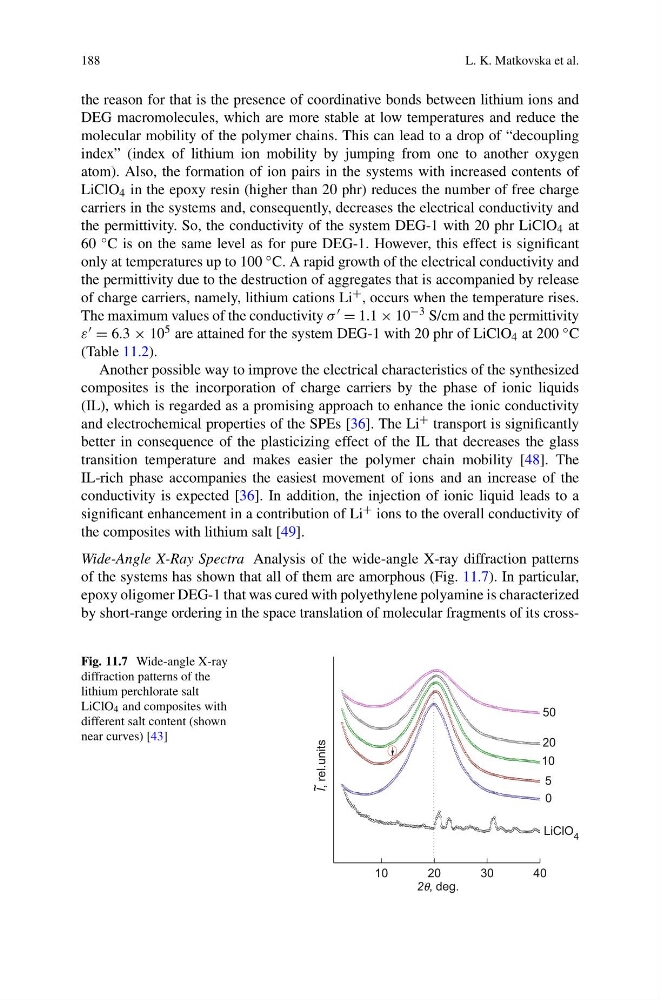
Wide-Angle X-Ray Spectra Analysis of the wide-angle X-ray diffraction patterns
of the systems has shown that all of them are amorphous (Fig. 11.7). In particular,
epoxy oligomer DEG-1 that was cured with polyethylene polyamine is characterized
by short-range ordering in the space translation of molecular fragments of its crossFig. 11.7 Wide-angle X-ray
diffraction patterns of the
lithium perchlorate salt
LiClO 4 and composites with
different salt content (shown
near curves) [43]
10
20
30
40
50
20
5
10
2 , deg.
q
~
I, rel.units
0
LiClO 4
L. K. Matkovska et al.
the reason for that is the presence of coordinative bonds between lithium ions and
DEG macromolecules, which are more stable at low temperatures and reduce the
molecular mobility of the polymer chains. This can lead to a drop of “decoupling
index” (index of lithium ion mobility by jumping from one to another oxygen
atom). Also, the formation of ion pairs in the systems with increased contents of
LiClO 4 in the epoxy resin (higher than 20 phr) reduces the number of free charge
carriers in the systems and, consequently, decreases the electrical conductivity and
the permittivity. So, the conductivity of the system DEG-1 with 20 phr LiClO 4 at
60 ◦ C is on the same level as for pure DEG-1. However, this effect is significant
only at temperatures up to 100 ◦ C. A rapid growth of the electrical conductivity and
the permittivity due to the destruction of aggregates that is accompanied by release
of charge carriers, namely, lithium cations Li + , occurs when the temperature rises.
The maximum values of the conductivity σ = 1.1 × 10 −3 S/cm and the permittivity
ε = 6.3 × 10 5 are attained for the system DEG-1 with 20 phr of LiClO 4 at 200 ◦ C
(Table 11.2).
Another possible way to improve the electrical characteristics of the synthesized
composites is the incorporation of charge carriers by the phase of ionic liquids
(IL), which is regarded as a promising approach to enhance the ionic conductivity
and electrochemical properties of the SPEs [36]. The Li + transport is significantly
better in consequence of the plasticizing effect of the IL that decreases the glass
transition temperature and makes easier the polymer chain mobility [48]. The
IL-rich phase accompanies the easiest movement of ions and an increase of the
conductivity is expected [36]. In addition, the injection of ionic liquid leads to a
significant enhancement in a contribution of Li + ions to the overall conductivity of
the composites with lithium salt [49].
Wide-Angle X-Ray Spectra Analysis of the wide-angle X-ray diffraction patterns
of the systems has shown that all of them are amorphous (Fig. 11.7). In particular,
epoxy oligomer DEG-1 that was cured with polyethylene polyamine is characterized
by short-range ordering in the space translation of molecular fragments of its crossFig. 11.7 Wide-angle X-ray
diffraction patterns of the
lithium perchlorate salt
LiClO 4 and composites with
different salt content (shown
near curves) [43]
10
20
30
40
50
20
5
10
2 , deg.
q
~
I, rel.units
0
LiClO 4