

10 High-Temperature Electrochemical Synthesis of Nanostructured Coatings. . .
169
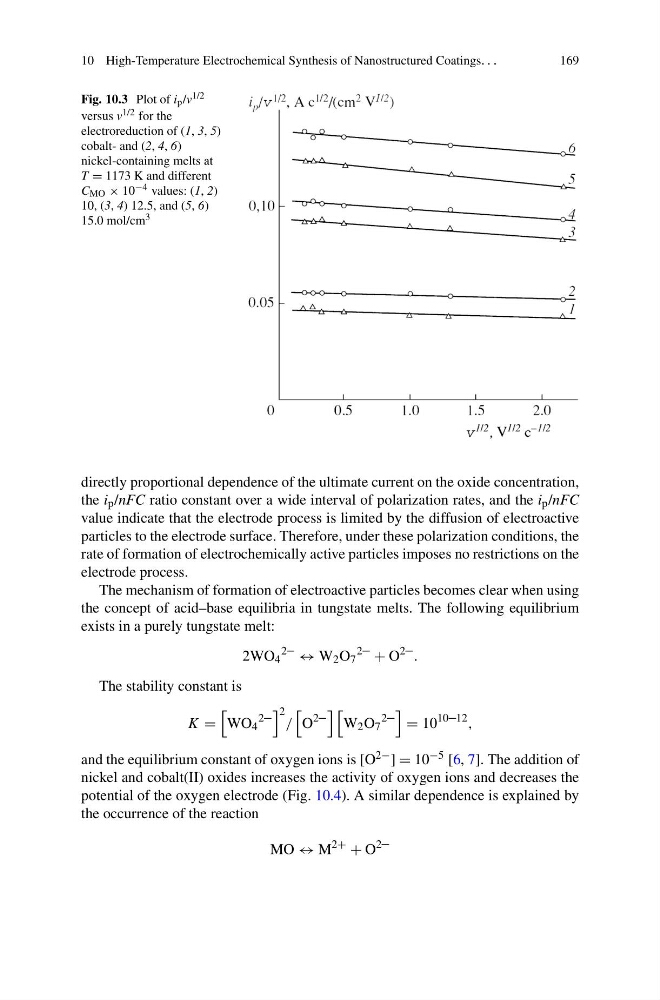
Fig. 10.3 Plot of i p /v 1/2
versus v 1/2 for the
electroreduction of (1, 3, 5)
cobalt- and (2, 4, 6)
nickel-containing melts at
T = 1173 K and different
C MO × 10 −4 values: (1, 2)
10, (3, 4) 12.5, and (5, 6)
15.0 mol/cm 3
directly proportional dependence of the ultimate current on the oxide concentration,
the i p /nFC ratio constant over a wide interval of polarization rates, and the i p /nFC
value indicate that the electrode process is limited by the diffusion of electroactive
particles to the electrode surface. Therefore, under these polarization conditions, the
rate of formation of electrochemically active particles imposes no restrictions on the
electrode process.
The mechanism of formation of electroactive particles becomes clear when using
the concept of acid–base equilibria in tungstate melts. The following equilibrium
exists in a purely tungstate melt:
2WO 4
2–
↔ W 2 O 7
2–
+ O
2– .
The stability constant is
K =
WO 4
2–
2
/
O
2–
W 2 O 7
2–
= 10
10–12 ,
and the equilibrium constant of oxygen ions is [O 2− ] = 10 −5 [6, 7]. The addition of
nickel and cobalt(II) oxides increases the activity of oxygen ions and decreases the
potential of the oxygen electrode (Fig. 10.4). A similar dependence is explained by
the occurrence of the reaction
MO ↔ M
2+
+ O
2–
169
Fig. 10.3 Plot of i p /v 1/2
versus v 1/2 for the
electroreduction of (1, 3, 5)
cobalt- and (2, 4, 6)
nickel-containing melts at
T = 1173 K and different
C MO × 10 −4 values: (1, 2)
10, (3, 4) 12.5, and (5, 6)
15.0 mol/cm 3
directly proportional dependence of the ultimate current on the oxide concentration,
the i p /nFC ratio constant over a wide interval of polarization rates, and the i p /nFC
value indicate that the electrode process is limited by the diffusion of electroactive
particles to the electrode surface. Therefore, under these polarization conditions, the
rate of formation of electrochemically active particles imposes no restrictions on the
electrode process.
The mechanism of formation of electroactive particles becomes clear when using
the concept of acid–base equilibria in tungstate melts. The following equilibrium
exists in a purely tungstate melt:
2WO 4
2–
↔ W 2 O 7
2–
+ O
2– .
The stability constant is
K =
WO 4
2–
2
/
O
2–
W 2 O 7
2–
= 10
10–12 ,
and the equilibrium constant of oxygen ions is [O 2− ] = 10 −5 [6, 7]. The addition of
nickel and cobalt(II) oxides increases the activity of oxygen ions and decreases the
potential of the oxygen electrode (Fig. 10.4). A similar dependence is explained by
the occurrence of the reaction
MO ↔ M
2+
+ O
2–