

170
V. Malyshev et al.
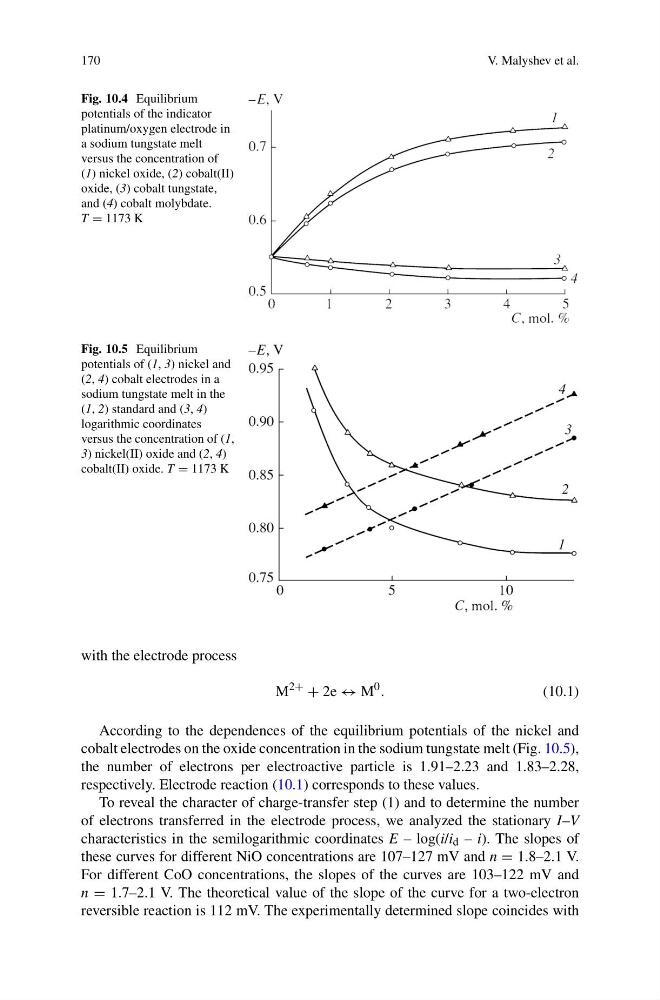
Fig. 10.4 Equilibrium
potentials of the indicator
platinum/oxygen electrode in
a sodium tungstate melt
versus the concentration of
(1) nickel oxide, (2) cobalt(II)
oxide, (3) cobalt tungstate,
and (4) cobalt molybdate.
T = 1173 K
Fig. 10.5 Equilibrium
potentials of (1, 3) nickel and
(2, 4) cobalt electrodes in a
sodium tungstate melt in the
(1, 2) standard and (3, 4)
logarithmic coordinates
versus the concentration of (1,
3) nickel(II) oxide and (2, 4)
cobalt(II) oxide. T = 1173 K
with the electrode process
M
2+
+ 2e ↔ M
0 .
(10.1)
According to the dependences of the equilibrium potentials of the nickel and
cobalt electrodes on the oxide concentration in the sodium tungstate melt (Fig. 10.5),
the number of electrons per electroactive particle is 1.91–2.23 and 1.83–2.28,
respectively. Electrode reaction (10.1) corresponds to these values.
To reveal the character of charge-transfer step (1) and to determine the number
of electrons transferred in the electrode process, we analyzed the stationary I–V
characteristics in the semilogarithmic coordinates E – log(i/i d – i). The slopes of
these curves for different NiO concentrations are 107–127 mV and n = 1.8–2.1 V.
For different CoO concentrations, the slopes of the curves are 103–122 mV and
n = 1.7–2.1 V. The theoretical value of the slope of the curve for a two-electron
reversible reaction is 112 mV. The experimentally determined slope coincides with
V. Malyshev et al.
Fig. 10.4 Equilibrium
potentials of the indicator
platinum/oxygen electrode in
a sodium tungstate melt
versus the concentration of
(1) nickel oxide, (2) cobalt(II)
oxide, (3) cobalt tungstate,
and (4) cobalt molybdate.
T = 1173 K
Fig. 10.5 Equilibrium
potentials of (1, 3) nickel and
(2, 4) cobalt electrodes in a
sodium tungstate melt in the
(1, 2) standard and (3, 4)
logarithmic coordinates
versus the concentration of (1,
3) nickel(II) oxide and (2, 4)
cobalt(II) oxide. T = 1173 K
with the electrode process
M
2+
+ 2e ↔ M
0 .
(10.1)
According to the dependences of the equilibrium potentials of the nickel and
cobalt electrodes on the oxide concentration in the sodium tungstate melt (Fig. 10.5),
the number of electrons per electroactive particle is 1.91–2.23 and 1.83–2.28,
respectively. Electrode reaction (10.1) corresponds to these values.
To reveal the character of charge-transfer step (1) and to determine the number
of electrons transferred in the electrode process, we analyzed the stationary I–V
characteristics in the semilogarithmic coordinates E – log(i/i d – i). The slopes of
these curves for different NiO concentrations are 107–127 mV and n = 1.8–2.1 V.
For different CoO concentrations, the slopes of the curves are 103–122 mV and
n = 1.7–2.1 V. The theoretical value of the slope of the curve for a two-electron
reversible reaction is 112 mV. The experimentally determined slope coincides with