

168
V. Malyshev et al.
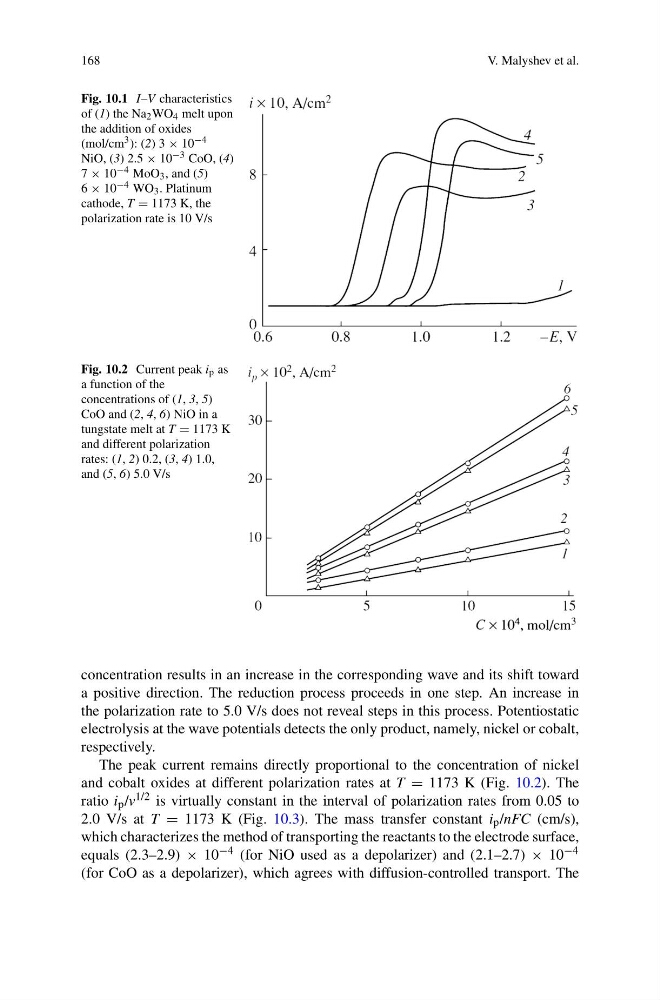
Fig. 10.1 I–V characteristics
of (1) the Na 2 WO 4 melt upon
the addition of oxides
(mol/cm 3 ): (2) 3 × 10 −4
NiO, (3) 2.5 × 10 −3 CoO, (4)
7 × 10 −4 MoO 3 , and (5)
6 × 10 −4 WO 3 . Platinum
cathode, T = 1173 K, the
polarization rate is 10 V/s
Fig. 10.2 Current peak i p as
a function of the
concentrations of (1, 3, 5)
CoO and (2, 4, 6) NiO in a
tungstate melt at T = 1173 K
and different polarization
rates: (1, 2) 0.2, (3, 4) 1.0,
and (5, 6) 5.0 V/s
concentration results in an increase in the corresponding wave and its shift toward
a positive direction. The reduction process proceeds in one step. An increase in
the polarization rate to 5.0 V/s does not reveal steps in this process. Potentiostatic
electrolysis at the wave potentials detects the only product, namely, nickel or cobalt,
respectively.
The peak current remains directly proportional to the concentration of nickel
and cobalt oxides at different polarization rates at T = 1173 K (Fig. 10.2). The
ratio i p /v 1/2 is virtually constant in the interval of polarization rates from 0.05 to
2.0 V/s at T = 1173 K (Fig. 10.3). The mass transfer constant i p /nFC (cm/s),
which characterizes the method of transporting the reactants to the electrode surface,
equals (2.3–2.9) × 10 −4 (for NiO used as a depolarizer) and (2.1–2.7) × 10 −4
(for CoO as a depolarizer), which agrees with diffusion-controlled transport. The
V. Malyshev et al.
Fig. 10.1 I–V characteristics
of (1) the Na 2 WO 4 melt upon
the addition of oxides
(mol/cm 3 ): (2) 3 × 10 −4
NiO, (3) 2.5 × 10 −3 CoO, (4)
7 × 10 −4 MoO 3 , and (5)
6 × 10 −4 WO 3 . Platinum
cathode, T = 1173 K, the
polarization rate is 10 V/s
Fig. 10.2 Current peak i p as
a function of the
concentrations of (1, 3, 5)
CoO and (2, 4, 6) NiO in a
tungstate melt at T = 1173 K
and different polarization
rates: (1, 2) 0.2, (3, 4) 1.0,
and (5, 6) 5.0 V/s
concentration results in an increase in the corresponding wave and its shift toward
a positive direction. The reduction process proceeds in one step. An increase in
the polarization rate to 5.0 V/s does not reveal steps in this process. Potentiostatic
electrolysis at the wave potentials detects the only product, namely, nickel or cobalt,
respectively.
The peak current remains directly proportional to the concentration of nickel
and cobalt oxides at different polarization rates at T = 1173 K (Fig. 10.2). The
ratio i p /v 1/2 is virtually constant in the interval of polarization rates from 0.05 to
2.0 V/s at T = 1173 K (Fig. 10.3). The mass transfer constant i p /nFC (cm/s),
which characterizes the method of transporting the reactants to the electrode surface,
equals (2.3–2.9) × 10 −4 (for NiO used as a depolarizer) and (2.1–2.7) × 10 −4
(for CoO as a depolarizer), which agrees with diffusion-controlled transport. The