

9 Polymeric Composite Films with Controlled Release of Natural Antioxidant Enoxil
161
for this material amount of polymeric samples under study becomes the largest.
Desorption of the active compound from the films Gel/Chit/HEMA, Gel/Chit,
and Gel/Chit/NT was found to be complicated due to polymer matrix swelling
during contacting with the release medium, which, undoubtedly, complicates
diffusion both the solvent and the adsorbate. In vitro drug desorption patterns from
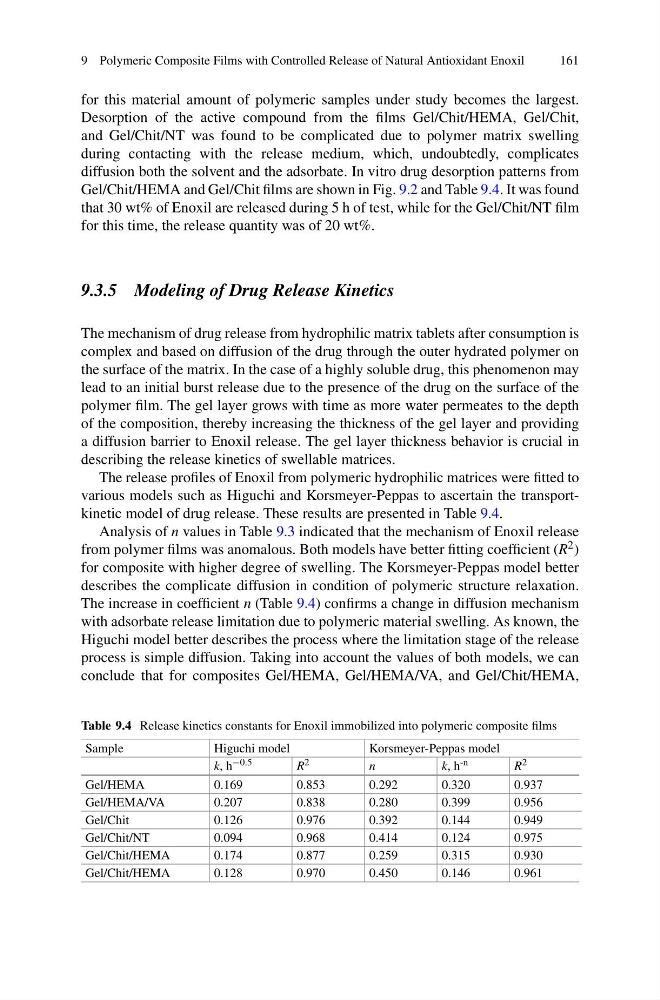
Gel/Chit/HEMA and Gel/Chit films are shown in Fig. 9.2 and Table 9.4. It was found
that 30 wt% of Enoxil are released during 5 h of test, while for the Gel/Chit/NT film
for this time, the release quantity was of 20 wt%.
9.3.5 Modeling of Drug Release Kinetics
The mechanism of drug release from hydrophilic matrix tablets after consumption is
complex and based on diffusion of the drug through the outer hydrated polymer on
the surface of the matrix. In the case of a highly soluble drug, this phenomenon may
lead to an initial burst release due to the presence of the drug on the surface of the
polymer film. The gel layer grows with time as more water permeates to the depth
of the composition, thereby increasing the thickness of the gel layer and providing
a diffusion barrier to Enoxil release. The gel layer thickness behavior is crucial in
describing the release kinetics of swellable matrices.
The release profiles of Enoxil from polymeric hydrophilic matrices were fitted to
various models such as Higuchi and Korsmeyer-Peppas to ascertain the transportkinetic model of drug release. These results are presented in Table 9.4.
Analysis of n values in Table 9.3 indicated that the mechanism of Enoxil release
from polymer films was anomalous. Both models have better fitting coefficient (R 2 )
for composite with higher degree of swelling. The Korsmeyer-Peppas model better
describes the complicate diffusion in condition of polymeric structure relaxation.
The increase in coefficient n (Table 9.4) confirms a change in diffusion mechanism
with adsorbate release limitation due to polymeric material swelling. As known, the
Higuchi model better describes the process where the limitation stage of the release
process is simple diffusion. Taking into account the values of both models, we can
conclude that for composites Gel/HEMA, Gel/HEMA/VA, and Gel/Chit/HEMA,
Table 9.4 Release kinetics constants for Enoxil immobilized into polymeric composite films
Sample
Higuchi model
Korsmeyer-Peppas model
k, h −0.5
R 2
n
k, h -n
R 2
Gel/HEMA
0.169
0.853
0.292
0.320
0.937
Gel/HEMA/VA
0.207
0.838
0.280
0.399
0.956
Gel/Chit
0.126
0.976
0.392
0.144
0.949
Gel/Chit/NT
0.094
0.968
0.414
0.124
0.975
Gel/Chit/HEMA
0.174
0.877
0.259
0.315
0.930
Gel/Chit/HEMA
0.128
0.970
0.450
0.146
0.961
161
for this material amount of polymeric samples under study becomes the largest.
Desorption of the active compound from the films Gel/Chit/HEMA, Gel/Chit,
and Gel/Chit/NT was found to be complicated due to polymer matrix swelling
during contacting with the release medium, which, undoubtedly, complicates
diffusion both the solvent and the adsorbate. In vitro drug desorption patterns from
Gel/Chit/HEMA and Gel/Chit films are shown in Fig. 9.2 and Table 9.4. It was found
that 30 wt% of Enoxil are released during 5 h of test, while for the Gel/Chit/NT film
for this time, the release quantity was of 20 wt%.
9.3.5 Modeling of Drug Release Kinetics
The mechanism of drug release from hydrophilic matrix tablets after consumption is
complex and based on diffusion of the drug through the outer hydrated polymer on
the surface of the matrix. In the case of a highly soluble drug, this phenomenon may
lead to an initial burst release due to the presence of the drug on the surface of the
polymer film. The gel layer grows with time as more water permeates to the depth
of the composition, thereby increasing the thickness of the gel layer and providing
a diffusion barrier to Enoxil release. The gel layer thickness behavior is crucial in
describing the release kinetics of swellable matrices.
The release profiles of Enoxil from polymeric hydrophilic matrices were fitted to
various models such as Higuchi and Korsmeyer-Peppas to ascertain the transportkinetic model of drug release. These results are presented in Table 9.4.
Analysis of n values in Table 9.3 indicated that the mechanism of Enoxil release
from polymer films was anomalous. Both models have better fitting coefficient (R 2 )
for composite with higher degree of swelling. The Korsmeyer-Peppas model better
describes the complicate diffusion in condition of polymeric structure relaxation.
The increase in coefficient n (Table 9.4) confirms a change in diffusion mechanism
with adsorbate release limitation due to polymeric material swelling. As known, the
Higuchi model better describes the process where the limitation stage of the release
process is simple diffusion. Taking into account the values of both models, we can
conclude that for composites Gel/HEMA, Gel/HEMA/VA, and Gel/Chit/HEMA,
Table 9.4 Release kinetics constants for Enoxil immobilized into polymeric composite films
Sample
Higuchi model
Korsmeyer-Peppas model
k, h −0.5
R 2
n
k, h -n
R 2
Gel/HEMA
0.169
0.853
0.292
0.320
0.937
Gel/HEMA/VA
0.207
0.838
0.280
0.399
0.956
Gel/Chit
0.126
0.976
0.392
0.144
0.949
Gel/Chit/NT
0.094
0.968
0.414
0.124
0.975
Gel/Chit/HEMA
0.174
0.877
0.259
0.315
0.930
Gel/Chit/HEMA
0.128
0.970
0.450
0.146
0.961