

160
R. Kozakevych et al.
Water uptake ability of polymeric composites is represented in Table 9.3.
Introducing HEMA into polymeric composition was found to provide a decrease
in water uptake. In comparison to gelatin-based composition, the films based
on chitosan had higher swelling degree. Additional cross-linking of HEMA with
organosilanes mixture does not significantly reduce swelling behavior of materials.
The higher volume of water uptake was found for composition Gel/Chit, as well as
lowest swelling degree had composition Gel/HEMA.
The Enoxil release from swellable hydrophilic matrices can be controlled by
physical and chemical processes, involving the liquid penetration within the polymer network, the swelling of hydrated polymer, and Enoxil diffusion throughout
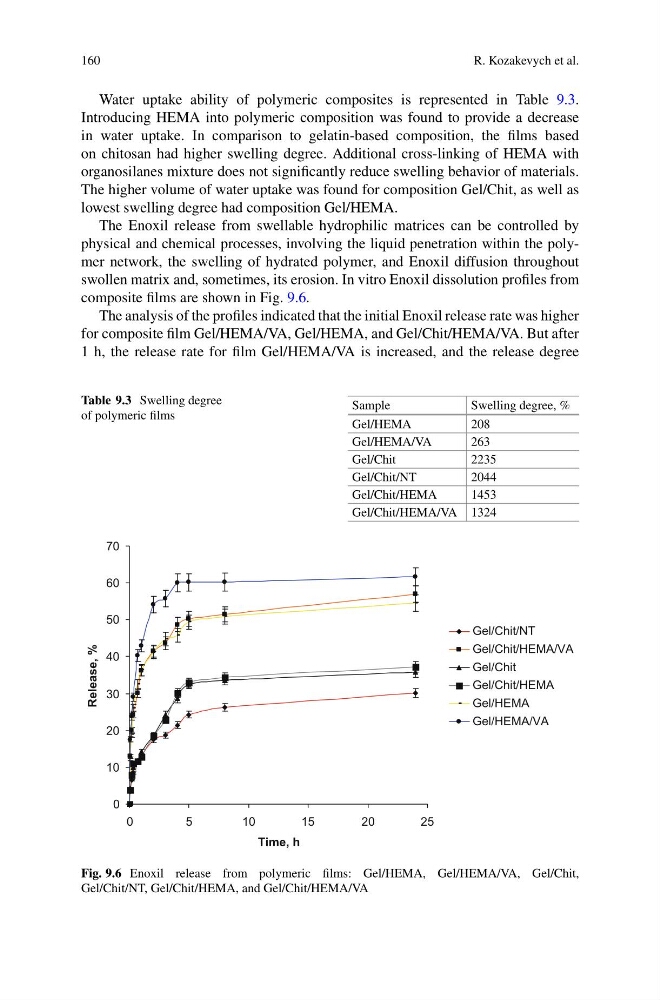
swollen matrix and, sometimes, its erosion. In vitro Enoxil dissolution profiles from
composite films are shown in Fig. 9.6.
The analysis of the profiles indicated that the initial Enoxil release rate was higher
for composite film Gel/HEMA/VA, Gel/HEMA, and Gel/Chit/HEMA/VA. But after
1 h, the release rate for film Gel/HEMA/VA is increased, and the release degree
Table 9.3 Swelling degree
of polymeric films
Sample
Swelling degree, %
Gel/HEMA
208
Gel/HEMA/VA
263
Gel/Chit
2235
Gel/Chit/NT
2044
Gel/Chit/HEMA
1453
Gel/Chit/HEMA/VA 1324
0
10
20
30
40
50
60
70
0
5
10
15
20
25
Time, h
Release, %
Gel/Chit/NT
Gel/Chit/HEMA/VA
Gel/Chit
Gel/Chit/HEMA
Gel/HEMA
Gel/HEMA/VA
Fig. 9.6 Enoxil release from polymeric films: Gel/HEMA, Gel/HEMA/VA, Gel/Chit,
Gel/Chit/NT, Gel/Chit/HEMA, and Gel/Chit/HEMA/VA
R. Kozakevych et al.
Water uptake ability of polymeric composites is represented in Table 9.3.
Introducing HEMA into polymeric composition was found to provide a decrease
in water uptake. In comparison to gelatin-based composition, the films based
on chitosan had higher swelling degree. Additional cross-linking of HEMA with
organosilanes mixture does not significantly reduce swelling behavior of materials.
The higher volume of water uptake was found for composition Gel/Chit, as well as
lowest swelling degree had composition Gel/HEMA.
The Enoxil release from swellable hydrophilic matrices can be controlled by
physical and chemical processes, involving the liquid penetration within the polymer network, the swelling of hydrated polymer, and Enoxil diffusion throughout
swollen matrix and, sometimes, its erosion. In vitro Enoxil dissolution profiles from
composite films are shown in Fig. 9.6.
The analysis of the profiles indicated that the initial Enoxil release rate was higher
for composite film Gel/HEMA/VA, Gel/HEMA, and Gel/Chit/HEMA/VA. But after
1 h, the release rate for film Gel/HEMA/VA is increased, and the release degree
Table 9.3 Swelling degree
of polymeric films
Sample
Swelling degree, %
Gel/HEMA
208
Gel/HEMA/VA
263
Gel/Chit
2235
Gel/Chit/NT
2044
Gel/Chit/HEMA
1453
Gel/Chit/HEMA/VA 1324
0
10
20
30
40
50
60
70
0
5
10
15
20
25
Time, h
Release, %
Gel/Chit/NT
Gel/Chit/HEMA/VA
Gel/Chit
Gel/Chit/HEMA
Gel/HEMA
Gel/HEMA/VA
Fig. 9.6 Enoxil release from polymeric films: Gel/HEMA, Gel/HEMA/VA, Gel/Chit,
Gel/Chit/NT, Gel/Chit/HEMA, and Gel/Chit/HEMA/VA