

9 Polymeric Composite Films with Controlled Release of Natural Antioxidant Enoxil
155
0
20
40
60
80
100
0
5
10
15
20
25
Time, h
Release, %
1
2
3
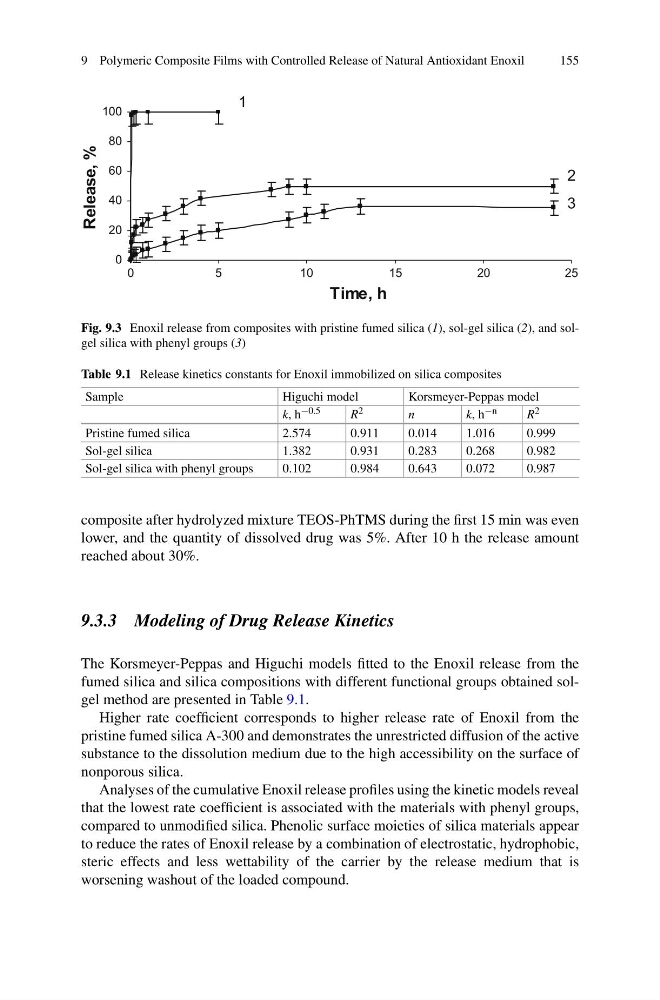
Fig. 9.3 Enoxil release from composites with pristine fumed silica (1), sol-gel silica (2), and solgel silica with phenyl groups (3)
Table 9.1 Release kinetics constants for Enoxil immobilized on silica composites
Sample
Higuchi model
Korsmeyer-Peppas model
k, h −0.5
R 2
n
k, h −n
R 2
Pristine fumed silica
2.574
0.911
0.014
1.016
0.999
Sol-gel silica
1.382
0.931
0.283
0.268
0.982
Sol-gel silica with phenyl groups
0.102
0.984
0.643
0.072
0.987
composite after hydrolyzed mixture TEOS-PhTMS during the first 15 min was even
lower, and the quantity of dissolved drug was 5%. After 10 h the release amount
reached about 30%.
9.3.3 Modeling of Drug Release Kinetics
The Korsmeyer-Peppas and Higuchi models fitted to the Enoxil release from the
fumed silica and silica compositions with different functional groups obtained solgel method are presented in Table 9.1.
Higher rate coefficient corresponds to higher release rate of Enoxil from the
pristine fumed silica A-300 and demonstrates the unrestricted diffusion of the active
substance to the dissolution medium due to the high accessibility on the surface of
nonporous silica.
Analyses of the cumulative Enoxil release profiles using the kinetic models reveal
that the lowest rate coefficient is associated with the materials with phenyl groups,
compared to unmodified silica. Phenolic surface moieties of silica materials appear
to reduce the rates of Enoxil release by a combination of electrostatic, hydrophobic,
steric effects and less wettability of the carrier by the release medium that is
worsening washout of the loaded compound.
155
0
20
40
60
80
100
0
5
10
15
20
25
Time, h
Release, %
1
2
3
Fig. 9.3 Enoxil release from composites with pristine fumed silica (1), sol-gel silica (2), and solgel silica with phenyl groups (3)
Table 9.1 Release kinetics constants for Enoxil immobilized on silica composites
Sample
Higuchi model
Korsmeyer-Peppas model
k, h −0.5
R 2
n
k, h −n
R 2
Pristine fumed silica
2.574
0.911
0.014
1.016
0.999
Sol-gel silica
1.382
0.931
0.283
0.268
0.982
Sol-gel silica with phenyl groups
0.102
0.984
0.643
0.072
0.987
composite after hydrolyzed mixture TEOS-PhTMS during the first 15 min was even
lower, and the quantity of dissolved drug was 5%. After 10 h the release amount
reached about 30%.
9.3.3 Modeling of Drug Release Kinetics
The Korsmeyer-Peppas and Higuchi models fitted to the Enoxil release from the
fumed silica and silica compositions with different functional groups obtained solgel method are presented in Table 9.1.
Higher rate coefficient corresponds to higher release rate of Enoxil from the
pristine fumed silica A-300 and demonstrates the unrestricted diffusion of the active
substance to the dissolution medium due to the high accessibility on the surface of
nonporous silica.
Analyses of the cumulative Enoxil release profiles using the kinetic models reveal
that the lowest rate coefficient is associated with the materials with phenyl groups,
compared to unmodified silica. Phenolic surface moieties of silica materials appear
to reduce the rates of Enoxil release by a combination of electrostatic, hydrophobic,
steric effects and less wettability of the carrier by the release medium that is
worsening washout of the loaded compound.