

8 Nanocomposites Based on Thermosetting Polyurethane Matrix. . .
141
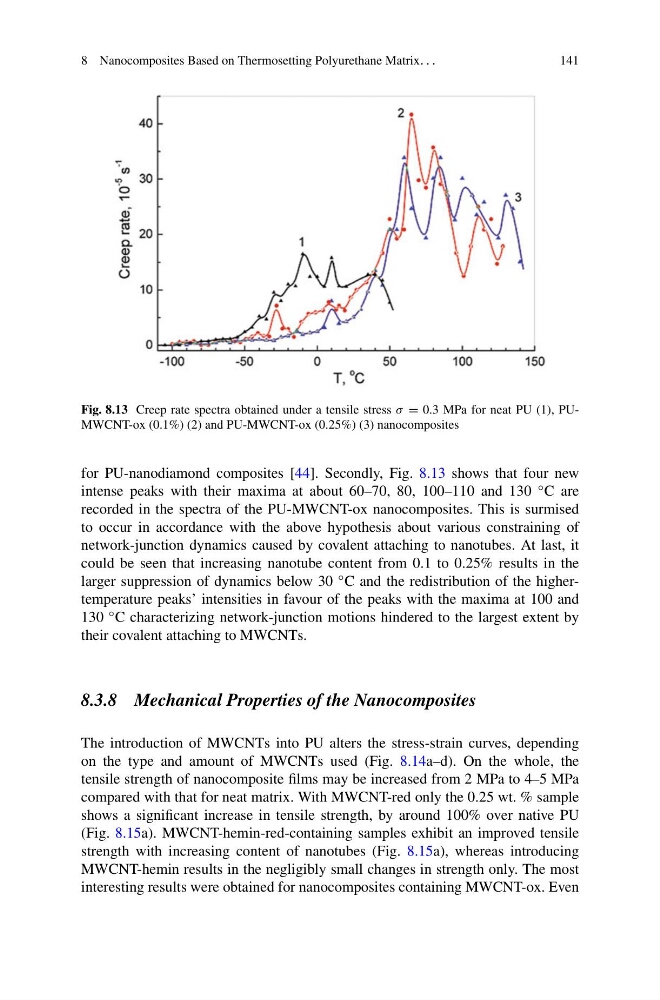
Fig. 8.13 Creep rate spectra obtained under a tensile stress σ = 0.3 MPa for neat PU (1), PUMWCNT-ox (0.1%) (2) and PU-MWCNT-ox (0.25%) (3) nanocomposites
for PU-nanodiamond composites [44]. Secondly, Fig. 8.13 shows that four new
intense peaks with their maxima at about 60–70, 80, 100–110 and 130 ◦ C are
recorded in the spectra of the PU-MWCNT-ox nanocomposites. This is surmised
to occur in accordance with the above hypothesis about various constraining of
network-junction dynamics caused by covalent attaching to nanotubes. At last, it
could be seen that increasing nanotube content from 0.1 to 0.25% results in the
larger suppression of dynamics below 30 ◦ C and the redistribution of the highertemperature peaks’ intensities in favour of the peaks with the maxima at 100 and
130 ◦ C characterizing network-junction motions hindered to the largest extent by
their covalent attaching to MWCNTs.
8.3.8 Mechanical Properties of the Nanocomposites
The introduction of MWCNTs into PU alters the stress-strain curves, depending
on the type and amount of MWCNTs used (Fig. 8.14a–d). On the whole, the
tensile strength of nanocomposite films may be increased from 2 MPa to 4–5 MPa
compared with that for neat matrix. With MWCNT-red only the 0.25 wt. % sample
shows a significant increase in tensile strength, by around 100% over native PU
(Fig. 8.15a). MWCNT-hemin-red-containing samples exhibit an improved tensile
strength with increasing content of nanotubes (Fig. 8.15a), whereas introducing
MWCNT-hemin results in the negligibly small changes in strength only. The most
interesting results were obtained for nanocomposites containing MWCNT-ox. Even
141
Fig. 8.13 Creep rate spectra obtained under a tensile stress σ = 0.3 MPa for neat PU (1), PUMWCNT-ox (0.1%) (2) and PU-MWCNT-ox (0.25%) (3) nanocomposites
for PU-nanodiamond composites [44]. Secondly, Fig. 8.13 shows that four new
intense peaks with their maxima at about 60–70, 80, 100–110 and 130 ◦ C are
recorded in the spectra of the PU-MWCNT-ox nanocomposites. This is surmised
to occur in accordance with the above hypothesis about various constraining of
network-junction dynamics caused by covalent attaching to nanotubes. At last, it
could be seen that increasing nanotube content from 0.1 to 0.25% results in the
larger suppression of dynamics below 30 ◦ C and the redistribution of the highertemperature peaks’ intensities in favour of the peaks with the maxima at 100 and
130 ◦ C characterizing network-junction motions hindered to the largest extent by
their covalent attaching to MWCNTs.
8.3.8 Mechanical Properties of the Nanocomposites
The introduction of MWCNTs into PU alters the stress-strain curves, depending
on the type and amount of MWCNTs used (Fig. 8.14a–d). On the whole, the
tensile strength of nanocomposite films may be increased from 2 MPa to 4–5 MPa
compared with that for neat matrix. With MWCNT-red only the 0.25 wt. % sample
shows a significant increase in tensile strength, by around 100% over native PU
(Fig. 8.15a). MWCNT-hemin-red-containing samples exhibit an improved tensile
strength with increasing content of nanotubes (Fig. 8.15a), whereas introducing
MWCNT-hemin results in the negligibly small changes in strength only. The most
interesting results were obtained for nanocomposites containing MWCNT-ox. Even