

142
L. V. Karabanova et al.
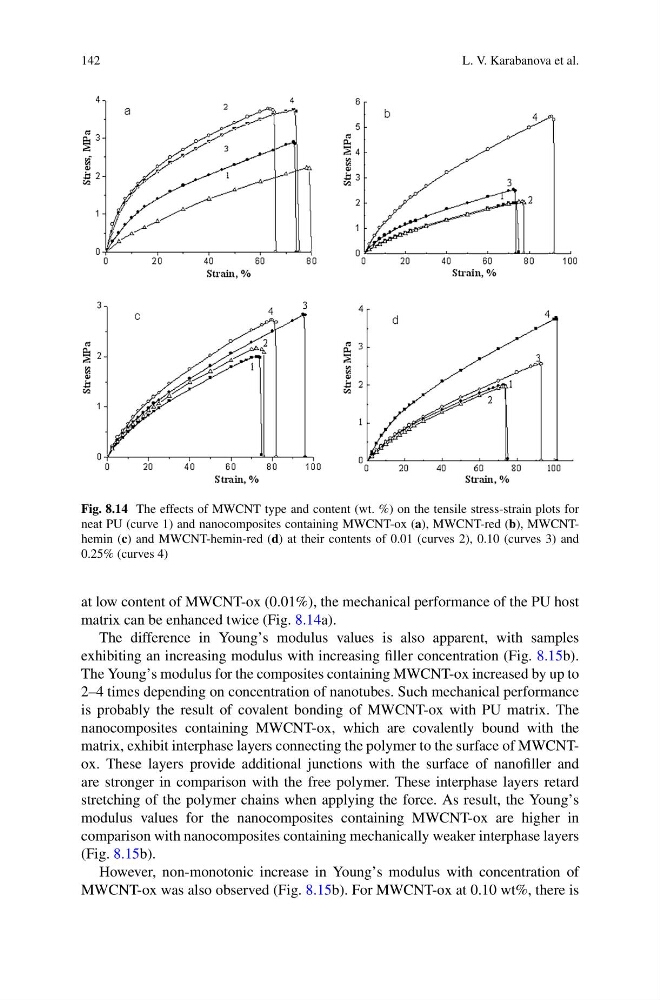
Fig. 8.14 The effects of MWCNT type and content (wt. %) on the tensile stress-strain plots for
neat PU (curve 1) and nanocomposites containing MWCNT-ox (a), MWCNT-red (b), MWCNThemin (c) and MWCNT-hemin-red (d) at their contents of 0.01 (curves 2), 0.10 (curves 3) and
0.25% (curves 4)
at low content of MWCNT-ox (0.01%), the mechanical performance of the PU host
matrix can be enhanced twice (Fig. 8.14a).
The difference in Young’s modulus values is also apparent, with samples
exhibiting an increasing modulus with increasing filler concentration (Fig. 8.15b).
The Young’s modulus for the composites containing MWCNT-ox increased by up to
2–4 times depending on concentration of nanotubes. Such mechanical performance
is probably the result of covalent bonding of MWCNT-ox with PU matrix. The
nanocomposites containing MWCNT-ox, which are covalently bound with the
matrix, exhibit interphase layers connecting the polymer to the surface of MWCNTox. These layers provide additional junctions with the surface of nanofiller and
are stronger in comparison with the free polymer. These interphase layers retard
stretching of the polymer chains when applying the force. As result, the Young’s
modulus values for the nanocomposites containing MWCNT-ox are higher in
comparison with nanocomposites containing mechanically weaker interphase layers
(Fig. 8.15b).
However, non-monotonic increase in Young’s modulus with concentration of
MWCNT-ox was also observed (Fig. 8.15b). For MWCNT-ox at 0.10 wt%, there is
L. V. Karabanova et al.
Fig. 8.14 The effects of MWCNT type and content (wt. %) on the tensile stress-strain plots for
neat PU (curve 1) and nanocomposites containing MWCNT-ox (a), MWCNT-red (b), MWCNThemin (c) and MWCNT-hemin-red (d) at their contents of 0.01 (curves 2), 0.10 (curves 3) and
0.25% (curves 4)
at low content of MWCNT-ox (0.01%), the mechanical performance of the PU host
matrix can be enhanced twice (Fig. 8.14a).
The difference in Young’s modulus values is also apparent, with samples
exhibiting an increasing modulus with increasing filler concentration (Fig. 8.15b).
The Young’s modulus for the composites containing MWCNT-ox increased by up to
2–4 times depending on concentration of nanotubes. Such mechanical performance
is probably the result of covalent bonding of MWCNT-ox with PU matrix. The
nanocomposites containing MWCNT-ox, which are covalently bound with the
matrix, exhibit interphase layers connecting the polymer to the surface of MWCNTox. These layers provide additional junctions with the surface of nanofiller and
are stronger in comparison with the free polymer. These interphase layers retard
stretching of the polymer chains when applying the force. As result, the Young’s
modulus values for the nanocomposites containing MWCNT-ox are higher in
comparison with nanocomposites containing mechanically weaker interphase layers
(Fig. 8.15b).
However, non-monotonic increase in Young’s modulus with concentration of
MWCNT-ox was also observed (Fig. 8.15b). For MWCNT-ox at 0.10 wt%, there is