

7 Applications Perspectives of Nanodispersed Chalcogenides of Transition. . .
109
200
160
120
80
40
0
200
160
120
80
40
0
0
20 40 60
Time, min
Time, min
a
b
macro sized
mesoporous
macro sized
mesoporous
RhB (ppm)
RdB (ppm)
80 100 120
0
60 120 180 240 300
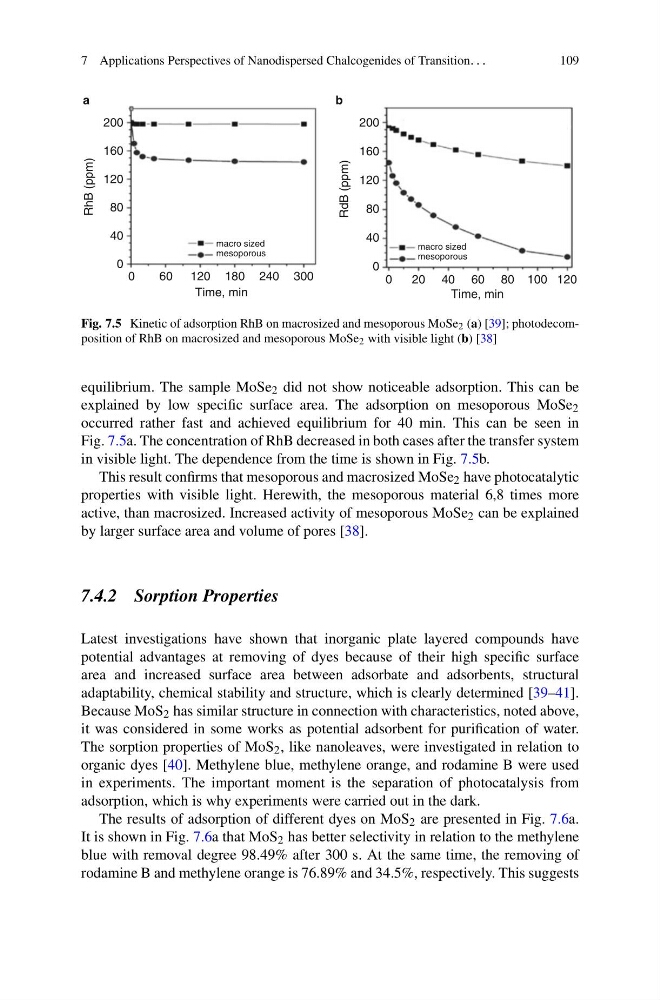
Fig. 7.5 Kinetic of adsorption RhB on macrosized and mesoporous MoSe 2 (a) [39]; photodecomposition of RhB on macrosized and mesoporous MoSe 2 with visible light (b) [38]
equilibrium. The sample MoSe 2 did not show noticeable adsorption. This can be
explained by low specific surface area. The adsorption on mesoporous MoSe 2
occurred rather fast and achieved equilibrium for 40 min. This can be seen in
Fig. 7.5a. The concentration of RhB decreased in both cases after the transfer system
in visible light. The dependence from the time is shown in Fig. 7.5b.
This result confirms that mesoporous and macrosized MoSe 2 have photocatalytic
properties with visible light. Herewith, the mesoporous material 6,8 times more
active, than macrosized. Increased activity of mesoporous MoSe 2 can be explained
by larger surface area and volume of pores [38].
7.4.2 Sorption Properties
Latest investigations have shown that inorganic plate layered compounds have
potential advantages at removing of dyes because of their high specific surface
area and increased surface area between adsorbate and adsorbents, structural
adaptability, chemical stability and structure, which is clearly determined [39–41].
Because MoS 2 has similar structure in connection with characteristics, noted above,
it was considered in some works as potential adsorbent for purification of water.
The sorption properties of MoS 2 , like nanoleaves, were investigated in relation to
organic dyes [40]. Methylene blue, methylene orange, and rodamine B were used
in experiments. The important moment is the separation of photocatalysis from
adsorption, which is why experiments were carried out in the dark.
The results of adsorption of different dyes on MoS 2 are presented in Fig. 7.6a.
It is shown in Fig. 7.6a that MoS 2 has better selectivity in relation to the methylene
blue with removal degree 98.49% after 300 s. At the same time, the removing of
rodamine B and methylene orange is 76.89% and 34.5%, respectively. This suggests
109
200
160
120
80
40
0
200
160
120
80
40
0
0
20 40 60
Time, min
Time, min
a
b
macro sized
mesoporous
macro sized
mesoporous
RhB (ppm)
RdB (ppm)
80 100 120
0
60 120 180 240 300
Fig. 7.5 Kinetic of adsorption RhB on macrosized and mesoporous MoSe 2 (a) [39]; photodecomposition of RhB on macrosized and mesoporous MoSe 2 with visible light (b) [38]
equilibrium. The sample MoSe 2 did not show noticeable adsorption. This can be
explained by low specific surface area. The adsorption on mesoporous MoSe 2
occurred rather fast and achieved equilibrium for 40 min. This can be seen in
Fig. 7.5a. The concentration of RhB decreased in both cases after the transfer system
in visible light. The dependence from the time is shown in Fig. 7.5b.
This result confirms that mesoporous and macrosized MoSe 2 have photocatalytic
properties with visible light. Herewith, the mesoporous material 6,8 times more
active, than macrosized. Increased activity of mesoporous MoSe 2 can be explained
by larger surface area and volume of pores [38].
7.4.2 Sorption Properties
Latest investigations have shown that inorganic plate layered compounds have
potential advantages at removing of dyes because of their high specific surface
area and increased surface area between adsorbate and adsorbents, structural
adaptability, chemical stability and structure, which is clearly determined [39–41].
Because MoS 2 has similar structure in connection with characteristics, noted above,
it was considered in some works as potential adsorbent for purification of water.
The sorption properties of MoS 2 , like nanoleaves, were investigated in relation to
organic dyes [40]. Methylene blue, methylene orange, and rodamine B were used
in experiments. The important moment is the separation of photocatalysis from
adsorption, which is why experiments were carried out in the dark.
The results of adsorption of different dyes on MoS 2 are presented in Fig. 7.6a.
It is shown in Fig. 7.6a that MoS 2 has better selectivity in relation to the methylene
blue with removal degree 98.49% after 300 s. At the same time, the removing of
rodamine B and methylene orange is 76.89% and 34.5%, respectively. This suggests