

108
I. Ivanenko et al.
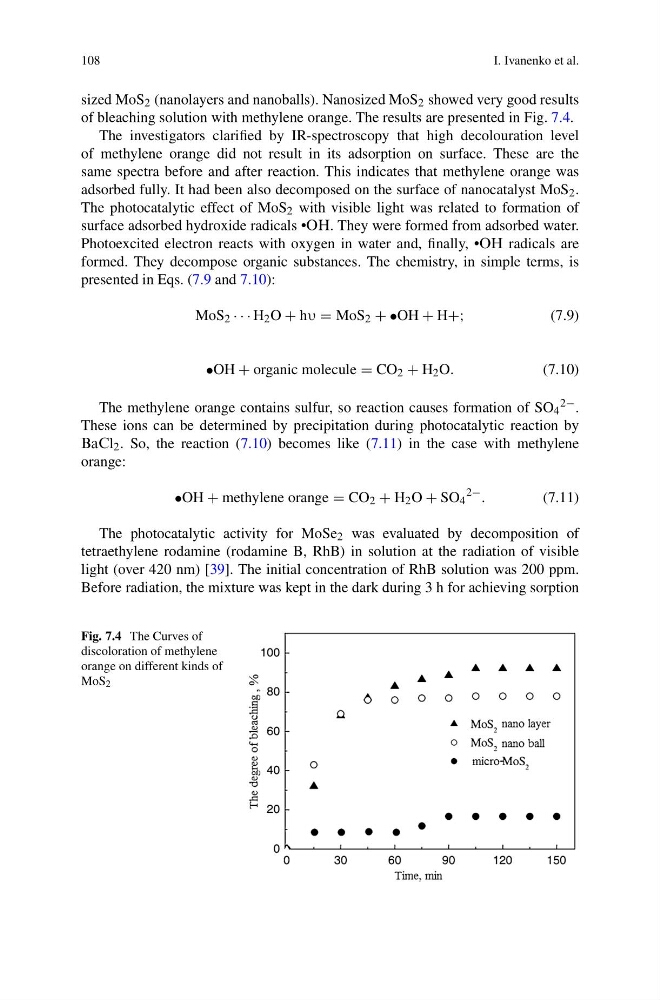
sized MoS 2 (nanolayers and nanoballs). Nanosized MoS 2 showed very good results
of bleaching solution with methylene orange. The results are presented in Fig. 7.4.
The investigators clarified by IR-spectroscopy that high decolouration level
of methylene orange did not result in its adsorption on surface. These are the
same spectra before and after reaction. This indicates that methylene orange was
adsorbed fully. It had been also decomposed on the surface of nanocatalyst MoS 2 .
The photocatalytic effect of MoS 2 with visible light was related to formation of
surface adsorbed hydroxide radicals •±°. They were formed from adsorbed water.
Photoexcited electron reacts with oxygen in water and, finally, •±° radicals are
formed. They decompose organic substances. The chemistry, in simple terms, is
presented in Eqs. (7.9 and 7.10):
MoS 2 · · · H 2 O + hυ = MoS 2 + •OH + H+;
(7.9)
•OH + organic molecule = CO 2 + H 2 O.
(7.10)
The methylene orange contains sulfur, so reaction causes formation of SO 4
2− .
These ions can be determined by precipitation during photocatalytic reaction by
¥Ã´l 2 . So, the reaction (7.10) becomes like (7.11) in the case with methylene
orange:
•OH + methylene orange = CO 2 + H 2 O + SO 4
2− .
(7.11)
The photocatalytic activity for MoSe 2 was evaluated by decomposition of
tetraethylene rodamine (rodamine B, RhB) in solution at the radiation of visible
light (over 420 nm) [39]. The initial concentration of RhB solution was 200 ppm.
Before radiation, the mixture was kept in the dark during 3 h for achieving sorption
Fig. 7.4 The Curves of
discoloration of methylene
orange on different kinds of
MoS 2
I. Ivanenko et al.
sized MoS 2 (nanolayers and nanoballs). Nanosized MoS 2 showed very good results
of bleaching solution with methylene orange. The results are presented in Fig. 7.4.
The investigators clarified by IR-spectroscopy that high decolouration level
of methylene orange did not result in its adsorption on surface. These are the
same spectra before and after reaction. This indicates that methylene orange was
adsorbed fully. It had been also decomposed on the surface of nanocatalyst MoS 2 .
The photocatalytic effect of MoS 2 with visible light was related to formation of
surface adsorbed hydroxide radicals •±°. They were formed from adsorbed water.
Photoexcited electron reacts with oxygen in water and, finally, •±° radicals are
formed. They decompose organic substances. The chemistry, in simple terms, is
presented in Eqs. (7.9 and 7.10):
MoS 2 · · · H 2 O + hυ = MoS 2 + •OH + H+;
(7.9)
•OH + organic molecule = CO 2 + H 2 O.
(7.10)
The methylene orange contains sulfur, so reaction causes formation of SO 4
2− .
These ions can be determined by precipitation during photocatalytic reaction by
¥Ã´l 2 . So, the reaction (7.10) becomes like (7.11) in the case with methylene
orange:
•OH + methylene orange = CO 2 + H 2 O + SO 4
2− .
(7.11)
The photocatalytic activity for MoSe 2 was evaluated by decomposition of
tetraethylene rodamine (rodamine B, RhB) in solution at the radiation of visible
light (over 420 nm) [39]. The initial concentration of RhB solution was 200 ppm.
Before radiation, the mixture was kept in the dark during 3 h for achieving sorption
Fig. 7.4 The Curves of
discoloration of methylene
orange on different kinds of
MoS 2