

7 Applications Perspectives of Nanodispersed Chalcogenides of Transition. . .
107
7.3.2 MoSe 2
The investigations review about phase structures of systems MoSe 2-x ÷
Mo 3 Se 4 ± x presented in [31]. Formation of two intermediate phases Mo 3 Se 4
and MoSe 2 was determined by roentgen method [32]. According to the data,
the compound MoSÈ 2 , obtained at 1500 ◦ ´ and pressure 4 GPa, is isostructural to
MoS 2 [33].
According to the chart, there are narrow fields of homogeneity in both compounds: Mo 3 Se 4 formed at interaction of solid ¯Ñ and gaseous Se 2 at 0.1 MPa and
the temperature (1400 ± 100) ◦ ´; MoSe 2 formed at interaction of solid Mo 3 Se 4
and gaseous Se 2 at 0.1 MPa and the temperature (1150 ± 50) ◦ ´. It is assumed
that at temperatures lower than 527 ◦ ´, the solubility of SÈ in ¯Ñ is controlled by
defects of lattice [34]. Molybdenum (IV) selenide, like MoS 2 , is related to TMDC
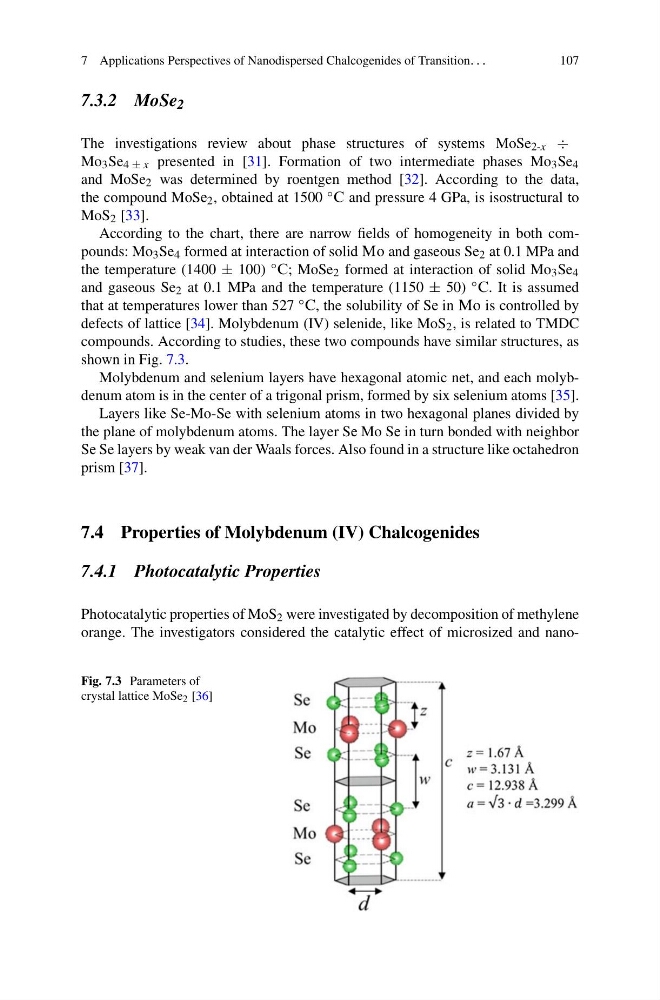
compounds. According to studies, these two compounds have similar structures, as
shown in Fig. 7.3.
Molybdenum and selenium layers have hexagonal atomic net, and each molybdenum atom is in the center of a trigonal prism, formed by six selenium atoms [35].
Layers like Se-Mo-Se with selenium atoms in two hexagonal planes divided by
the plane of molybdenum atoms. The layer SÈ Mo SÈ in turn bonded with neighbor
SÈ Se layers by weak van der Waals forces. Also found in a structure like octahedron
prism [37].
7.4 Properties of Molybdenum (IV) Chalcogenides
7.4.1 Photocatalytic Properties
Photocatalytic properties of MoS 2 were investigated by decomposition of methylene
orange. The investigators considered the catalytic effect of microsized and nanoFig. 7.3 Parameters of
crystal lattice MoSe 2 [36]
107
7.3.2 MoSe 2
The investigations review about phase structures of systems MoSe 2-x ÷
Mo 3 Se 4 ± x presented in [31]. Formation of two intermediate phases Mo 3 Se 4
and MoSe 2 was determined by roentgen method [32]. According to the data,
the compound MoSÈ 2 , obtained at 1500 ◦ ´ and pressure 4 GPa, is isostructural to
MoS 2 [33].
According to the chart, there are narrow fields of homogeneity in both compounds: Mo 3 Se 4 formed at interaction of solid ¯Ñ and gaseous Se 2 at 0.1 MPa and
the temperature (1400 ± 100) ◦ ´; MoSe 2 formed at interaction of solid Mo 3 Se 4
and gaseous Se 2 at 0.1 MPa and the temperature (1150 ± 50) ◦ ´. It is assumed
that at temperatures lower than 527 ◦ ´, the solubility of SÈ in ¯Ñ is controlled by
defects of lattice [34]. Molybdenum (IV) selenide, like MoS 2 , is related to TMDC
compounds. According to studies, these two compounds have similar structures, as
shown in Fig. 7.3.
Molybdenum and selenium layers have hexagonal atomic net, and each molybdenum atom is in the center of a trigonal prism, formed by six selenium atoms [35].
Layers like Se-Mo-Se with selenium atoms in two hexagonal planes divided by
the plane of molybdenum atoms. The layer SÈ Mo SÈ in turn bonded with neighbor
SÈ Se layers by weak van der Waals forces. Also found in a structure like octahedron
prism [37].
7.4 Properties of Molybdenum (IV) Chalcogenides
7.4.1 Photocatalytic Properties
Photocatalytic properties of MoS 2 were investigated by decomposition of methylene
orange. The investigators considered the catalytic effect of microsized and nanoFig. 7.3 Parameters of
crystal lattice MoSe 2 [36]