

59
Human-Inspired Hyper Dynamic Manipulation
⎛
n
⎞
⎛
n
⎞
τ i − τ i+1 + τ id = ⎜ J i + m i l
2
+ l
2
⎜
gi
i ∑ m j ⎟ ϕ qq q i + ⎜ m l
i gi + l i
m j ⎟ g cos ϕ i
⎝
j i
= +1
⎟
⎜
⎠
∑
j i
⎟
⎝
= +1
⎠
(4.3)
(i = 1 2
, , � �, n − 1)
where
id = − ∑
n−1
τ
P j ( M L L
, , g ) ⎡ ϕ qq j cos ( ϕ i − ϕ ) + ϕ q 2
⎣
j
j sin ( ϕ i − ϕ j ) ) ⎤ ⎦
j=1, j≠ i
J i is the moment of inertia of link i about the center of mass, m is the mass
i
of link i, l i is the length of link i, l gi is the length from the centroid to joint of
lin
(
k i, φ i is t
)
he angular position of link i referring to the world coordinate,
P j M L L
g is the coefficient function, and g is acceleration due to gravity. In
particular, for the end-effector the following equation holds:
τ n + τ nd = ( J + m l
2
n
n gn ) ϕ qq n + m n gl ϕ
(4.4)
gn cos n
where
τ nd = −m l
n gn ∑
n−1
ϕ qq j l j cos ( ϕ n − ϕ j ) + ϕ q 2
j l j sin ( ϕ n
− ϕ j )
j j=1
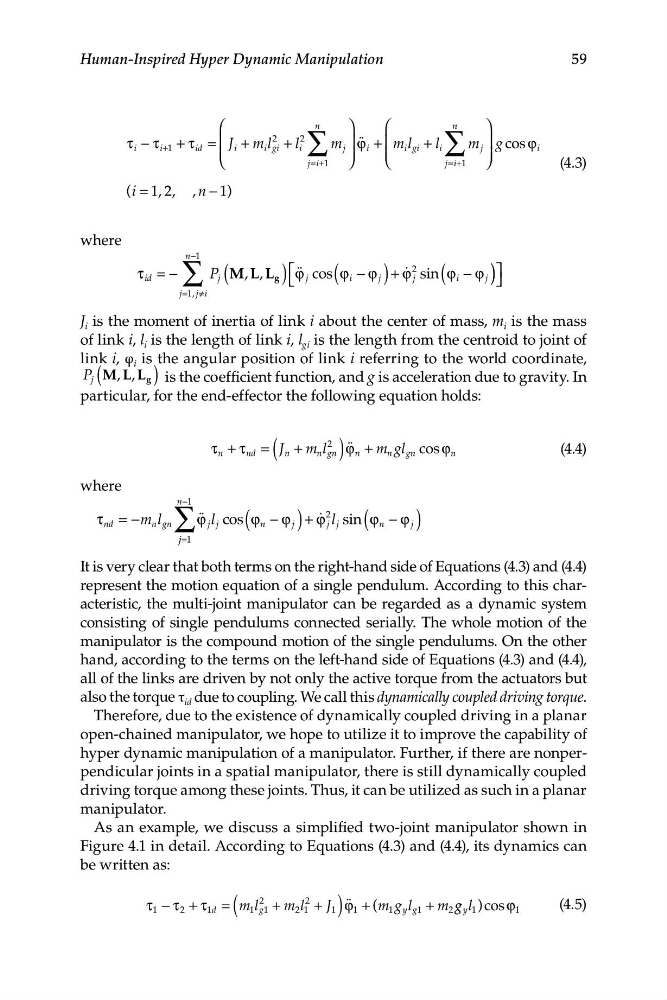
It is very clear that both terms on the right-hand side of Equations (4.3) and (4.4)
represent the motion equation of a single pendulum. According to this characteristic, the multi-joint manipulator can be regarded as a dynamic system
consisting of single pendulums connected serially. The whole motion of the
manipulator is the compound motion of the single pendulums. On the other
hand, according to the terms on the left-hand side of Equations (4.3) and (4.4),
all of the links are driven by not only the active torque from the actuators but
also the torque τ id due to coupling. We call this dynamically coupled driving torque.
Therefore, due to the existence of dynamically coupled driving in a planar
open-chained manipulator, we hope to utilize it to improve the capability of
hyper dynamic manipulation of a manipulator. Further, if there are nonperpendicular joints in a spatial manipulator, there is still dynamically coupled
driving torque among these joints. Thus, it can be utilized as such in a planar
manipulator.
As an example, we discuss a simplified two-joint manipulator shown in
Figure 4.1 in detail. According to Equations (4.3) and (4.4), its dynamics can
be written as:
τ 1 − τ 2 + τ = m l
2
2
1d
( 1 g1 + m 2 1
l + J 1 ) ϕ qq m g l 1 + m g y 1 )cos ϕ
1 + ( 1 y g
2 g l
1
(4.5)
Human-Inspired Hyper Dynamic Manipulation
⎛
n
⎞
⎛
n
⎞
τ i − τ i+1 + τ id = ⎜ J i + m i l
2
+ l
2
⎜
gi
i ∑ m j ⎟ ϕ qq q i + ⎜ m l
i gi + l i
m j ⎟ g cos ϕ i
⎝
j i
= +1
⎟
⎜
⎠
∑
j i
⎟
⎝
= +1
⎠
(4.3)
(i = 1 2
, , � �, n − 1)
where
id = − ∑
n−1
τ
P j ( M L L
, , g ) ⎡ ϕ qq j cos ( ϕ i − ϕ ) + ϕ q 2
⎣
j
j sin ( ϕ i − ϕ j ) ) ⎤ ⎦
j=1, j≠ i
J i is the moment of inertia of link i about the center of mass, m is the mass
i
of link i, l i is the length of link i, l gi is the length from the centroid to joint of
lin
(
k i, φ i is t
)
he angular position of link i referring to the world coordinate,
P j M L L
g is the coefficient function, and g is acceleration due to gravity. In
particular, for the end-effector the following equation holds:
τ n + τ nd = ( J + m l
2
n
n gn ) ϕ qq n + m n gl ϕ
(4.4)
gn cos n
where
τ nd = −m l
n gn ∑
n−1
ϕ qq j l j cos ( ϕ n − ϕ j ) + ϕ q 2
j l j sin ( ϕ n
− ϕ j )
j j=1
It is very clear that both terms on the right-hand side of Equations (4.3) and (4.4)
represent the motion equation of a single pendulum. According to this characteristic, the multi-joint manipulator can be regarded as a dynamic system
consisting of single pendulums connected serially. The whole motion of the
manipulator is the compound motion of the single pendulums. On the other
hand, according to the terms on the left-hand side of Equations (4.3) and (4.4),
all of the links are driven by not only the active torque from the actuators but
also the torque τ id due to coupling. We call this dynamically coupled driving torque.
Therefore, due to the existence of dynamically coupled driving in a planar
open-chained manipulator, we hope to utilize it to improve the capability of
hyper dynamic manipulation of a manipulator. Further, if there are nonperpendicular joints in a spatial manipulator, there is still dynamically coupled
driving torque among these joints. Thus, it can be utilized as such in a planar
manipulator.
As an example, we discuss a simplified two-joint manipulator shown in
Figure 4.1 in detail. According to Equations (4.3) and (4.4), its dynamics can
be written as:
τ 1 − τ 2 + τ = m l
2
2
1d
( 1 g1 + m 2 1
l + J 1 ) ϕ qq m g l 1 + m g y 1 )cos ϕ
1 + ( 1 y g
2 g l
1
(4.5)