

58
Biologically Inspired Robotics
C ,
( θ θ q ) = Coriolis matrix determining the Coriolis force and the centrifugal force
1 ( θ θ
q ) = gravity force and frictional/damping force
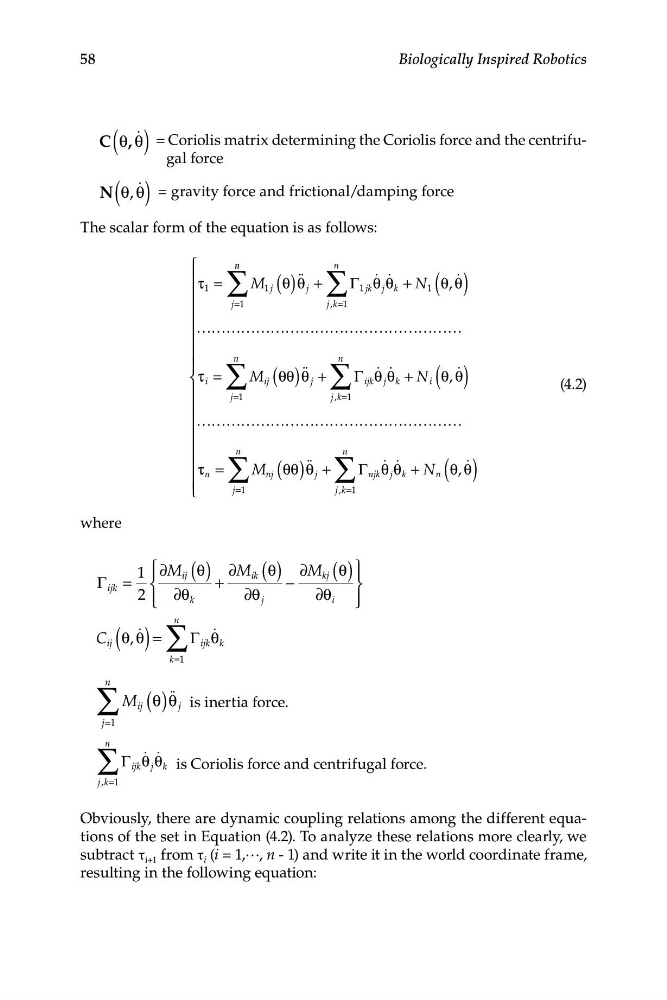
The scalar form of the equation is as follows:
⎧
n n
n
⎪ τ 1 = ∑ M qq
1 ( )
θ θ j + ∑ Γ q θ q
j
1 jk θ j k + N 1 ( θ, θ q
⎪
)
⎪
j=
1
j k
, =1
⎪
������������������
⎪
⎪
⎪
n
( )
n
τ = ∑ M θθ θ qq + ∑ Γ θ q
⎨
j θ q q
i
ij
j
ijk
k + N i θ θ q
( , )
(4.2)
⎪
j=1
j k
, =1
⎪
⎪������������������
⎪
⎪
n
τ τ =
n
⎪
∑ M ( )
θθ θ qq
n
θ q θ q
n
j
+
Γ
j
∑ njk j k + N ( q
⎪
n θ, θ )
⎩
j= =1
j k
, =1
where
1 ⎪ ⎧ ∂M ij ( )
θ
∂M ik
Γ
θ
∂
θ
ijk = ⎨
+
( ) M kj ( )⎪ ⎫
−
⎬
2 ⎪ ⎪ ⎩ ∂θ k
∂θ j
∂θ i ⎪ ⎭
C ij ( θ θ
, q ) = ∑
n
Γ q
ijk θ k
k=1
∑
n
M θ θ qq
ij ( ) j is inertia force.
j=
∑
n
Γ ijk θ θ
q q
j k is Coriolis force and centrifugal force.
j k
, =1
Obviously, there are dynamic coupling relations among the different equations of the set in Equation (4.2). To analyze these relations more clearly, we
subtract τ i+1 from τ i (i = 1, … , n - 1) and write it in the world coordinate frame,
resulting in the following equation:
Biologically Inspired Robotics
C ,
( θ θ q ) = Coriolis matrix determining the Coriolis force and the centrifugal force
1 ( θ θ
q ) = gravity force and frictional/damping force
The scalar form of the equation is as follows:
⎧
n n
n
⎪ τ 1 = ∑ M qq
1 ( )
θ θ j + ∑ Γ q θ q
j
1 jk θ j k + N 1 ( θ, θ q
⎪
)
⎪
j=
1
j k
, =1
⎪
������������������
⎪
⎪
⎪
n
( )
n
τ = ∑ M θθ θ qq + ∑ Γ θ q
⎨
j θ q q
i
ij
j
ijk
k + N i θ θ q
( , )
(4.2)
⎪
j=1
j k
, =1
⎪
⎪������������������
⎪
⎪
n
τ τ =
n
⎪
∑ M ( )
θθ θ qq
n
θ q θ q
n
j
+
Γ
j
∑ njk j k + N ( q
⎪
n θ, θ )
⎩
j= =1
j k
, =1
where
1 ⎪ ⎧ ∂M ij ( )
θ
∂M ik
Γ
θ
∂
θ
ijk = ⎨
+
( ) M kj ( )⎪ ⎫
−
⎬
2 ⎪ ⎪ ⎩ ∂θ k
∂θ j
∂θ i ⎪ ⎭
C ij ( θ θ
, q ) = ∑
n
Γ q
ijk θ k
k=1
∑
n
M θ θ qq
ij ( ) j is inertia force.
j=
∑
n
Γ ijk θ θ
q q
j k is Coriolis force and centrifugal force.
j k
, =1
Obviously, there are dynamic coupling relations among the different equations of the set in Equation (4.2). To analyze these relations more clearly, we
subtract τ i+1 from τ i (i = 1, … , n - 1) and write it in the world coordinate frame,
resulting in the following equation: