

57
Human-Inspired Hyper Dynamic Manipulation
Such limitations are often utilized by humans to improve their capability of dynamic manipulation. For example, in the downswing phase of a
high-speed golf swing motion, the joint stop in the wrist joint is utilized
by professional golfers to accelerate the golf club (Ming, Kajitani, and
Shimojo 2002; Ming et al. 2001; Ming et al. 2003).
As a human-inspired approach to improve the capability of a manipulator for hyper dynamic manipulations by a smart structure, we propose to
utilize dynamically coupled driving and the joint stop in the manipulator. That is, to make the joint stop in the manipulator available and utilize
the structural joint stops effectively by a unique control method based on
dynamically coupled driving. This will lead to a large improvement on the
dynamic capability.
This chapter gives the basic idea and expected effects of utilizing dynamically coupled driving and structural joint stops in a manipulator in Section
4.2. The control method to utilize dynamically coupled driving and joint
stops is described in Section 4.3. Simulation and experimental results and
discussion are given in Section 4.4. Section 4.5 concludes.
4.2 Basic Concept
4.2.1 Utilization of Dynamically Coupled Driving
As mentioned before, humans can utilize dynamically coupled driving
while performing hyper dynamic manipulation, which provides a useful
suggestion of realizing hyper dynamic manipulation by a manipulator with
a smart structure. There have been some works about the positioning control of manipulators with passive joints using dynamically coupled driving
(Arai and Tachi 1991; DeLuca and Oriolo 2002; Nakamura, Koinuma, and
Suzuki 1996). Here, we consider how to utilize dynamically coupled driving
to design a hyper dynamic manipulator with a smart structure.
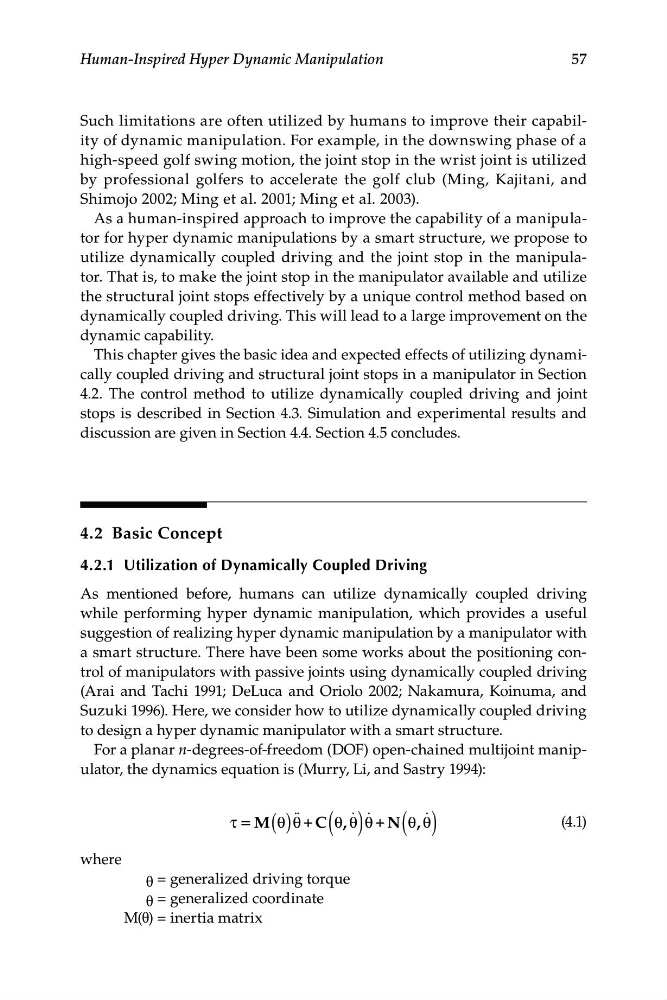
For a planar n-degrees-of-freedom (DOF) open-chained multijoint manipulator, the dynamics equation is (Murry, Li, and Sastry 1994):
qq
q q
q
( )
)
,
(4.1)
τ = M θ θ + C ( θ θ θ
,
+ N ( θ θ )
where
θ = generalized driving torque
θ = generalized coordinate
M(θ) = inertia matrix
Human-Inspired Hyper Dynamic Manipulation
Such limitations are often utilized by humans to improve their capability of dynamic manipulation. For example, in the downswing phase of a
high-speed golf swing motion, the joint stop in the wrist joint is utilized
by professional golfers to accelerate the golf club (Ming, Kajitani, and
Shimojo 2002; Ming et al. 2001; Ming et al. 2003).
As a human-inspired approach to improve the capability of a manipulator for hyper dynamic manipulations by a smart structure, we propose to
utilize dynamically coupled driving and the joint stop in the manipulator. That is, to make the joint stop in the manipulator available and utilize
the structural joint stops effectively by a unique control method based on
dynamically coupled driving. This will lead to a large improvement on the
dynamic capability.
This chapter gives the basic idea and expected effects of utilizing dynamically coupled driving and structural joint stops in a manipulator in Section
4.2. The control method to utilize dynamically coupled driving and joint
stops is described in Section 4.3. Simulation and experimental results and
discussion are given in Section 4.4. Section 4.5 concludes.
4.2 Basic Concept
4.2.1 Utilization of Dynamically Coupled Driving
As mentioned before, humans can utilize dynamically coupled driving
while performing hyper dynamic manipulation, which provides a useful
suggestion of realizing hyper dynamic manipulation by a manipulator with
a smart structure. There have been some works about the positioning control of manipulators with passive joints using dynamically coupled driving
(Arai and Tachi 1991; DeLuca and Oriolo 2002; Nakamura, Koinuma, and
Suzuki 1996). Here, we consider how to utilize dynamically coupled driving
to design a hyper dynamic manipulator with a smart structure.
For a planar n-degrees-of-freedom (DOF) open-chained multijoint manipulator, the dynamics equation is (Murry, Li, and Sastry 1994):
q q
q
( )
)
,
(4.1)
τ = M θ θ + C ( θ θ θ
,
+ N ( θ θ )
where
θ = generalized driving torque
θ = generalized coordinate
M(θ) = inertia matrix