

3 0 m m
3
7
m
m
Lens
and lens
holder
Camera
module and
platform
Actuator A
Push Rod B
Magnetic
position sensor B
Gimbal joint
Push rod A
Linear slide unit A
Magnetic
encoder
scale A
Universal
joint
Controller
PCB
Magnetic encoder
scale B
Linear slide unit B
303
A Test Environment for Studying Robotic Eye Movements
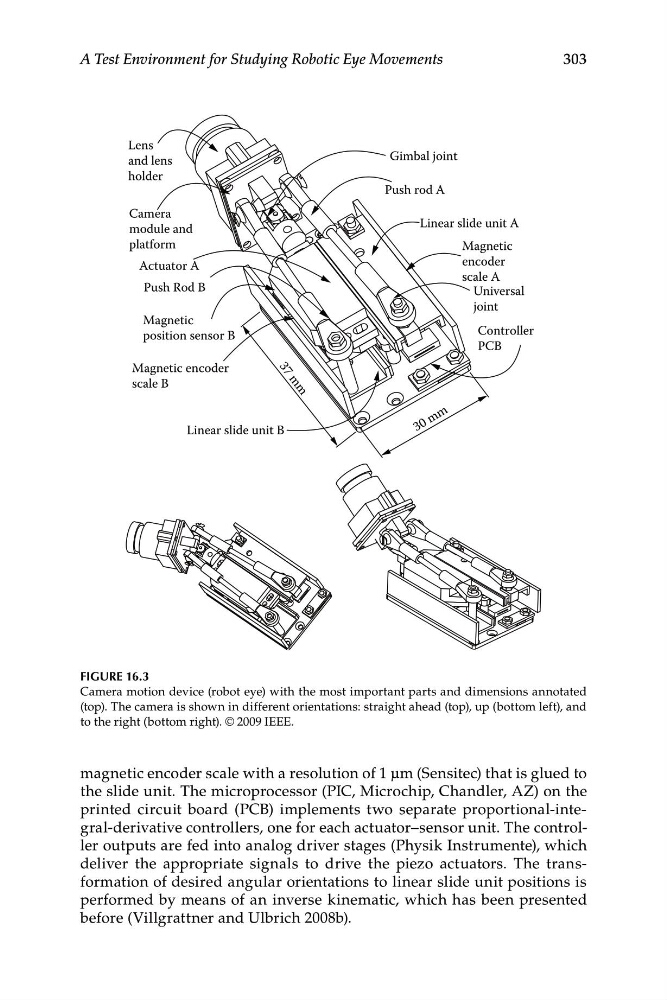
FIGURE 16.3
Camera motion device (robot eye) with the most important parts and dimensions annotated
(top). The camera is shown in different orientations: straight ahead (top), up (bottom left), and
to the right (bottom right). © 2009 IEEE.
magnetic encoder scale with a resolution of 1 μm (Sensitec) that is glued to
the slide unit. The microprocessor (PIC, Microchip, Chandler, AZ) on the
printed circuit board (PCB) implements two separate proportional-integral-derivative controllers, one for each actuator–sensor unit. The controller outputs are fed into analog driver stages (Physik Instrumente), which
deliver the appropriate signals to drive the piezo actuators. The transformation of desired angular orientations to linear slide unit positions is
performed by means of an inverse kinematic, which has been presented
before (Villgrattner and Ulbrich 2008b).
3
7
m
m
Lens
and lens
holder
Camera
module and
platform
Actuator A
Push Rod B
Magnetic
position sensor B
Gimbal joint
Push rod A
Linear slide unit A
Magnetic
encoder
scale A
Universal
joint
Controller
PCB
Magnetic encoder
scale B
Linear slide unit B
303
A Test Environment for Studying Robotic Eye Movements
FIGURE 16.3
Camera motion device (robot eye) with the most important parts and dimensions annotated
(top). The camera is shown in different orientations: straight ahead (top), up (bottom left), and
to the right (bottom right). © 2009 IEEE.
magnetic encoder scale with a resolution of 1 μm (Sensitec) that is glued to
the slide unit. The microprocessor (PIC, Microchip, Chandler, AZ) on the
printed circuit board (PCB) implements two separate proportional-integral-derivative controllers, one for each actuator–sensor unit. The controller outputs are fed into analog driver stages (Physik Instrumente), which
deliver the appropriate signals to drive the piezo actuators. The transformation of desired angular orientations to linear slide unit positions is
performed by means of an inverse kinematic, which has been presented
before (Villgrattner and Ulbrich 2008b).