

302
Biologically Inspired Robotics
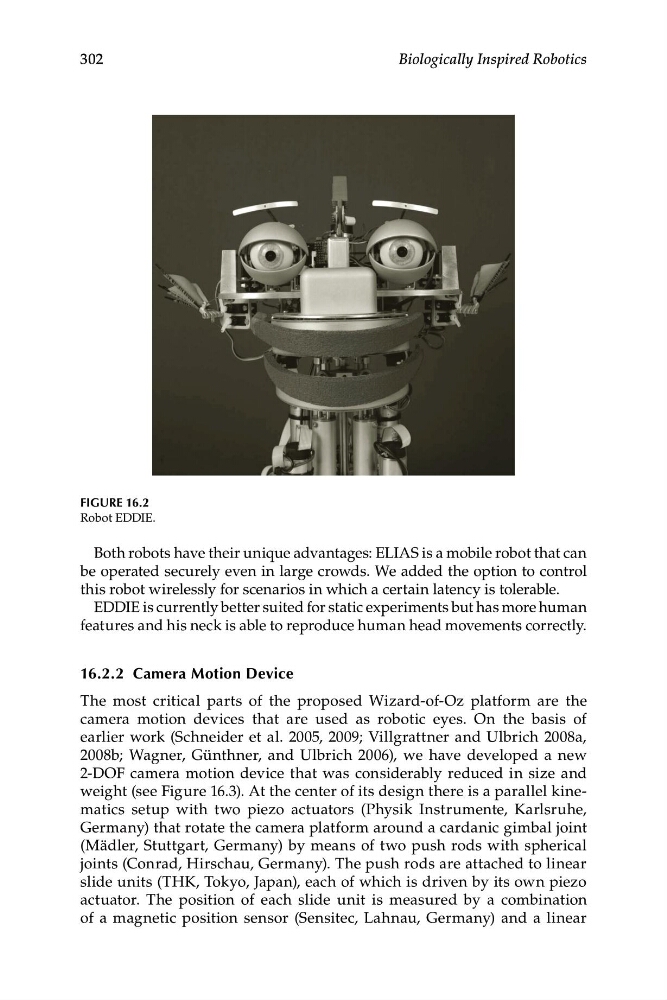
FIGURE 16.2
Robot EDDIE.
Both robots have their unique advantages: ELIAS is a mobile robot that can
be operated securely even in large crowds. We added the option to control
this robot wirelessly for scenarios in which a certain latency is tolerable.
EDDIE is currently better suited for static experiments but has more human
features and his neck is able to reproduce human head movements correctly.
16.2.2 Camera Motion Device
The most critical parts of the proposed Wizard-of-Oz platform are the
camera motion devices that are used as robotic eyes. On the basis of
earlier work (Schneider et al. 2005, 2009; Villgrattner and Ulbrich 2008a,
2008b; Wagner, Günthner, and Ulbrich 2006), we have developed a new
2-DOF camera motion device that was considerably reduced in size and
weight (see Figure 16.3). At the center of its design there is a parallel kinematics setup with two piezo actuators (Physik Instrumente, Karlsruhe,
Germany) that rotate the camera platform around a cardanic gimbal joint
(Mädler, Stuttgart, Germany) by means of two push rods with spherical
joints (Conrad, Hirschau, Germany). The push rods are attached to linear
slide units (THK, Tokyo, Japan), each of which is driven by its own piezo
actuator. The position of each slide unit is measured by a combination
of a magnetic position sensor (Sensitec, Lahnau, Germany) and a linear
Biologically Inspired Robotics
FIGURE 16.2
Robot EDDIE.
Both robots have their unique advantages: ELIAS is a mobile robot that can
be operated securely even in large crowds. We added the option to control
this robot wirelessly for scenarios in which a certain latency is tolerable.
EDDIE is currently better suited for static experiments but has more human
features and his neck is able to reproduce human head movements correctly.
16.2.2 Camera Motion Device
The most critical parts of the proposed Wizard-of-Oz platform are the
camera motion devices that are used as robotic eyes. On the basis of
earlier work (Schneider et al. 2005, 2009; Villgrattner and Ulbrich 2008a,
2008b; Wagner, Günthner, and Ulbrich 2006), we have developed a new
2-DOF camera motion device that was considerably reduced in size and
weight (see Figure 16.3). At the center of its design there is a parallel kinematics setup with two piezo actuators (Physik Instrumente, Karlsruhe,
Germany) that rotate the camera platform around a cardanic gimbal joint
(Mädler, Stuttgart, Germany) by means of two push rods with spherical
joints (Conrad, Hirschau, Germany). The push rods are attached to linear
slide units (THK, Tokyo, Japan), each of which is driven by its own piezo
actuator. The position of each slide unit is measured by a combination
of a magnetic position sensor (Sensitec, Lahnau, Germany) and a linear