

304
Biologically Inspired Robotics
In the Results section we will report on the dynamical properties of the
new camera motion device with special focus on the delay that is achieved
between the movement of the wizard’s eye and its replication in the artificial
robot eye.
16.2.3 Eye and Head Tracker
The wizard sits in front of a video monitor that displays the image of the
scene view camera that is attached to the robot’s neck (see Figure 16.1). A
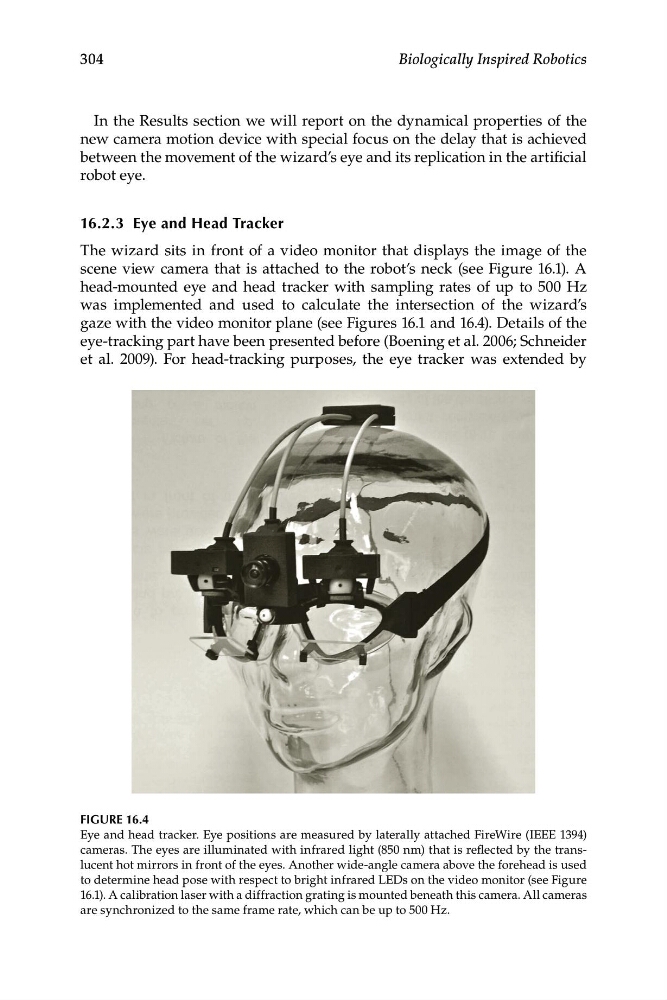
head-mounted eye and head tracker with sampling rates of up to 500 Hz
was implemented and used to calculate the intersection of the wizard’s
gaze with the video monitor plane (see Figures 16.1 and 16.4). Details of the
eye-tracking part have been presented before (Boening et al. 2006; Schneider
et al. 2009). For head-tracking purposes, the eye tracker was extended by
FIGURE 16.4
Eye and head tracker. Eye positions are measured by laterally attached FireWire (IEEE 1394)
cameras. The eyes are illuminated with infrared light (850 nm) that is reflected by the translucent hot mirrors in front of the eyes. Another wide-angle camera above the forehead is used
to determine head pose with respect to bright infrared LEDs on the video monitor (see Figure
16.1). A calibration laser with a diffraction grating is mounted beneath this camera. All cameras
are synchronized to the same frame rate, which can be up to 500 Hz.
Biologically Inspired Robotics
In the Results section we will report on the dynamical properties of the
new camera motion device with special focus on the delay that is achieved
between the movement of the wizard’s eye and its replication in the artificial
robot eye.
16.2.3 Eye and Head Tracker
The wizard sits in front of a video monitor that displays the image of the
scene view camera that is attached to the robot’s neck (see Figure 16.1). A
head-mounted eye and head tracker with sampling rates of up to 500 Hz
was implemented and used to calculate the intersection of the wizard’s
gaze with the video monitor plane (see Figures 16.1 and 16.4). Details of the
eye-tracking part have been presented before (Boening et al. 2006; Schneider
et al. 2009). For head-tracking purposes, the eye tracker was extended by
FIGURE 16.4
Eye and head tracker. Eye positions are measured by laterally attached FireWire (IEEE 1394)
cameras. The eyes are illuminated with infrared light (850 nm) that is reflected by the translucent hot mirrors in front of the eyes. Another wide-angle camera above the forehead is used
to determine head pose with respect to bright infrared LEDs on the video monitor (see Figure
16.1). A calibration laser with a diffraction grating is mounted beneath this camera. All cameras
are synchronized to the same frame rate, which can be up to 500 Hz.