

231
Classification of Hand Motion Using Surface EMG Signals
in both time and frequency domains. Then, the spectral flatness feature is
introduced and used to describe the speed. The description of the movement
speed is also based on STFT results, and then the spectral moment is calculated as the feature.
12.4.1 STFT Method
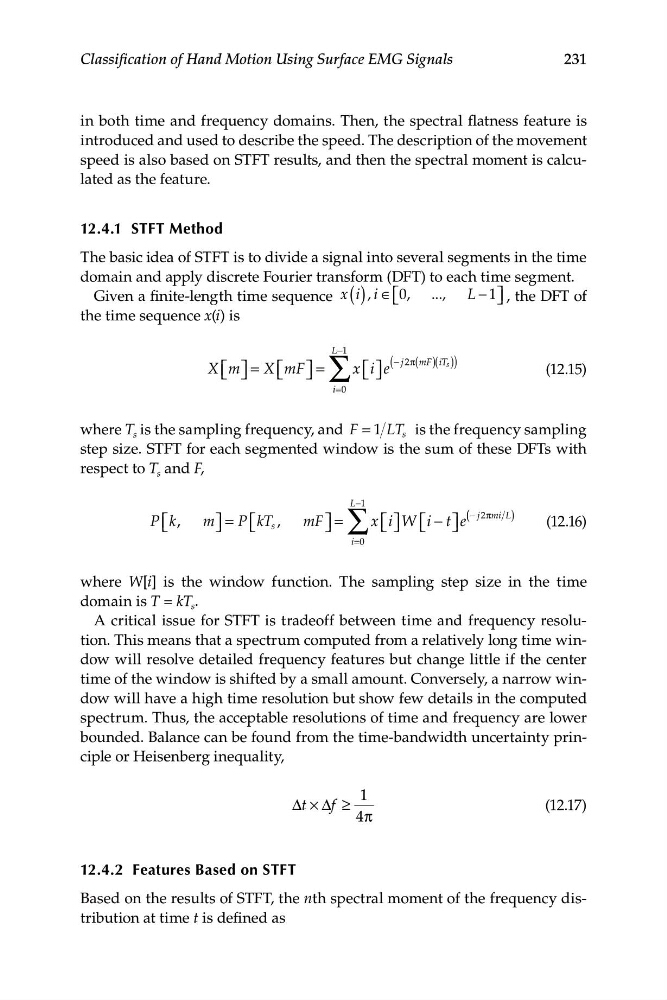
The basic idea of STFT is to divide a signal into several segments in the time
domain and apply discrete Fourier transform (DFT) to each time segment.
Given a finite-length time sequence x i
( ), i ∈ ⎡ ⎣ 0, ..., L − 1⎤ ⎦ , the DFT of
the time sequence x(i) is
L−1
( −
X m
⎡ ⎤ = X m
⎡ F ⎤ = ∑ ∑ x ⎡i⎤ e
j 2π ( mF )(iT ))
⎣ ⎦
⎣ ⎦
⎣ ⎦
s
(12.15)
i=0
where T s is the sampling frequency, and F = LT s is the frequency sampling
step size. STFT for each segmented window is the sum of these DFTs with
respect to T s and F,
L−1
( (
)
P k
⎣ ⎡ , m ⎦ ⎤ = P ⎣ ⎡kT s , mF ⎦ ⎤ = ∑ x ⎡ ⎣ i ⎦ ⎤ W ⎣ ⎡i
π
−
2
t⎤ e
− j mi L
⎦
(12.16)
i=0
where W[i] is the window function. The sampling step size in the time
domain is T = kT s .
A critical issue for STFT is tradeoff between time and frequency resolution. This means that a spectrum computed from a relatively long time window will resolve detailed frequency features but change little if the center
time of the window is shifted by a small amount. Conversely, a narrow window will have a high time resolution but show few details in the computed
spectrum. Thus, the acceptable resolutions of time and frequency are lower
bounded. Balance can be found from the time-bandwidth uncertainty principle or Heisenberg inequality,
1
Δt × Δf ≥
(12.17)
4π
12.4.2 Features Based on STFT
Based on the results of STFT, the nth spectral moment of the frequency distribution at time t is defined as
Classification of Hand Motion Using Surface EMG Signals
in both time and frequency domains. Then, the spectral flatness feature is
introduced and used to describe the speed. The description of the movement
speed is also based on STFT results, and then the spectral moment is calculated as the feature.
12.4.1 STFT Method
The basic idea of STFT is to divide a signal into several segments in the time
domain and apply discrete Fourier transform (DFT) to each time segment.
Given a finite-length time sequence x i
( ), i ∈ ⎡ ⎣ 0, ..., L − 1⎤ ⎦ , the DFT of
the time sequence x(i) is
L−1
( −
X m
⎡ ⎤ = X m
⎡ F ⎤ = ∑ ∑ x ⎡i⎤ e
j 2π ( mF )(iT ))
⎣ ⎦
⎣ ⎦
⎣ ⎦
s
(12.15)
i=0
where T s is the sampling frequency, and F = LT s is the frequency sampling
step size. STFT for each segmented window is the sum of these DFTs with
respect to T s and F,
L−1
( (
)
P k
⎣ ⎡ , m ⎦ ⎤ = P ⎣ ⎡kT s , mF ⎦ ⎤ = ∑ x ⎡ ⎣ i ⎦ ⎤ W ⎣ ⎡i
π
−
2
t⎤ e
− j mi L
⎦
(12.16)
i=0
where W[i] is the window function. The sampling step size in the time
domain is T = kT s .
A critical issue for STFT is tradeoff between time and frequency resolution. This means that a spectrum computed from a relatively long time window will resolve detailed frequency features but change little if the center
time of the window is shifted by a small amount. Conversely, a narrow window will have a high time resolution but show few details in the computed
spectrum. Thus, the acceptable resolutions of time and frequency are lower
bounded. Balance can be found from the time-bandwidth uncertainty principle or Heisenberg inequality,
1
Δt × Δf ≥
(12.17)
4π
12.4.2 Features Based on STFT
Based on the results of STFT, the nth spectral moment of the frequency distribution at time t is defined as